
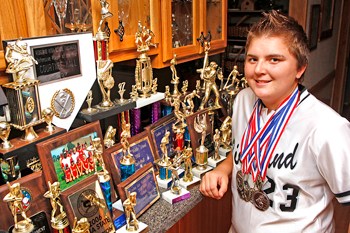

There are times when Courtnee Hall wishes her brain had an off switch or a mute button. Anything to keep the bad thoughts from taking control.
Until a still-undiagnosed illness took control of her body 20 months ago, the Ridgeland High School senior was the class clown, continually smiling and digging at people. Now she has an adult-like seriousness.
Having to relearn how to talk, walk and feed herself is not something even Hall can just laugh off.
“I think about it all the time, especially when I’m at school doing nothing,” she says. “I’m like, what if this happens again? So I’ll text my mom from under my desk, ‘I love you, Mom,’ just because I don’t want there to ever be another time when I can’t tell her that.”
Softball has, by her own admission, been Hall’s main focus in life. The catcher has been on all-star teams since she could first hold a bat. She will leave Ridgeland with a lifetime batting average well over .400 and is one of the most feared hitters in northwest Georgia in recent memory.
Ridgeland softball coach Scott Harden nicknamed her “Coach” because of her uncommon knowledge of the game – and her quickness in sharing suggestions.
Now Hall plays passionately because she knows there is much more to life than sports.
Christmas of 2008 was a typical one for Hall – the usual gifts and visits with family. The start of softball drills was only a few weeks away, though, and she was eager to build on a 2008 summer and high school season during which she caught the attention of several big-time college programs. With one more good season, she likely would have her pick of schools.
The drills never happened for Hall. In January 2009 she woke up one morning with a headache. Twenty-four hours later she was lying unresponsive in intensive care at Erlanger hospital. The next morning she couldn’t talk or remember anything. Her parents, Mike and Angela Daniel, were braced for what they were about to see.
“We didn’t get to see her until the next morning. The doctor told us to be prepared to see her that way,” Angela recalled. “Suddenly, it was can’t walk, can’t talk, can’t write … knows nobody. It was really hard for us to see her that way. She was like a baby again.”
A virus had invaded Hall’s brain. Doctors still don’t know why or how. They only know that it could have left her in a childlike state or even taken her life.
While physicians searched furiously for answers, Hall progessed quickly, regaining her memory and motor skills. She improved so thoroughly that playing softball for her summer team was a reachable goal.
That May, however, she had a second, much more severe episode. She would spend two months in the hospital, with almost daily seizures and her formerly glowing personality replaced by something her mom did not recognize.
“This last time she was in the hospital, it was bad,” Angela Daniel said. “She was having two, three, four, five seizures a day. They were lasting anywhere from an hour to two hours and sometimes all night. She would yank her IVs and monitor lines out; she would pull out wads of her hair. She would cuss and spit and talk to people who weren’t there. It seemed almost demonic.”
Hall was given anti-viral drugs to no avail. Neurologist Dr. David Rankine and his staff then began to try to identify something he says “was like trying to find a needle in a haystack.”
“She was suffering from encephalopathy/encephalitis, which is a fancy way of saying her brain was sick,” Rankine said. “It was pretty bad; the seizures were frequent. It was difficult because there are thousands of viruses out there that could have caused it.”
While Rankine waited on the results of extensive blood tests, Hall had her worst night, an eight-hour seizure during which her dad and Coach Harden had to hold her down to keep her from hurting herself. Rankine the next day ordered a plasma tranfusion in attempting to remove the harmful antibodies from her system. Almost immediately she began to improve.
“Once we flushed her blood out, she responded quickly,” Rankine said.
Though her body was getting better, the long road to recovery was just beginning. Her parents bought her coloring books and kindergarten-level reading material. They taught her how to take care of herself again. During the rehab, the Daniels noticed that through the tragedy and heartbreak – which also included a serious motorcycle wreck involving their son – something amazing was happening.
“I know this sounds crazy, but it was kind of cool to watch her go from that to where she is today,” Angela said. “It’s like I got to watch her grow up all over again, as crazy as that sounds
“It tore us apart in a big way, but it’s finally brought us closer together. It’s been really weird. We’ve kind of been on an emotional roller coaster. We nearly lost our daughter, then our son. I don’t know what the reason is. Maybe it was to bring us all together. We were always close, but never like we are now. We laugh more, we love more and we live more.
“I can’t say I don’t go to bed and cry every night, because I do. My heart breaks for her. She says it doesn’t bother her, because she doesn’t want us to worry about her, but I know it does.”
Hall, with the goal of playing for the Lady Panthers driving her, worked hours every day to regain her strength and motor skills. However, only days from getting cleared to play, a cyst developed on her lower back and had to be surgically removed. The resulting deep wound, which was left open so it could heal properly, forced her to miss most of her junior season. She returned for the final few games, wearing football pads to protect her back.
But the recruiting calls and letters suddenly stopped. Daily medication was controlling the seizures, and Rankine had cleared her for all activities. Her grades, thanks in large part to Ridgeland’s homebound teaching program, had remained stellar (she carries a 3.8 grade point average).
Hall, who had poured everything into getting back on the field, was devastated.
“The rumor went around that she had major back surgery,” Angela Daniel said. “But that wasn’t true. I think everybody giving up on Courtnee made her give up on herself somewhat. It’s changed her life and the person she is. People just don’t understand. A lot of girls play this sport for fun, but for Courtnee it’s been her life.”
Added Hall: “It took a lot to get back. A lot of people told me I would never play again, and I’ve been told by a lot of college coaches that they don’t want me anymore. That kind of hurts, but it doesn’t stop the drive. I still love softball, and I still want to play. I can’t let it discourage me. It is motivating in a way. It makes me want to push forward. You have to fuel bad things into good aspects and use them.”
Wanting to prove the coaches wrong, she worked harder during the winter and into spring of this year. This time, though, a new problem arose. She was gaining weight at an alarming rate. Her illness had, unknown to her or her family at the time, caused her to develop a resistance to insulin, causing her to gain weight. When she started playing with the Fury summer team, college coaches didn’t like what they saw even though she was still crushing the ball.
“She worked out for two hours every day and ran two or three miles every day, but she was still gaining weight,” Mike Daniel said. “When she went to the first practice day for summer ball, she was 15 pounds heavier than the previous year.
“We even heard from some coaches that she was lazy and not working hard. That just wasn’t the case. Six weeks after she got out of the hospital the second time – when she couldn’t even feed herself – she was playing in a showcase tournament and hitting home runs. After that, to hear people say she’s lazy and doesn’t work hard … it makes me mad. I have to just ignore it and let Courtnee show people she can do it on the field.”
Hall now is on a diabetic diet, and heading into the final week of the 2010 regular season she is hitting over .500 for the Lady Panthers, who are ranked ninth in the Class AAA coaches’ state poll. Though Harden has heard from several smaller schools in recent weeks, the big offers haven’t returned. Even Rankine shares the family’s bewilderment.
“From my perspective, she’s doing great,” the doctor said. “I know she’s frustrated that coaches have dropped her, and in my opinion it’s not very fair. Yes, I can appreciate that people want a label on what caused her illness, but we may never know. The bottom line is she is clinically healthy. Is there a chance the antibody will flare up? Sure, but as I tell my patients, there is a chance I can get hit by a bus today.”
In the meantime, Hall takes out her frustration on the softball and hopes for a chance to play in college. She’s prepared for a life without the sport and contemplated going to medical school. Though she may not be the happy-go-lucky person she once was, the new Hall has a healthy perspective on life.
She doesn’t plan to waste a moment of it.
“I’m just hoping something good comes out of all the bad that’s happened,” Hall said, admitting she’s gotten better at pushing bad thoughts aside. “That’s the way you have to look at it and not just concentrate on the bad things.
“They’re [doctors] still looking at everything. They have no leads and nowhere to really go, I guess. You have to think about it and be cautious, but not to the point where you’re scared to do anything. I’m not scared of anything. If my mom would let me go skydiving, I’d go do it. I’m not afraid of having a seizure or anything. My mom’s more cautious right now, and I guess I can understand that.
“Someday I’ll do it. Someday.”
Contact Lindsey Young at lyoung@timesfreepress.com or 423-757-6296.