
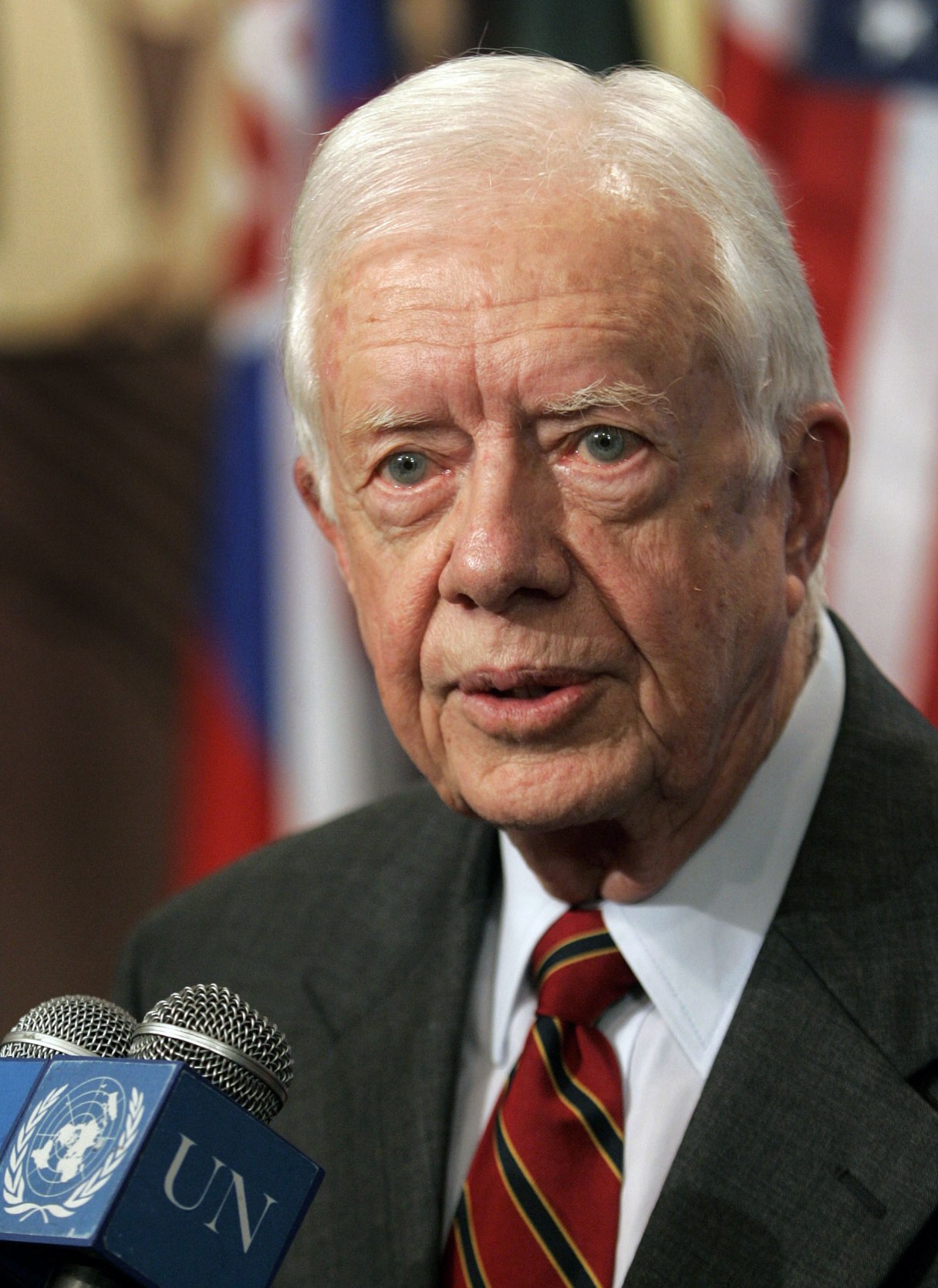
 Former president Jimmy Carter
Since he left office in 1981, former President Jimmy Carter has hardly avoided the limelight. Indeed, his post-presidential career has made the Nobel Peace Prize winner a regular on the global news beat – and a lightning rod for both praise and criticism. Almost no one, though, questions his sincerity. He is a man of peace and a determined promoter of human equality and personal dignity. His current visit to North Korea is a case in point.
Carter and three other members of the Elders, a group of retired world leaders founded by Nelson Mandela of South Africa, begin a three-day visit to North Korea today. The goal is threefold: To determine the severity of the food shortage that currently afflicts the country, to discuss the revival of nuclear disarmament talks and to promote communication between North Korea and South Korea. There is no certainty that the group will accomplish anything substantial.
Carter, in fact, said that “The Elders are not in a position to negotiate. We’re not mediators. We’re going to learn what we can and share what we find with the leaders with whom we have contact …” In more normal circumstances, those might not seem to be critical goals. When it comes to North Korea, though, any contact and any information that is potentially useful to a reducing nuclear-fueled tensions in the Far is East is valuable.
At this writing, Carter was unsure whether he and the others would meet with North Korean leader Kim Jong-Il and his heir apparent and son, Kim Jong Un. A meeting seems likely, though. Carter is traveling to North Korea at the invitation of unnamed North Korean officials, and he has had success in dealing with the secretive nation and its rulers.
In 1994, Carter helped firm up a deal that reduced nuclear tensions between Washington and Pyongyang, and that improved ties between North Korea and many of its neighboring nations. He helped secure the release last August of an American who had been sentenced to eight years of hard labor in a North Korean prison. Carter’s past successes don’t guarantee future ones. They do give him unprecedented access to North Korean leadership.