
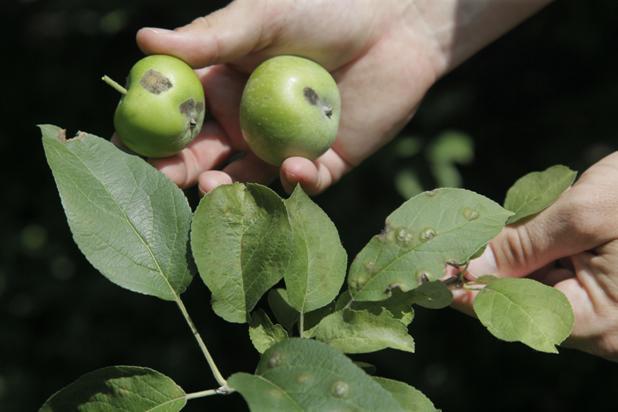
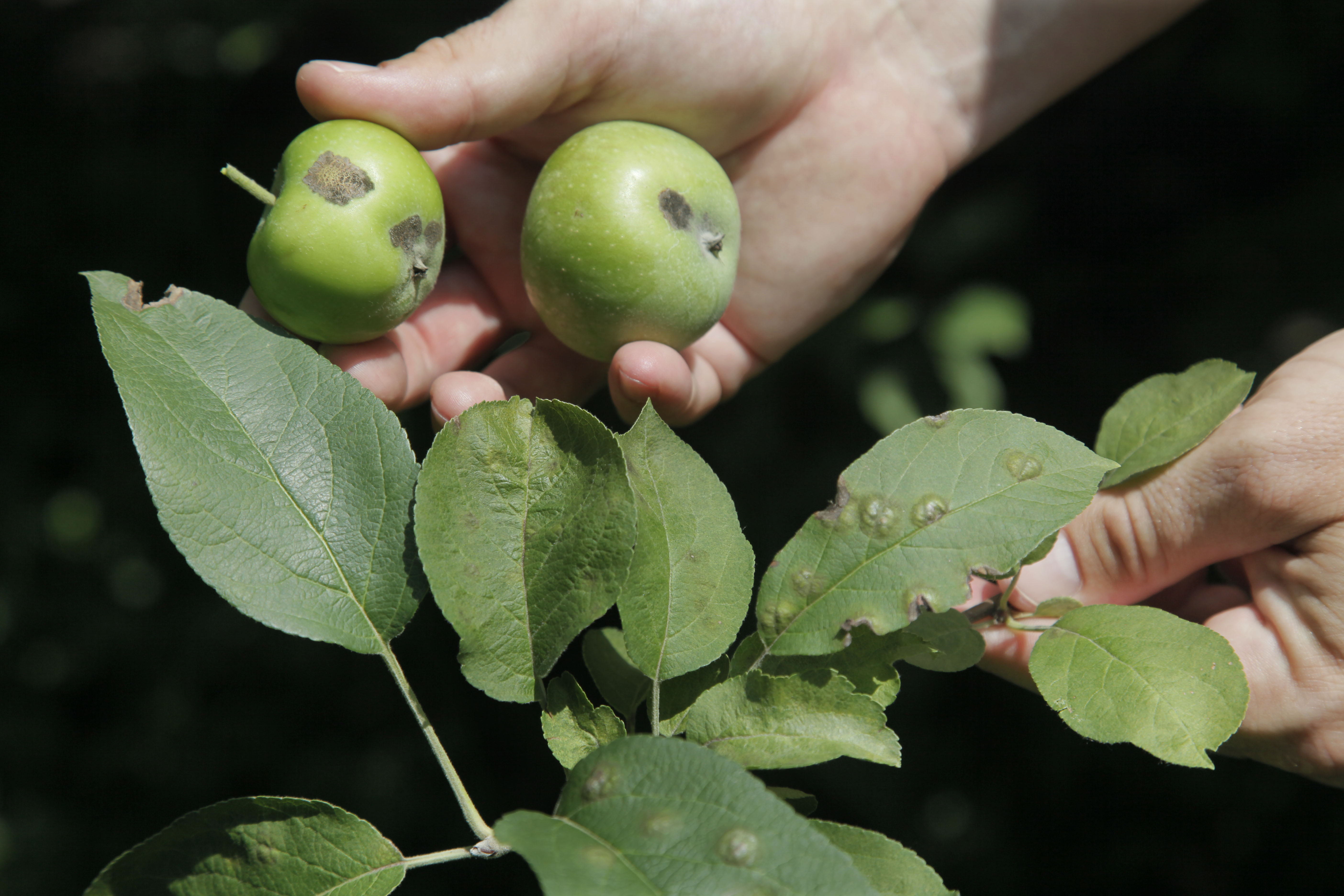
 Farmer Ryan Richardson, owner of County Line Orchard, displays examples of apples and leaves from McIntosh apple trees on his farm that have been affected by apple scab fungus, in Hobart, Ind. Research from Purdue University shows Michigan and Indiana apple crops are being bothered by apple scab fungus, because fungicides that are quite important to apple growers are failing. The fungus is becoming resistant, and it could mean some serious problems for orchard operators.
By JOHN FLESHER
AP Environmental Writer
TRAVERSE CITY, Mich. – Apple growers in the eastern U.S. have a despised enemy known as apple scab – a disease caused by a fungus that forms ugly brown or greenish-black pockmarks on the fruit’s skin. A scabby apple is unfit for grocery stores because consumers are notoriously picky about blemished fruit.
Growers have kept the disease under control for decades by spraying trees with pesticides. Now, researchers say the chemicals may be losing their effectiveness as apple scab becomes ever more resistant, worsening the threat of outbreaks in commercial orchards.
“We’ve dealt with fungicide resistance over the years, but this time we’re losing three or four different classes of completely unrelated fungicides at the same time,” said Henry Ngugi, a plant pathologist with Penn State University’s Fruit Research and Extension Center. “We have to literally go back to the drawing board.”