
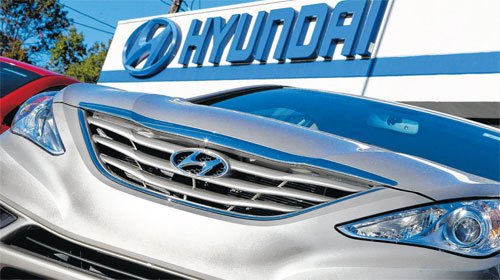
What worries Manish Sahay, the sales manager of Star Hyundai-Bayside, a New York City dealership in Queens for South Korean automaker Hyundai Motor Co., is a stock shortage.
“Right now we have a lack of inventory. That’s just one of the issues that Hyundai is dealing with – just too much demand and not enough supply. We’re very limited in our (available) inventory and that’s one of our biggest drawbacks at this point. All Hyundai dealers have inventory issues,” he said.
Without doubt, he has been kept busy by demand. The number of Hyundai cars sold at his dealership each month this year has risen to 100, up 30 percent from last year. He said his shop has the potential to sell about 170 cars a month but doesn’t have enough stock. New car sales in the United States have been steady despite the nation’s slowing economy.
The U.S. market share of Hyundai and its affi liate Kia Motor Corp. rose from 7.7 percent in February to 8.8 percent in October. Production cuts among Japanese automakers, due to the country’s March earthquake, contributed to the situation. But that hasn’t not been the sole cause of Hyundai’s growth.
Motor journalist Naotsugu Mihori argues the quality of a Hyundai luxury sedan is comparable to its Japanese counterparts. “I felt it was very smooth and comfortable to ride in. If you were driving blindfolded you wouldn’t be able to tell the difference between Japanese and Hyundai sedans,” he said.