
 Staff Photo by Jake Daniels/Chattanooga Times Free Press
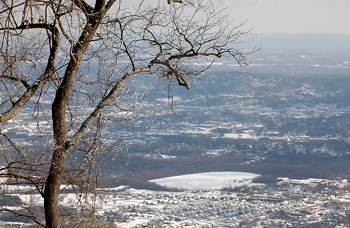
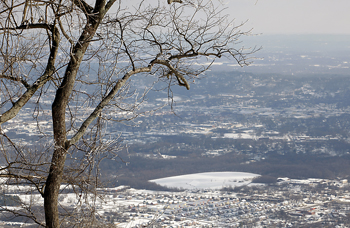
A tree sits on the brow of Lookout Mountain above the valley Thursday morning. Trees have held up well under the duress of the snow and ice of the past week.
Ice that coated streets and sidewalks following Sunday night’s storm may have sent plenty of people crashing to the ground, but local oaks, pines and other trees have been doing fine.
Chattanooga City Forester Gene Hyde said a typical winter storm sends his office into high gear as workers deal with 10, 20, sometimes up to 100 calls about tree-related problems.
“So far, we’ve had five or six at the most, maybe even less than that,” he said. “If somebody told me we were going to get 8 or 9 inches of snow and not get many calls, I wouldn’t believe them.”
Jerry Roberts, owner of Robert’s Tree Service, attributed the lack of damage to the “light, playful snow.”
Wetter, heavier snow will sit on tree branches, weighing them down and often sending them to the ground, he said.
“It’s like water, the weight of water in a gallon jug, hanging down,” he said. When branches snap, “it sounds like rifle fire.”
Last year, it probably sounded more like a machine gun going off.
Roberts said some areas were “devastated” after a particularly intense storm last winter, and his workers cleaned up broken limbs all over the area.
John Thomason, a certified arborist for ABC Tree Services, said he and his crew worked for 71/2 straight weeks after a storm last year, and he’s still noticing the effects today.
“Trees are not like humans,” he said. “We respond in milliseconds. They respond in months and years.”
TREE CARE TIPS• Trim dangerous branches hanging over important areas• Prune sides facing buildings to ensure trees fall in the other direction• Shake snow off smaller trees and use a broom to knock accumulation from higher branches• Seal cracks and holes with wood glue to keep out insects during the summer• Call a tree specialist as soon as damage occurs to speed emergency removal
But so far, this January has been different from last year for tree-damage calls, he said.
“This year we haven’t had any, and I’m saying zero,” he said.
Barring any more icy precipitation, calls aren’t likely to shoot up.
Trees native to Southeast Tennessee and Northwest Georgia naturally are able to tolerate temperatures as low as about 5 degrees, meaning only extreme conditions such as wind and ice will cause damage.
Unfortunately, the same holds true for tree troublemakers.
“The cold temperatures aren’t going to inhibit any pests or diseases,” Thomason said. “Sorry, it has to be really cold. It has to be Minnesota cold. This is situation-normal for most all the trees.”
In fact, this could be situation-ideal for local plant life. Droughts over the past few years have depleted underground water tables, and every bit of precipitation can help.
But all that white powder doesn’t have to melt before trees start to benefit.
“The snow is an insulator. It’ll probably help it a little bit more than it’ll hurt it,” said Jack Townsend, tree and shrub specialist at The Barn Nursery. “Just like the Eskimos with the igloo.”
And falling limbs – while they are a danger to homes or parked cars – can help trees.
“The trees are hardy. They’ll take it,” Townsend said. “It’s just like pruning them. If you’re gonna prune a tree, now’s the time to prune it, and if there’s freezing rain, nature’s gonna do that for you.”