
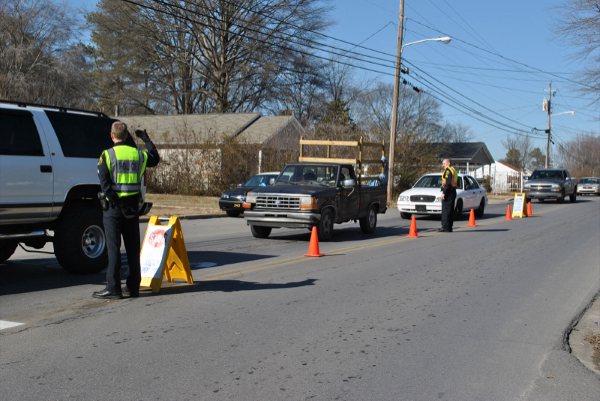
 Dalton Police Department roadblocks screen drivers and passengers earlier this year.
Supreme Court RulingsThe Fourth Amendment requires that searches and seizures be reasonable. The Supreme Court has found in various rulings that a search or seizure is ordinarily unreasonable in the absence of individualized suspicion of wrongdoing, except in limited circumstances in which the usual rule does not apply.The court has also found that the only constitutionally allowed roadblocks are those carried out pursuant to a plan containing explicit, neutral limitations on the conduct of the individual officers executing the roadblock.• United States v. Martinez-Fuerte, 1976: The Court upheld brief, suspicionless seizures at a fixed checkpoint designed to intercept illegal aliens. The lawsuit brought Fourth Amendment challenges to stops at two permanent immigration checkpoints located on major U.S. highways less than 100 miles from the Mexican border. The court response noted at the outset the particular context in which the constitutional question arose, describing in some detail the “formidable law enforcement problems” posed by the northbound tide of illegal entrants into the United States. Although the stops in Martinez-Fuerte did not occur at the border itself, the checkpoints were located near the border and served a border control function made necessary by the difficulty of guarding the border’s entire length.• Delaware v. Prouse, 1979: In this lawsuit, the Court invalidated a discretionary, suspicionless stop for a spot check of a motorist’s driver’s license and vehicle registration. The officer’s conduct in that case was unconstitutional primarily on account of his exercise of “standardless and unconstrained discretion.” However, the Court has also suggested that a similar roadblock to verify drivers’ licenses and registrations would be permissible to serve a highway safety interest.• Michigan Department of State Police v. Sitz, 1990: The Court evaluated the constitutionality of a Michigan highway sobriety checkpoint program aimed at removing drunk drivers from the road. This checkpoint program was clearly aimed at reducing the immediate hazard posed by the presence of drunk drivers on the highways, and there was an obvious connection between the imperative of highway safety and the law enforcement practice at issue. The gravity of the drunk driving problem and the magnitude of the State’s interest in getting drunk drivers off the road weighed heavily in the Court’s determination that the program was constitutional.• City of Indianapolis v. Edmond, 2000: The Court considered the constitutionality of a highway checkpoint program whose primary purpose is the discovery and interdiction of illegal narcotics. Because the Court found the primary purpose was to uncover evidence of ordinary criminal wrongdoing, the program contravenes the Fourth Amendment. According to the ruling, “our checkpoint cases have recognized only limited exceptions to the general rule that a seizure must be accompanied by some measure of individualized suspicion.” The court declined to suspend the usual requirement of individualized suspicion where the police seek to employ a checkpoint primarily for the ordinary enterprise of investigating crimes and said they could not sanction stops justified only by the generalized and ever-present possibility that interrogation and inspection may reveal that any given motorist has committed some crime.Sources: Supreme Court rulings and the University of Tennessee’s Municipal Technical Advisory Service.
DALTON, Ga. – The Dalton Police Department may be violating a U.S. Supreme Court ruling if it holds police roadblocks to address specific criminal activity, according to a Georgia law professor and several lawyers.
However, Dalton police said they are familiar with the Supreme Court ruling, and the roadblocks held in recent weeks are primarily for traffic safety and not to address criminal activity. The checkpoints are held in accordance with any Supreme Court ruling, Chief Jason Parker said.
Dalton police sent out several news releases in June after meeting with local Hispanics about complaints that police roadblocks target them in an effort to arrest illegal immigrants. The department held 38 roadblocks this year through June, according to the Governor’s Office of Highway Safety website.
One news release, sent out June 29, says police plan to conduct roadblocks in various parts of the city “as part of the department’s district plans to address traffic and crime problems within the city.”