
East Ridge High School students and teachers are working to illuminate efficient homemade solar energy panels, having already completed several prototypes.
“I like the idea of training our students in high-skilled jobs and applications that are contemporary,” said academy chemistry teacher Cary Gibson, who is working with environmental sciences teacher Davis Mounger. “I think it’s important that these kids get exposed to doing something like this.”
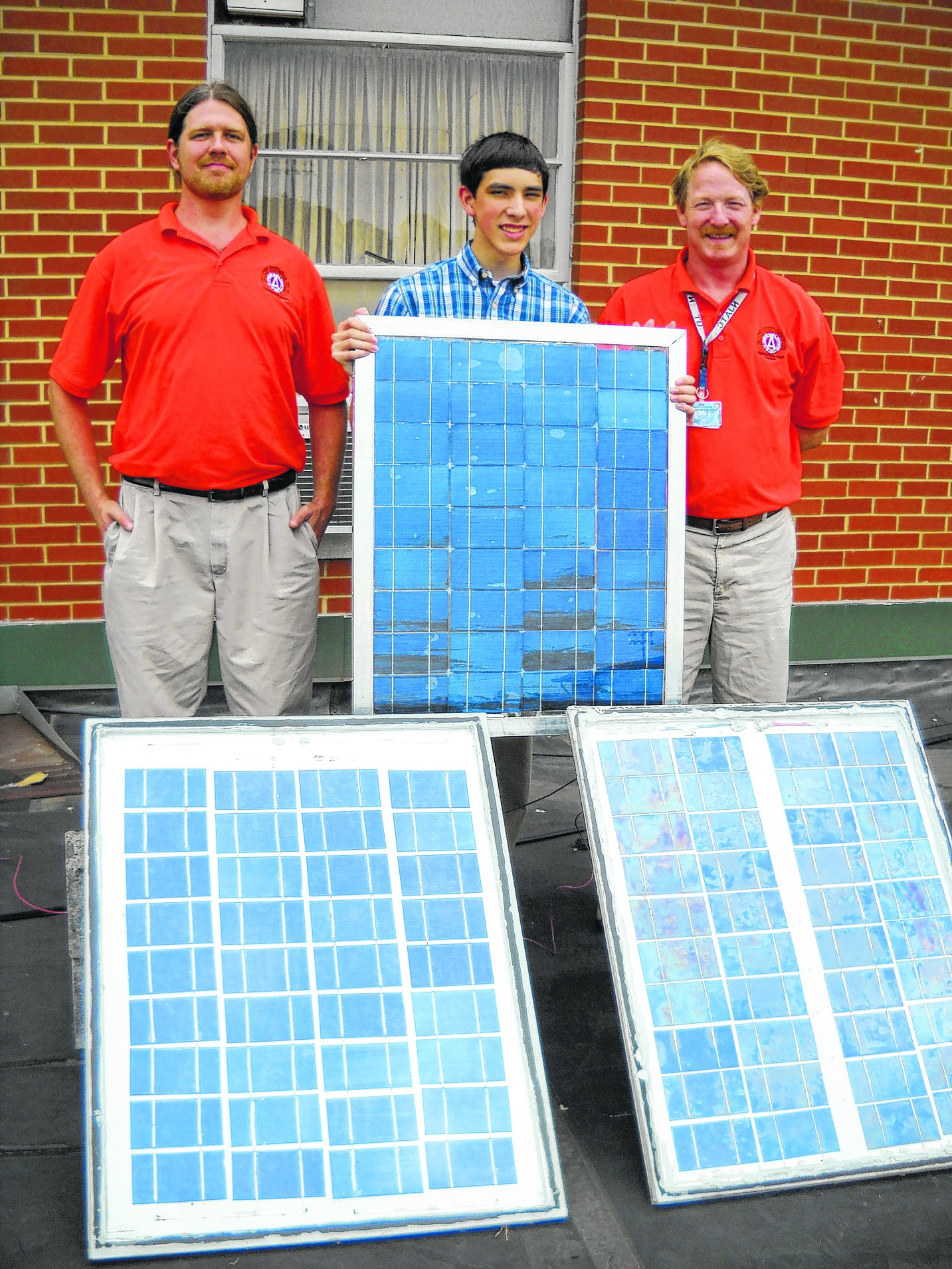 East Ridge High School teacher Davis Mounger, sophomore Morgan Hiu and teacher Cary Gibson, from left, work together to perfect their homemade solar panel design.
Just as their funding is running dry, they believe they may have found the perfect design. Only $40 of a $1,000 grant received in the fall of 2009 from the Public Education Foundation remains.
“Basically, it’s the best DIY way of making your own solar panel that is not paying a company to make it for you,” said upcoming sophomore Morgan Hiu, who said he hopes to use the viable hands-on experience gained to find a career within the alternative energy industry. “I feel like in the future we are going to be less dependent on fossil fuels. I feel this is going to help me make a career in that path.”
The grant purchased fragile solar cells that when put together and connected in a series front to back create a homemade energy-collecting device. As simple as it may sound to create the grid, protecting the panel and sensitive cells from moisture in a perfectly sealed, air-tight casing is anything but easy, said Mounger.
“Instead of sinking all the money into the first design, we spread it out to build prototypes,” he said. “The problem has always been how they should be sealed and waterproofed efficiently.”
The first design, which involved setting the grid inside what looks like the space between two window panes, leaked.
It is also inefficient because heat causes the frame to swell, “like a milk jug out in the sun,” which takes away from the cells’ ability to collect and transfer sunlight, making it only efficient on cooler days. The newest prototype is by far the most efficient design, perhaps by as much as 25 percent, Mounger said.
The new panel is built with no gap between the glass (optically clear silicon) and the cells which are potted into the frame.
Hiu, Gibson and Mounger are measuring and comparing data from their earliest prototypes to the newest design. The panels are connected to two micro-grid tie inverters from Enphase Energy that allow energy collected on the rooftop to feed back into the school’s power grid. Each inverter feeds information on volts collected and amps created to a website: enlighten.enphaseenergy.com, where the progress of each panel is recorded.
“So far, the old panels, even with their inefficient design, have given back enough power to sustain 56 light bulbs for one day,” said Gibson, who will use an additional grant from Unum Provident to create a new frame for the entire panel system that will stabilize the units.
Hiu plans to create a tracking system that will automatically move the panels so they will follow the sun. To build further panels, Mounger said, they will have to find raise funds or apply for additional grants.
Email Rebecca W. Miller at rmiller@timesfreepress.com.