
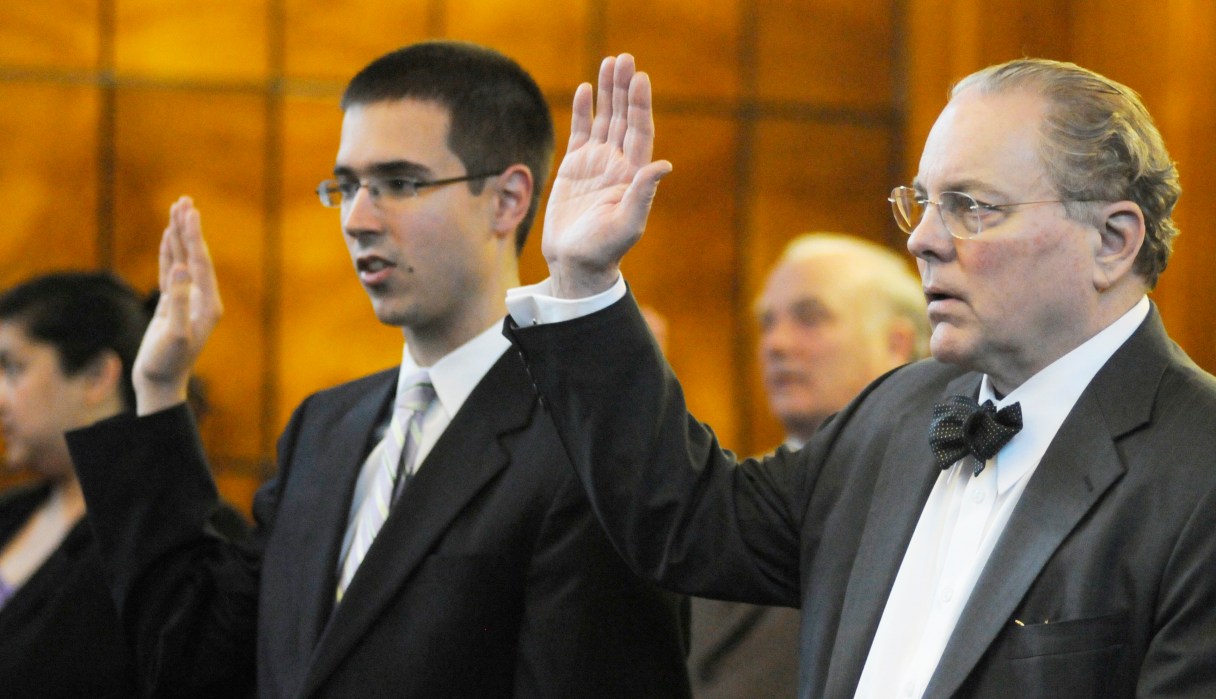
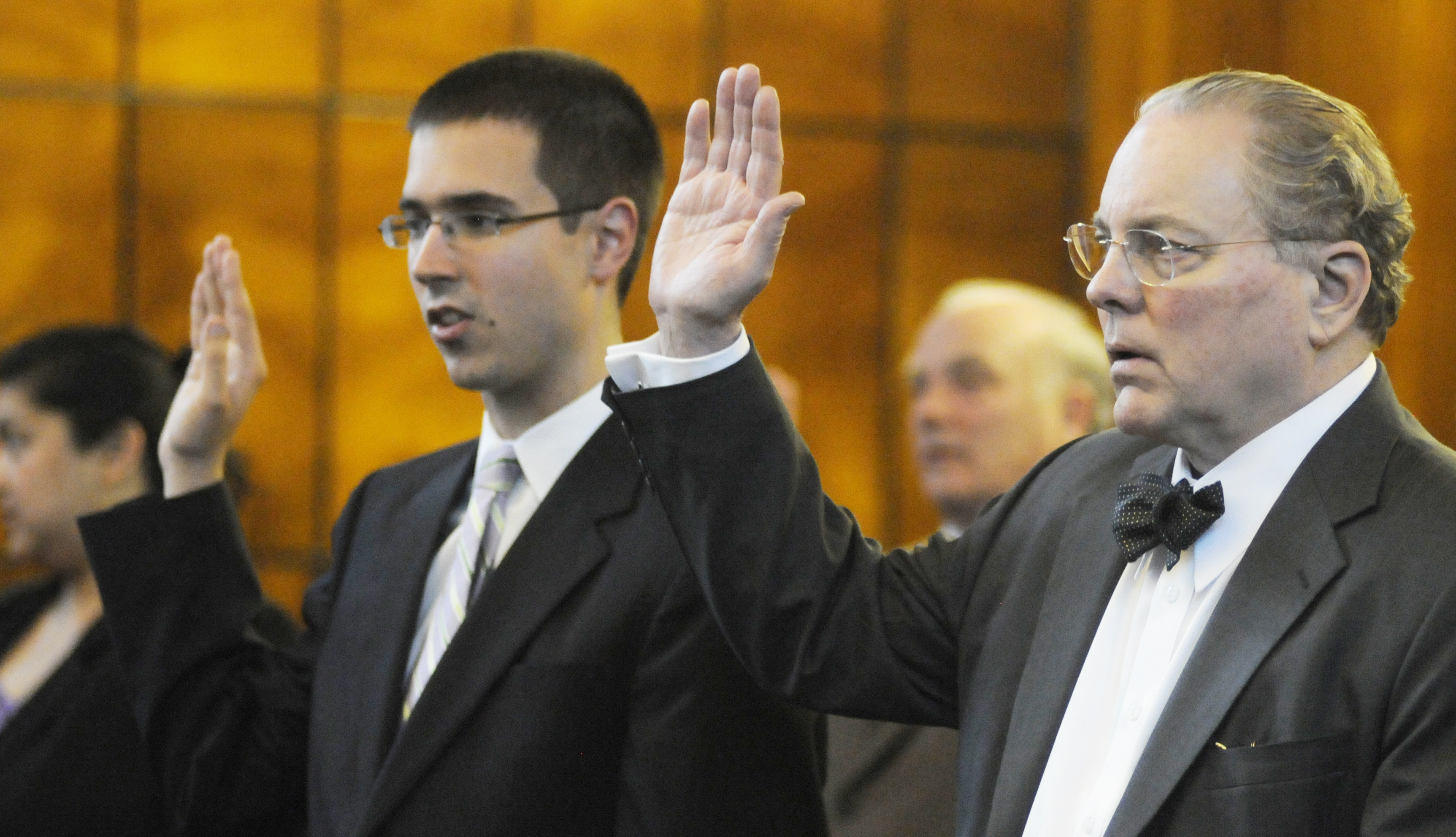
 Jim Harris, right, and Ryan Clark take an oath during a ceremony Thursday at the Joel W. Solomon Federal Building to admit some local attorneys into federal court.
Staff Photo by Angela Lewis/Chattanooga Times Free Press
U.S. District Court Judge Harry “Sandy” Mattice had good news for 44 attorneys admitted to the federal bar Thursday – as of that moment, they were all undefeated in federal court.
Now they’ve got to defend that record in a real courtroom.
To try cases in federal court, attorneys must apply to the court and attend a legal education seminar that instructs them on some of the differences between federal and state court.
One difference noted by most attorneys is that federal court is much more formal and, due to federal rules on trials, criminal cases move much more quickly.
Another difference, Mattice told attorneys, is that most work is done behind the scenes. People often think a judge dons the black robe and sits on a bench all day, but most of his work is done on paper while the judge is in chambers reviewing motions, Mattice told the group.
Max Bahner, chairman of the federal court admissions committee in Tennessee’s Eastern District, had a clear message for the attorneys before they raised their right hands to swear oaths to the court.
“I want to remind you that practicing law is a privilege; it is a service profession,” he said.
Before the ceremony, Bahner explained that committee members review each attorney’s application individually, then review the applications as a committee. The process isn’t too complicated, he said; an applicant must hold a law degree, pass the Tennessee state bar exam and pass a criminal background check.
Attorneys must apply to practice in each federal district, since the bar admittance does not qualify them to practice in all federal districts.
And not every attorney wants to work in federal court, Bahner said.
“Some people are afraid of coming to federal court because the rules are different and they are pretty well observed,” he said. “You can make a mistake and be out of court.”
Melissa Reinders, 31, was one of the attorneys joining the federal bar. She practices general civil litigation and said the federal certification opens up more potential cases to work.
“A lot of the procedures are different,” she said. “They handle things a lot more quickly, they set schedules; whereas in state court, they often play it by ear.”
Local criminal defense attorney Garth Best joined the federal bar Wednesday. He’s also trying to join the federal criminal defense appointment attorney list, a process that includes more training and work than becoming certified to practice civil or bankruptcy law in federal court.
To qualify to be a federal criminal defense attorney, he must observe different proceedings and serve as “second chair” or assist the Federal Public Defender’s office in at least one case before being added to the appointment list.
Though he still will practice in state court, Best said he’ll get to “broaden his horizons” by working federal cases.