
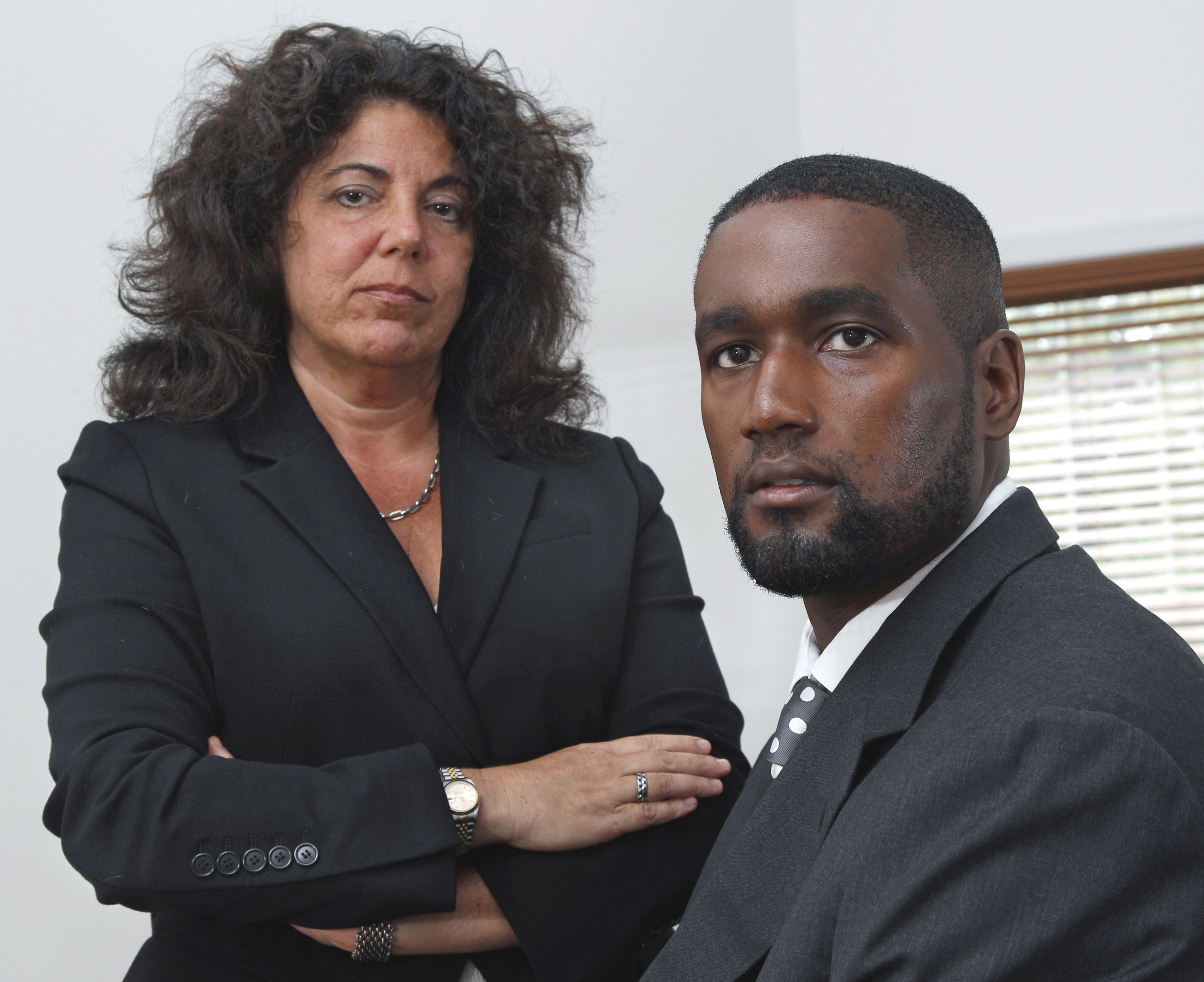
 In this Oct. 11, 2011 file photo, Albert Florence, right, sits at his home Bordentown, N.J., with his attorney Susan Chana Lask. In a 5-4 decision, the Supreme Court ruled against Florence, who faced strip searches in two county jails following his arrest on a warrant for an unpaid fine that he had, in reality, paid. An ideologically divided court ruled today that jailers may perform invasive strip searches on people arrested even for minor offenses. (AP Photo/Mel Evans, File)
In another 5-4 decision that followed the increasingly familiar ideological divide, the U.S. Supreme Court ruled Monday that jail guards may strip-search individuals arrested for any offense, including minor ones such as a traffic violation. The ruling needlessly weakens the Fourth Amendment’s safeguard against unreasonable searches.
Justice Anthony Kennedy said in the majority opinion that if an individual is to be incarcerated with the general jail population, “courts must defer to the judgment of correctional officials unless the record contains substantial evidence showing their policies are an unnecessary or unjustified response to problems of jail security.” Kennedy wrote that it would be “unworkable” to make an exception for people arrested minor offenses. The court’s highly politicized right wing — Chief Justice John G. Roberts and Justices Antonin Scalia, Clarence Thomas and Samuel A. Alito Jr. — concurred with Kennedy that strip searches were reasonable.
The court’s liberal minority took a far more balanced view.
Justice Steven G. Breyer, writing for himself and Justices Ruth Bader Ginsburg, Sonia Sotomayor and Elena Kagan, said jailers should have reasonable grounds before conducting an invasive strip search, which generally requires an individual to remove his or her clothes, to be subjected to a body cavity search and to allow their genitals to be inspected. Breyer correctly wrote that such searches were “a serious affront to human dignity and individual privacy” and should be used only when there was reason to expect that a person was hiding something.
The minority’s opinion certainly matches the Fourth Amendment’s view of unreasonable searches more closely than the majority’s blanket approval of strip searches.