
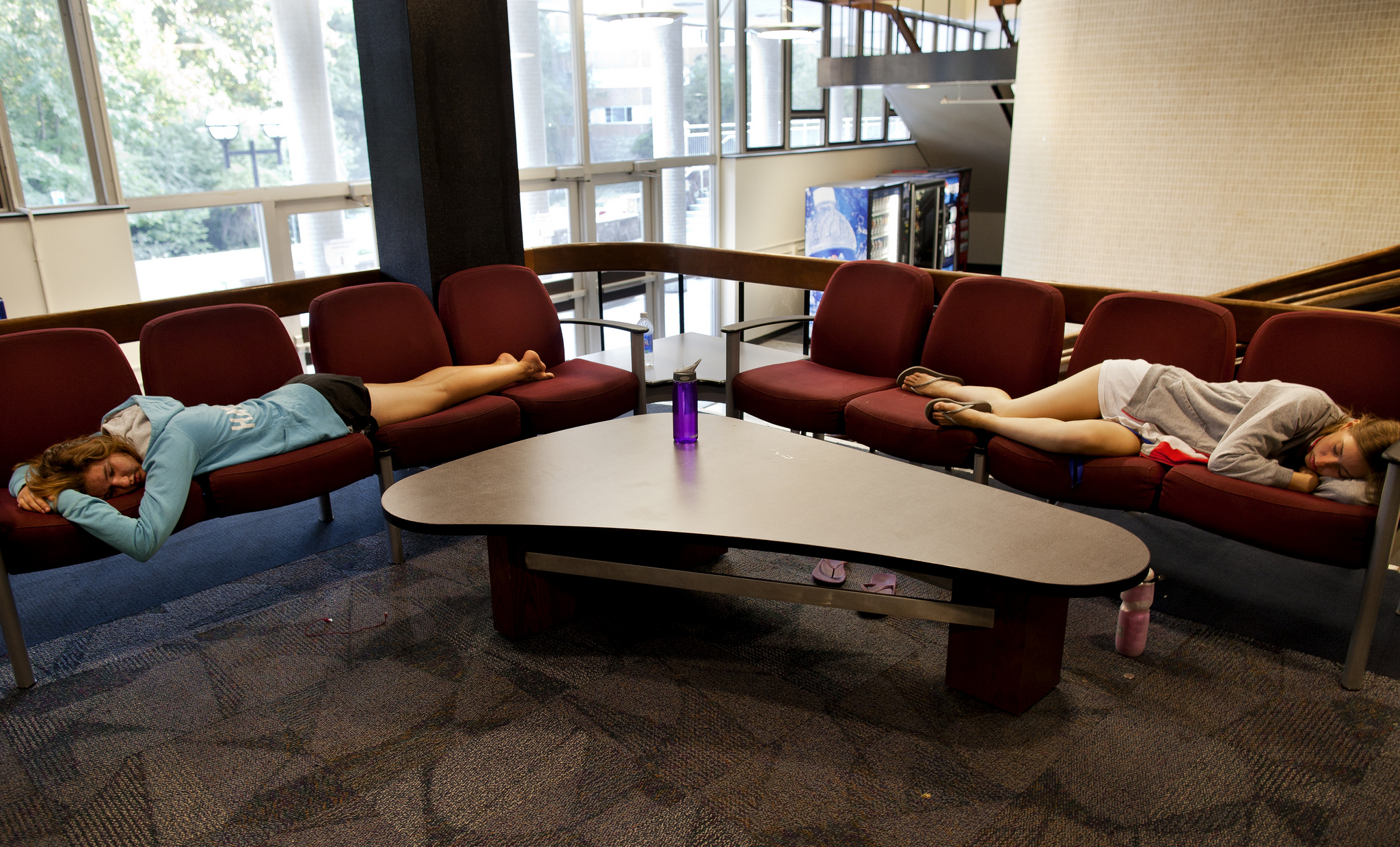
 Michigan Science, Technology, Engineering and Mathematics (M-STEM) Academy members Noelle Hansford, left, and Andrea Case take a nap in the lobby of Bursley Hall on the campus of the University of Michigan in Ann Arbor, Mich. As college students return to campus in the coming weeks, theyíll be showered in the usual handouts of coupons, condoms, and credit cards. But some schools are also giving students what a growing body of research reveals could make a huge difference in their college careers: ear plugs, sleep shades and napping lessons.
By JUSTIN POPE
AP Education Writer
As college students return to campus in the coming weeks, they’ll be showered in the usual handouts of coupons, condoms and credit cards. But some schools are also giving students what a growing body of research reveals could make a huge difference in their college careers: ear plugs, sleep shades and napping lessons.
College health officials are finally realizing that healthy sleep habits are a potential miracle drug for much of what ails the famously frazzled modern American college student: anxiety, depression, physical health problems and – more than most students realize – academic troubles. Some studies have found students getting adequate sleep average a full letter grade higher than those who don’t.
But adolescent biorhythms make it hard enough for college students to get the sleep they need, a recommended nine hours. On top of that, campus life turns out to resemble a giant laboratory experiment designed for maximum sleep deprivation: irregular schedules, newfound freedom, endless social interaction, loud and crowded housing, late-night exercise and food washed down by booze, coffee energy drinks. Campuses pulsing with energy at midnight by mid-afternoon resemble Zombie U., with students dozing off in library chairs, on yoga mats and even in coffee shops.