
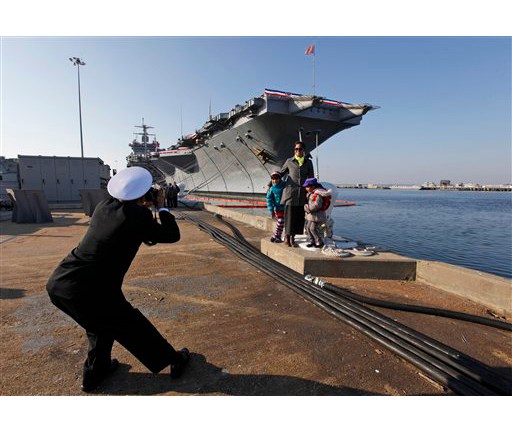
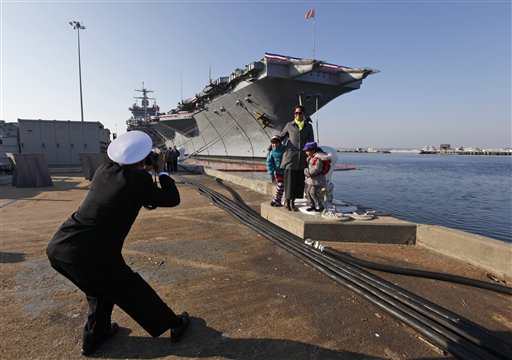
 Senior Chief Nageer Rahim, originally from Guyane, photographs his wife, Aliya and their kids in front of the USS Enterprise after an inactivation ceremony for the first nuclear powered aircraft carrier USS Enterprise at Naval Station Norfolk Dec. 1, 2012, in Norfolk, VA. The ship served in the fleet for 51 years.
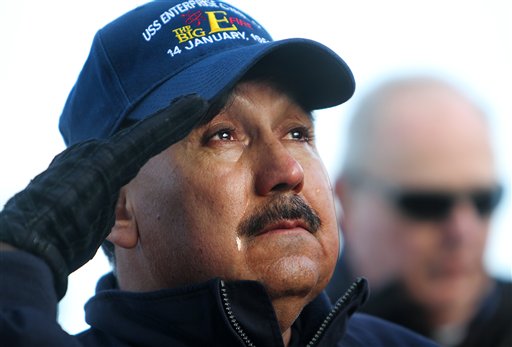 USS Enterprise alumnus Jimmy Gonzales struggles to hold back tears during a ceremony to honor those who were killed in the Jan. 14, 1969 fire, on the ships flight deck at Naval Station Norfolk, Va. on Friday, Nov. 30, 2012, Gonzales, who lives near Dallas, set foot on The Big E for the first time since he was an 18 year-old Seaman Apprentice who helped care for the wounded and dying.
NORFOLK, Va. – The world’s first nuclear-powered aircraft carrier was retired from active service on Saturday, temporarily reducing the number of carriers in the U.S. fleet to 10 until 2015.
The USS Enterprise ended its notable 51-year career during a ceremony at its home port at Naval Station Norfolk, where thousands of former crew members, ship builders and their families lined a pier to bid farewell to one of the most decorated ships in the Navy.
“It’ll be a special memory. The tour yesterday was a highlight of the last 20 years of my life. I’ve missed the Enterprise since every day I walked off of it,” said Kirk McDonnell, a former interior communications electrician aboard the ship from 1983 to 1987 who now lives in Highmore, S.D.
The Enterprise was the largest ship in the world at the time it was built, earning the nickname “Big E.” It didn’t have to carry conventional fuel tanks for propulsion, allowing it to carry twice as much aircraft fuel and ordnance than conventional carriers at the time. Using nuclear reactors also allowed the ship to set speed records and stay out to sea during a deployment without ever having to refuel, one of the times ships are most vulnerable to attack.
“Nuclear propulsion changed everything,” said Adm. John Richardson, director of Naval Reactors.