
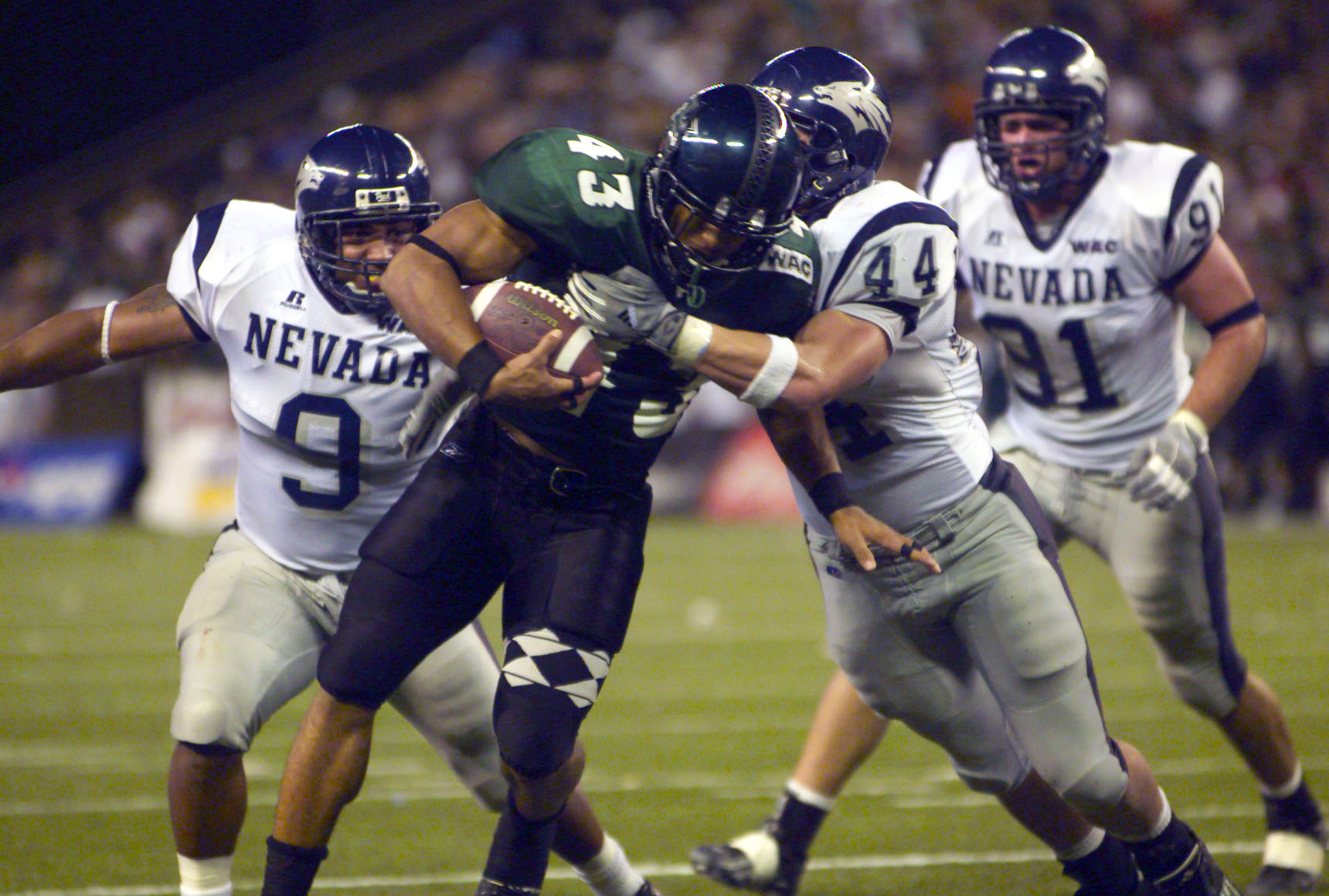
 Hawaii’s Bryan Maneafaiga (43) scores a touchdown against Nevada in Honolulu. With uneven testing for steroids and inconsistent punishment, college football players are packing on significant weight – in some cases, 30 pounds or more in a single year – without drawing much attention from their schools or the NCAA in a sport that earns tens of billions of dollars for teams. But looking solely at the most significant weight gainers also ignores players like Maneafaiga. In the summer of 2004, Maneafaiga was an undersized 180-pound running back trying to make the University of Hawaii football team. Twice, once in pre-season and once in the fall, he failed school drug tests, showing up positive for marijuana use. What surprised him was that the same tests turned up negative for steroids. Heíd started injecting stanozolol, a steroid, in the summer to help bulk up to a roster weight of 200 pounds.
WASHINGTON – With steroids easy to buy, testing weak and punishments inconsistent, college football players are packing on significant weight – 30 pounds or more in a single year, sometimes – without drawing much attention from their schools or the NCAA in a sport that earns tens of billions of dollars for teams.
Rules vary so widely that, on any given game day, a team with a strict no-steroid policy can face a team whose players have repeatedly tested positive.
An investigation by The Associated Press – based on dozens of interviews with players, testers, dealers and experts and an analysis of weight records for more than 61,000 players – revealed that while those running the multibillion-dollar sport believe the problem is under control, that is hardly the case.
—
EDITOR’S NOTE – Whether for athletics or age, Americans from teenagers to baby boomers are trying to get an edge by illegally using anabolic steroids and human growth hormone, despite well-documented risks. This is the first of a two-part series.