
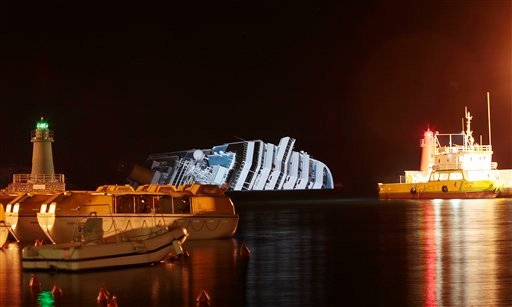
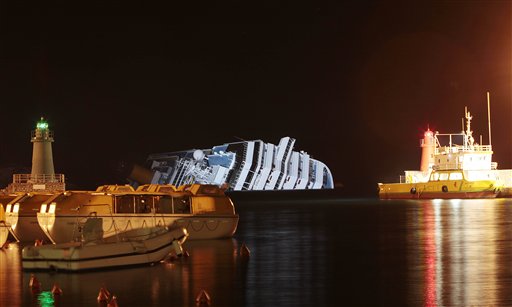
 The cruise ship Costa Concordia leans on its side Monday, Jan.16, 2012, after running aground near the tiny Tuscan island of Giglio, Italy.
The year is barely a fortnight old, but it is fairly safe to assume that pictures of a massive cruise liner on its side on rocks in shallow waters near a small Italian island on Friday night will be among 2012’s most remembered. They will be recalled for the thankfully small loss of life — six dead so far — in the disaster, for the high drama involved and for the short and long-term costs the wreck likely will have on the global cruise industry.
For the moment, the effort to find the missing, including two Americans, is paramount. Experts, though, say that the chance any individuals would be found alive after three days are slim. Still, the search, as it must, continues.
The rescue effort was halted for a while Monday as seas roughened. Choppy waters and slight shifting of the liner on the submerged rocks on which it foundered, officials feared, could endanger divers and cause the 500,000 gallons of fuel aboard to leak. The latter would threaten nearby coastlines and waters that are a protected sanctuary for sealife. The sea did calm late Monday, and rescuers returned to the ship. Plans to offload fuel and to salvage the ship continued.
Accounts of the dramatic wreck and its aftermath have caused alarm around the globe. Questions about the conduct of the captain and crew of the Costa Concordia abound. Some accounts indicate that the now-jailed captain left the ship before passengers, a violation of both Italian law and the code of the sea.
There are reports, too, that the captain purposefully deviated from his prescribed course before the ship came to grief. A spokesman for the Costa line, a division of Carnival Corp., seemed to agree, saying that the captain had violated “written rules of conduct.” It will take time to determine the sequence of events that lead to the shipwreck and to assign blame, if, indeed, there is blame to be assigned.