
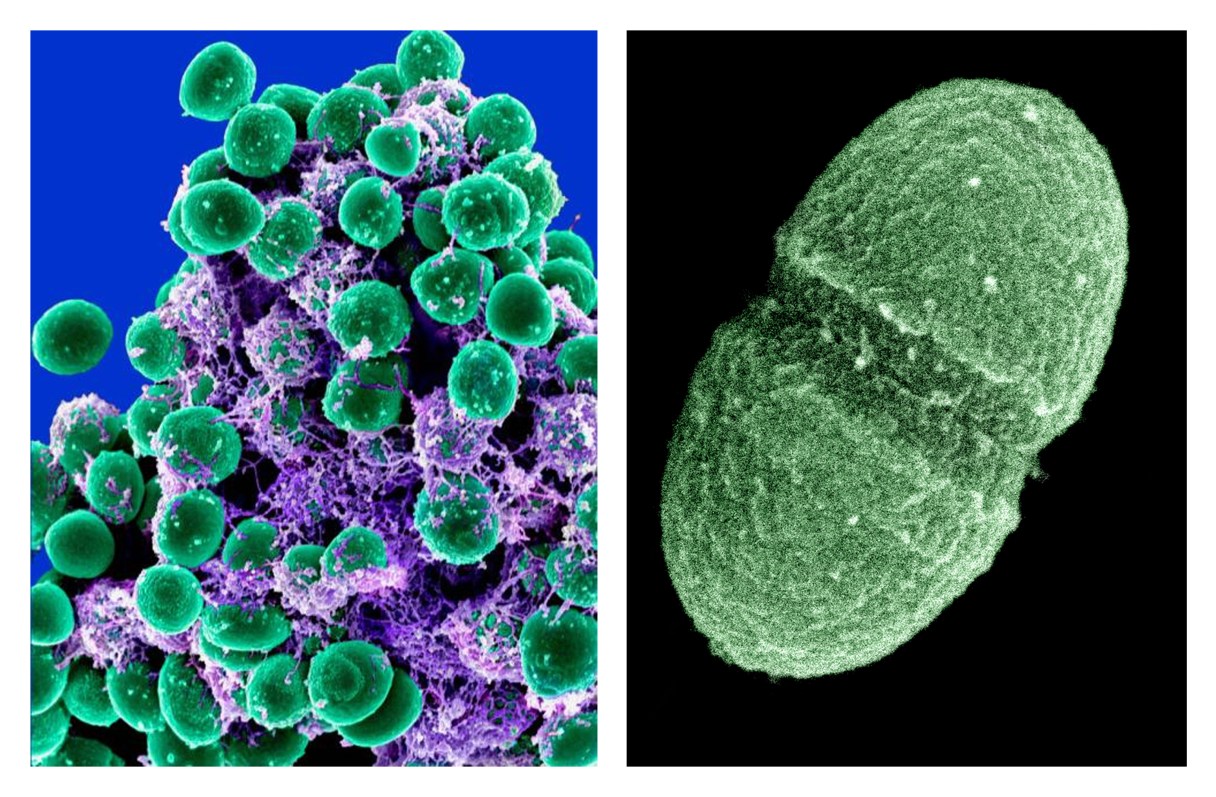
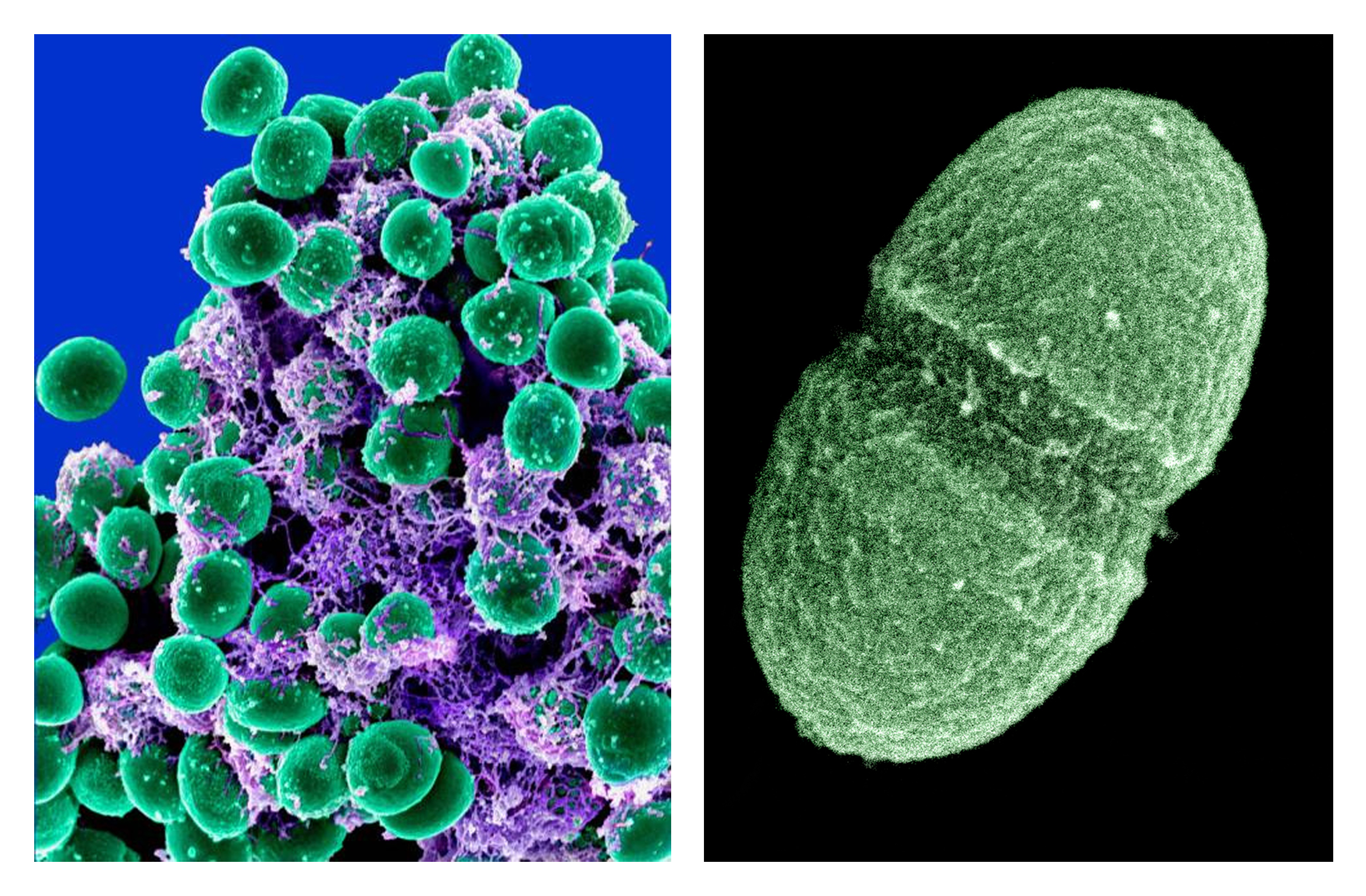
 At left, undated handout image provided by the National Institute of Allergy and Infectious Diseases (NIAID) shows a clump of Staphylococcus epidermidis bacteria (green) in the extracellular matrix, which connects cells and tissue, taken with a scanning electron microscope, showing. At right, undated handout image provided by the Agriculture Department showing the bacterium, Enterococcus faecalis, which lives in the human gut, is just one type of microbe that will be studied as part of NIH’s Human Microbiome Project. They live on your skin, up your nose, in your gut _ enough bacteria, fungi and other microbes that collected together could weigh, amazingly, a few pounds. Now scientists have mapped just which critters normally live in or on us and where, calculating that healthy people can share their bodies with more than 10,000 species of microbes. (AP Photo/NIAID, Agriculture Department)
LAURAN NEERGAARD
WASHINGTON (AP) – They live on your skin, up your nose, in your gut – enough bacteria, fungi and other microbes that collected together could weigh, amazingly, a few pounds.
Now scientists have mapped just which critters normally live in or on us and where, calculating that healthy people can share their bodies with more than 10,000 species of microbes.
Don’t say “eeew” just yet. Many of these organisms work to keep humans healthy, and results reported Wednesday from the government’s Human Microbiome Project define what’s normal in this mysterious netherworld.
One surprise: It turns out that nearly everybody harbors low levels of some harmful types of bacteria, pathogens that are known for causing specific infections. But when a person is healthy – like the 242 U.S. adults who volunteered to be tested for the project – those bugs simply quietly coexist with benign or helpful microbes, perhaps kept in check by them.