
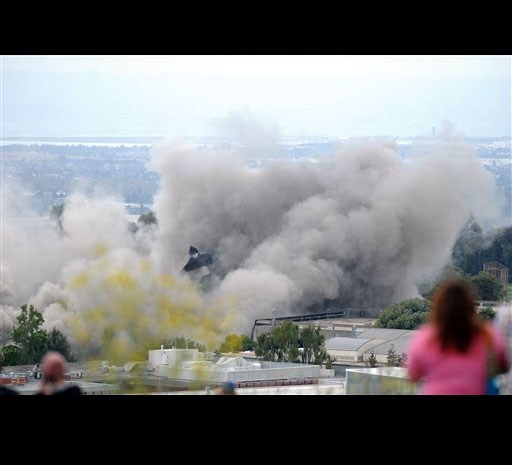
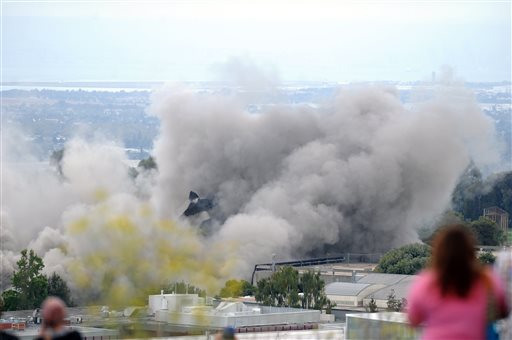
 Warren Hall is imploded on the campus of Cal State East Bay in Hayward, Calif., on Saturday, Aug. 17, 2013.
HAYWARD, Calif. – It took just seconds for a 13-story building overlooking San Francisco Bay to implode, spewing smoke and chunks of concrete as it crumbled into a heap of rubble. But U.S. Geological Survey scientist Rufus Catchings was marveling less at the visual spectacle than what he could feel with his feet.
As the building collapsed, the vibrations Catchings noted told him that a novel experiment to study one of the most dangerous fault lines in the country likely was a success.
“I was trying to sense the seismic energy on the ground,” Catchings said.
On Saturday, workers imploded Warren Hall, for four decades a fixture of the East Bay hillsides and the Cal State East Bay campus.
The boxy building was built roughly 2,000 feet from the Hayward fault, and officials recently deemed it seismically unsafe. Scientists turned its destruction into a valuable tool in their ongoing efforts to understand the earthquakes that have shaped California.