
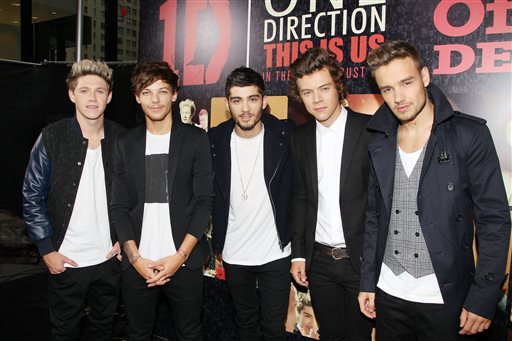
 This image released by Starpix shows members of One Direction, from left, Niall Horan, Louis Tomlinson, Zayn Malik, Harry Styles, and Liam Payne at the premiere of the film “One Direction:This Is Us” at the Ziegfeld Theatre in New York.
LOS ANGELES – The 1980s had New Kids on the Block; the ’90s had the Backstreet Boys; and now boy bands are resurgent again with British group-of-the-moment One Direction, currently a chart-topping global pop phenom. While hardly a very incisive look at the band or its five individual singers – who are barely old enough to even have personal histories – Morgan Spurlock’s documentary “One Direction: This Is Us” should score big with kids.
London-based One Direction flashed onto the international music scene in 2010, following the members’ appearances on British TV’s “The X Factor.” Response to the group among young female fans was strong – particularly on social media – prompting the band to sign with Simon Cowell’s Syco recording label, launching a 2011 U.K. concert tour and garnering a Columbia Records contract for their first studio album, the precedent-setting “Up All Night,” which was followed by a North American tour.
Marking Spurlock’s first concert doc, “This Is Us” picks up with 1D’s 2012-13 world tour, covering more than 100 shows in North America, Europe, Asia and Australia, culminating with a sold-out, four-night stand at L.A.’s Staples Center earlier in August. Now mostly pushing into their 20s, bandmembers Niall Horan, Louis Tomlinson, Harry Styles, Liam Payne and Zayn Malik revel in their globe-trotting stardom, often performing back-to-back shows for legions of shrieking teen girls, their chaperones and even the occasional male concertgoer.
This might be a Spurlock documentary, but counter to his usual approach, the filmmaker doesn’t make a single appearance. Shooting the band and their concerts in a variety of formats over six months at a series of international venues, Spurlock only wrapped up in June with 1D’s Mexico City show. If the film’s production schedule, driven by the practically nonstop concert dates, seems rushed, it doesn’t particularly show. Throughout the film, live 3D performance footage alternates with scenes of “the lads” cutting up backstage, huddling in their tour bus, dodging fervent fans or making promotional appearances.
Overall, Spurlock plays things incredibly safely compared to his usual irreverent, hang-loose style. The concert scenes represent fairly standard fare, with 3D visual effects adding a touch of hyper-reality. Individual interviews with the singers create a more intimate vibe, with discussions ranging from their musical influences to expressions of homesickness and awe at their rapid rise to popularity.