
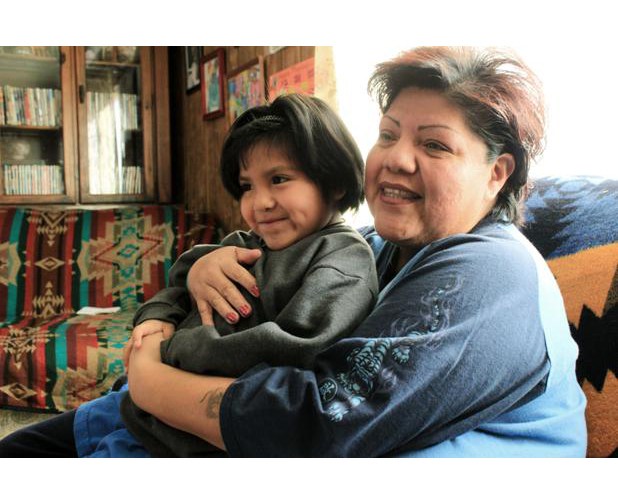
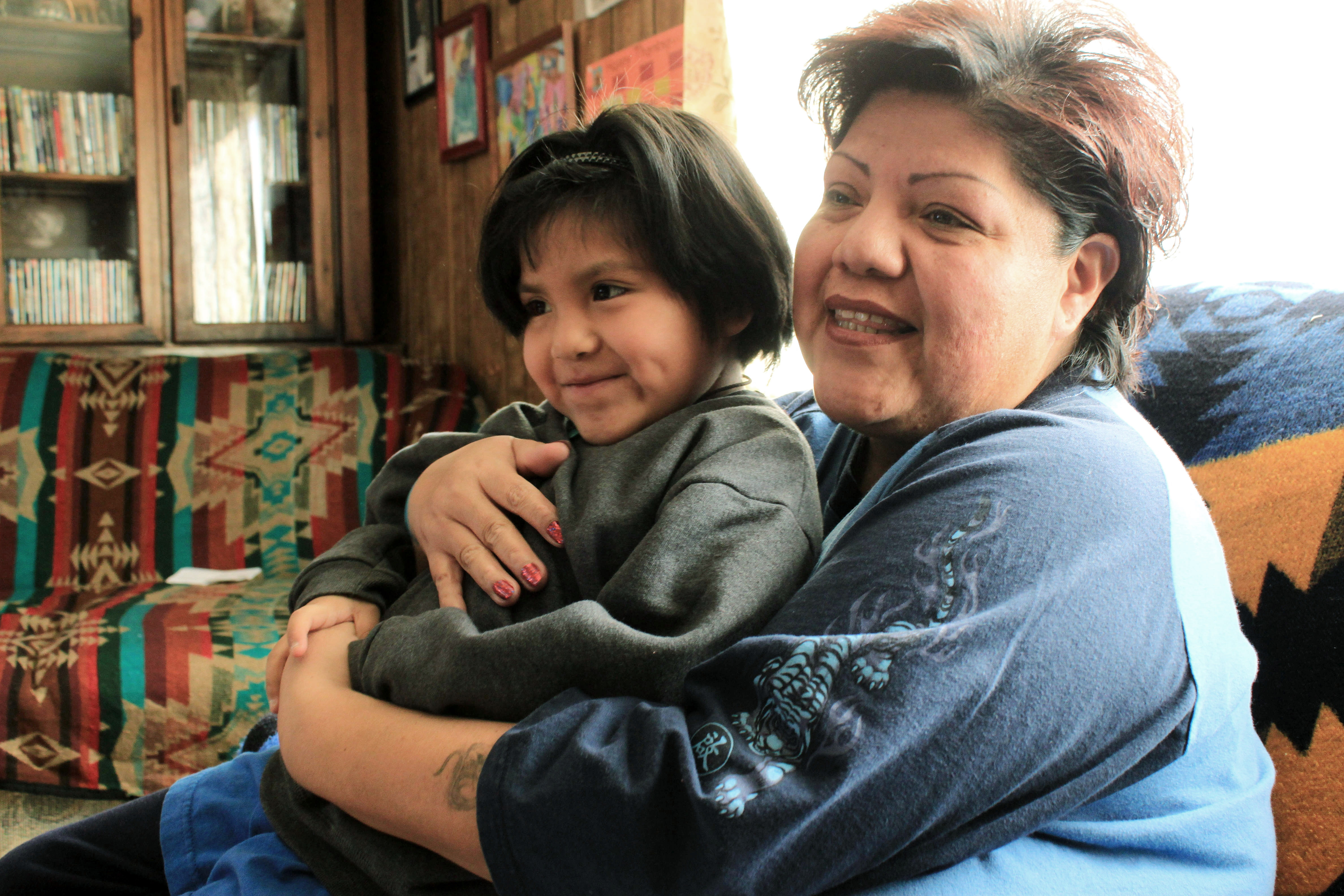
 Robin Sanchez hugs her 5-year-old daughter, Nicholle, as she talks about surviving domestic violence during an interview at her home in Acoma Pueblo, N.M. Hope was high in 2010 when President Barack Obama signed the Tribal Law and Order Act, an overhaul intended to give tribal leaders more authority to combat crime on their reservations, but implementation of the law remains inconsistent on reservations nationwide.
ACOMA PUEBLO, N.M. – In a desperate attempt to make it to the front door, Robin Sanchez crawled across the living room floor. Her ex-husband, fresh out of jail and intoxicated, used a wooden slat from one of the kitchen chairs to beat her.
She recalls how she was about to open the door when a loud crack resonated across her head. Blood gushed down her face as she heard her 3-year-old daughter cry: “Daddy, don’t be mean to Mommy.”
That September night in 2011 ended outside their home on the Acoma reservation in western New Mexico with tribal police officers, guns drawn, ordering Kirby Sanchez to release the mother of his child from a chokehold.
Scenes like this are far too common in Indian Country, where violent crime rates on some reservations are 20 times the national average. Women are especially vulnerable; federal statistics show that nearly half of all American Indian and Alaska Native women have experienced physical violence, sexual assault or stalking by an intimate partner and 1 in 3 will be raped in her lifetime.
That’s why hope was high in 2010 when President Barack Obama signed the Tribal Law and Order Act, an overhaul intended to give tribal leaders more authority to combat crime on their reservations.