
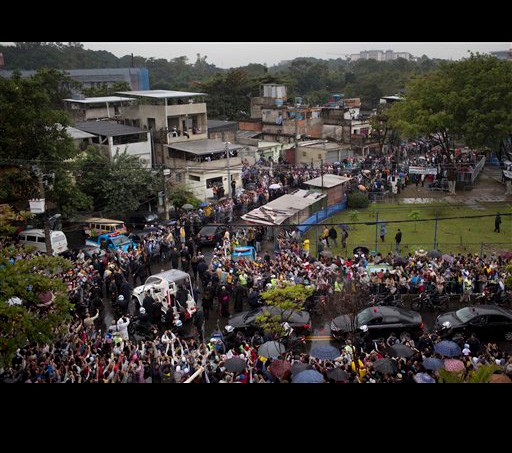
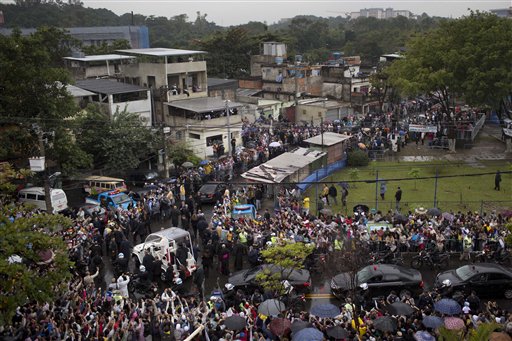
 People line the roads to greet Pope Francis as he arrives in his popemobile to the Varginha slum, part of the Manguinhos slum complex in Rio de Janeiro, Brazil, Thursday, July 25, 2013. Pope Francis on Thursday visited one of Rio de Janeiro’s shantytowns, or favelas, a place that saw such rough violence in the past that it’s known by locals as the Gaza Strip
RIO DE JANEIRO – Pope Francis, dubbed the “slum pope” for his work with the poor, received a rapturous welcome Thursday from one of Rio’s most violent shantytowns and demanded the world’s wealthy end the injustices that have left the poor on the margins of society. He received an even more frenzied welcome as he opened a rain-soaked World Youth Day in a far different setting: Rio’s upscale Copacabana Beach.
In between, he showed off some of his offbeat – almost rebellious – personality, telling pilgrims from his native Argentina that he wanted them to make trouble, shake things up in their dioceses and make a “mess” by going out into the streets to spread the faith.
“We knew that in Rio there would be great disorder, but I want trouble in the dioceses!” he said, speaking off the cuff in his native Spanish. “I want to see the church get closer to the people. I want to get rid of clericalism, the mundane, this closing ourselves off within ourselves, in our parishes, schools or structures. Because these need to get out!”
He put that into practice on Thursday. Amid the stench of raw sewage and the shrieks of residents, Francis made his way through the Varginha shantytown, part of a region so violent it’s known as the Gaza Strip. The 76-year-old Argentine seemed entirely at home, wading into the cheering crowds, kissing residents young and old and telling them the Roman Catholic Church was on their side.
It was a message aimed at reversing the decline in the numbers of Catholics in most of Latin America, with many poor worshippers leaving the church for Pentecostal and evangelical congregations. Those churches have taken up a huge presence in favelas, or shantytowns such as Varginha, attracting souls with nuts-and-bolts advice on how to improve their lives.