
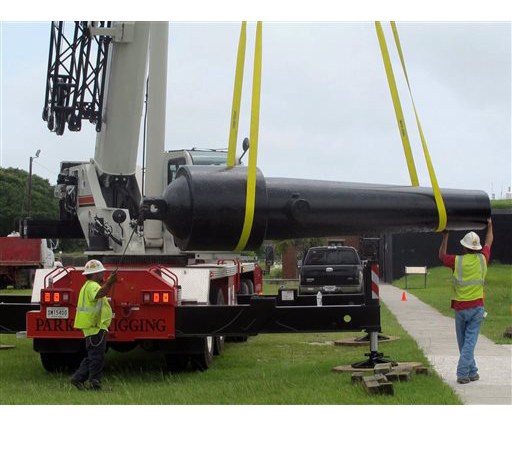
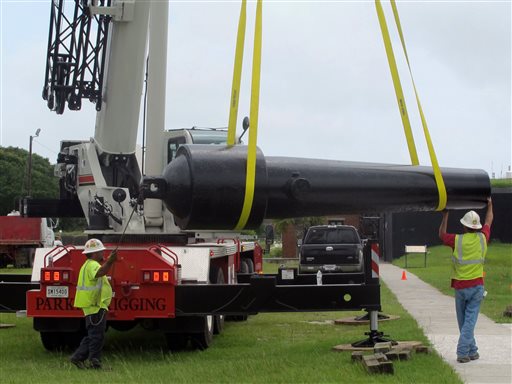
 Workers move a Civil War cannon into position at Fort Moultrie on Sullivans Island, S.C., on June 10, 2013 after the gun was conserved. The fort, part of the Fort Sumter National Monument and from which Confederate gunners fired at Sumter in Charleston Harbor to open the Civil War in 1861, recently conserved 10 large cannon. The National Park Service is using computer sensors to monitor the temperature and humidity inside the guns.
SULLIVANS ISLAND, S.C. – Preservationists are using computer sensors and other high-tech methods to protect massive iron Civil War guns at a fort in South Carolina that fired on Fort Sumter to open the war in April 1861.
The sensors and modern rust-fighting epoxy coatings are being used to preserve historic siege and garrison guns, some of which were used to lob shells at Fort Sumter in Charleston Harbor when the war erupted. Union forces surrendered 34 hours after the bombardment started as the nation plunged into a bloody, four-year war.
Ten massive guns from Fort Moultrie on Sullivans Island, which is part of the Fort Sumter National Monument, were recently conserved as part of an ongoing program to protect the historic pieces from the salty, humid air. The guns were cast in foundries both in the North and South a century and a half ago.
The last of the guns, a 7-ton Union rifled Parrott gun suspended in a yellow sling held by a crane, was slowly jockeyed into place onto a new concrete base last week. It completes what the fort refers to as Cannon Row, where seven of the heavy guns are lined up next to each other.
The conservation work is being done under a multiyear, $900,000 agreement between the National Park Service and the Clemson University Restoration Institute, said Rick Dorrance, chief of resource management at the national monument.