

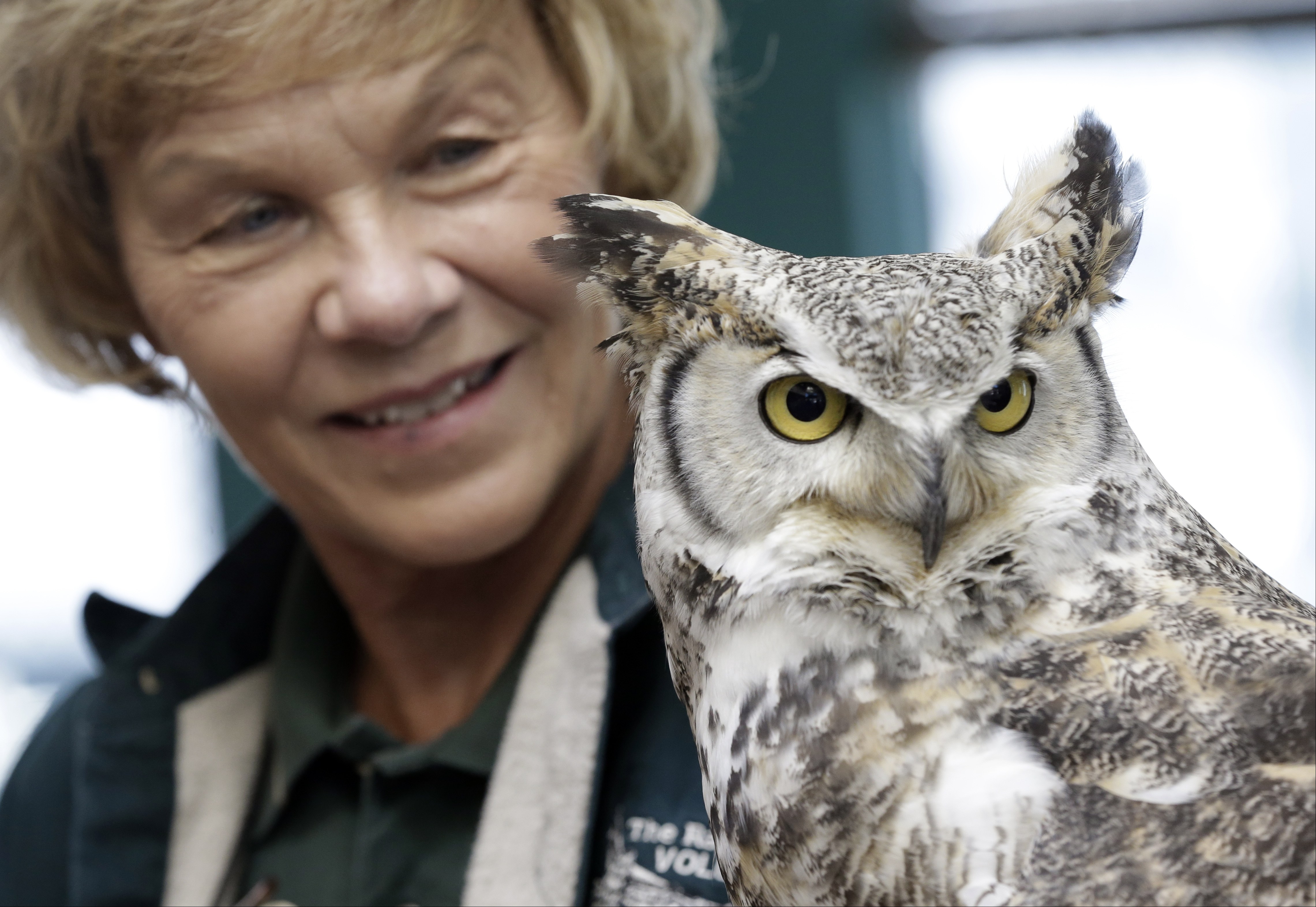
 Volunteer Claire Palmer holds a great horned owl Wednesday at the Raptor Center on the St. Paul campus of the University of Minnesota. The center listed about 30 owls as patients this week. It has been a tough winter for owls in some parts of North America. Some have headed south in search of food instead of staying in their northern territories.
MINNEAPOLIS – It’s been a tough winter for owls in parts of North America, and the evidence is turning up on roadsides, at bird feeders and at a wildlife rehabilitation center in Minnesota.
The dead, injured and sick owls are symptoms of what ornithologists call an “irruption,” a natural, cyclical phenomenon that happens when hungry owls that normally winter in northern Canada head south in search of food – either because their normal food of mice, voles and lemmings are in short supply or heavy snow cover makes it difficult to hunt for small rodents. Other irruptions have been reported recently in New England, as well as southern Ontario and Quebec, and parts of British Columbia.
This year it happens to be northern Minnesota that’s seeing much of the action and it’s mostly tiny boreal owls.
“They’re excruciatingly cute,” said Geoff LeBaron, director of the Christmas Bird Count program at the National Audubon Society.
As the owls flock to Minnesota, so do bird watchers. The prime owl habitat of the Sax-Zim Bog is about 45 miles northwest of Duluth, and it has an annual birding festival in February.