
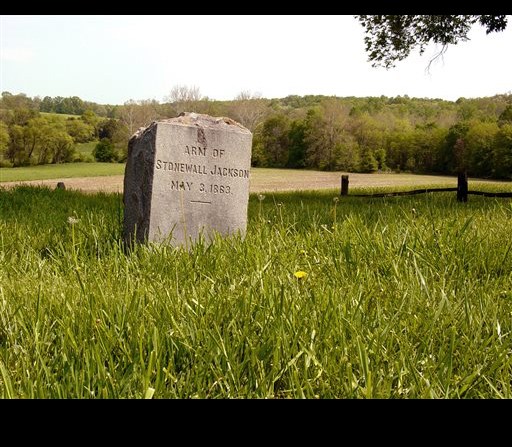
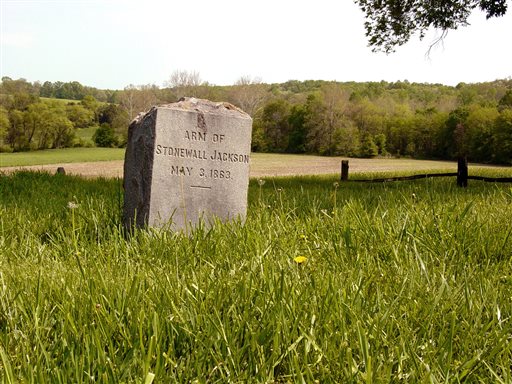
 This photo provided by National Park Service shows a tombstone for a the amputated arm of Confederate Gen. Thomas J. “Stonewall” Jackson near Orange County, Va. An astronomer on the 150th anniversary of Jackson’s death has reported in the May issue of “Sky & Telescope” magazine that some North Carolina soldiers were peering directly toward a rising full moon the fateful night they accidentally shot their beloved lieutenant general – and because of the low-hanging moon it would have been hard to tell friend from foe.
RALEIGH, N.C. – Friendly fire felled Thomas J. “Stonewall” Jackson under a full moon in the thick of the northern Virginia wilderness during the Civil War. Ever since, debate has waxed and waned much like the moon over whether his fighters carelessly shot the legendary Confederate under a bright night sky – or mistook him for an approaching enemy.
Now an astronomer on the 150th anniversary of Jackson’s death has reported in the May issue of “Sky & Telescope” magazine that some North Carolina soldiers were peering directly toward a rising full moon the fateful night they accidentally shot their beloved lieutenant general – and because of the low-hanging moon it would have been hard to tell friend from foe.
Donald Olson, who teaches astronomy and physics at Texas State University, concluded with colleague Laurie Jasinski that while others concentrate on the full moon and the unusual night fighting in Virginia when Jackson was shot, the relevant issue for him was the moon’s position the night of May 2, 1863.
Jackson had made the unusual decision that night to keep fighting at the Battle of Chancellorsville. It was about 9 p.m. when he rode up with a group to scout out Union lines. Upon returning, the North Carolina soldiers mistook the group for the enemy and shot Jackson, hitting him three times.
Hours afterward, doctors at a field hospital amputated Jackson’s left arm. And the next day, the Confederates drove away the Union forces, protecting the Confederate capital of Richmond. But a deteriorating Jackson died on May 10, 1863. He was 39.