
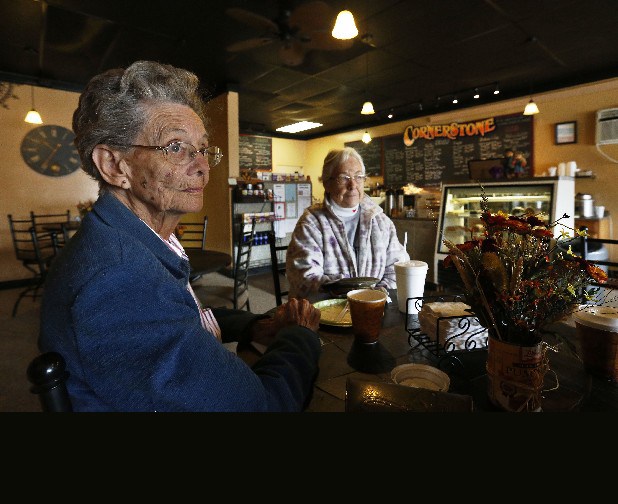
 Pearl Gasser, 80, sits with her friend Velma Drumtalk, at the Cornerstone Cafe in the rural town of Akron, the county seat of Washington County, Colo. A day earlier, a majority in Washington and four other counties on Colorado’s Eastern Plains voted yes on the creation of a 51st state, largely over residents’ alienation from voters statewide on issues such as civil unions for gay couples, new renewable energy standards, and limits on ammunition magazines.
DENVER – The nation’s newest state, if rural Colorado residents had their way, would be about the size of Vermont but with the population of a small town spread across miles of farmland. There wouldn’t be civil unions for gay couples, new renewable energy standards, or limits on ammunition magazines.
After all, those were some of the reasons five counties on the state’s Eastern Plains voted on Election Day to approve the creation of a 51st state in the first place.
Secession supporters know the votes were symbolic, designed to grab the attention of a Democratic-controlled Legislature. They say the vote results emphasize a growing frustration in conservative prairie towns with the more populous and liberal urban Front Range, which has helped solidify the Democrats’ power.
“We can’t outvote the metropolitan areas anymore, and the rural areas don’t have a voice anymore,” said Perk Odell, 80, a lifelong resident of Akron in Washington County, which voted to secede.
The five counties share borders, covering about 9,500 square miles and have a combined population of about 29,200. Four of the counties — Philips, Yuma, Kit Carson and Cheyenne — border Kansas. They are solidly Republican areas that have long identified more with Kansas and Nebraska because of their agricultural background than with Denver.