
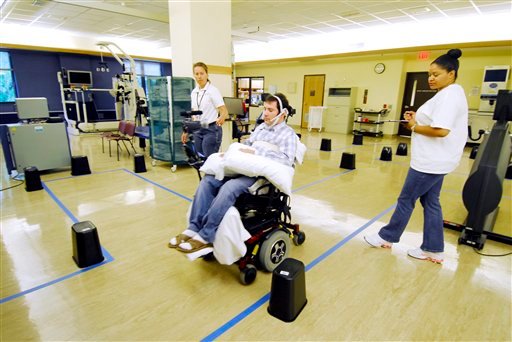
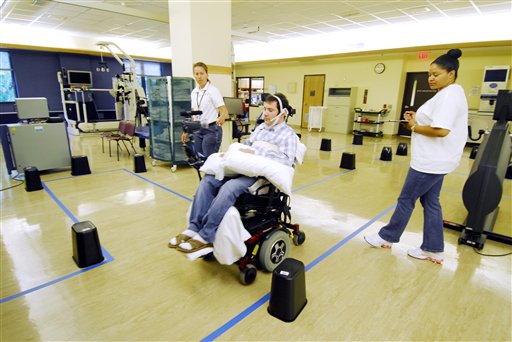
 This undated handout photo provided by the Shepherd Center shows Jason DiSanto navigating an obstacle course in an electric-powered wheelchair by issuing commands with a magnetic tongue piercing.
WASHINGTON – An experimental device is letting paralyzed people drive wheelchairs simply by flicking their tongue in the right direction.
Key to this wireless system: Users get their tongue pierced with a magnetic stud that resembles jewelry and acts like a joystick, in hopes of offering them more mobility and independence.
Researchers reported Wednesday that 11 people paralyzed from the neck down rapidly learned to use the tongue device to pilot their wheelchairs through an obstacle course full of twists and turns, and to operate a computer, too.
“It’s really powerful because it’s so intuitive,” said Jason DiSanto, 39, of Atlanta, who was among the first spinal cord-injured patients to get his tongue pierced for science and try out the system. “The first time I did it, people thought I was driving for, like, years.”
The team of researchers in Atlanta and Chicago put the Tongue Drive System to the test against one of the most widely used assistive technologies, called sip-and-puff, that users operate by breathing into a straw. Using the tongue, patients operated their wheelchairs a bit faster but just as accurately — and on average, they performed about three times better on video game-like computer tests, said lead researcher Maysam Ghovanloo, director of Georgia Tech’s bionics lab.