
There’s a saying among ultra-distance runners: In a 10K race, it’s 80 percent physical. For a marathon or 50K race, it’s about 50-50 between physical and mental. In the 100-mile race, it’s 80 percent mental.
Chattanooga runner Daniel Lucas says his first attempt at a 100- miler was like running with no air. Training on the course for the week leading up to the race couldn’t prepare him for race day. That’s because he was trying out the Leadville 100, a 100-mile trail race that has notoriously kept runners coming back to Colorado for butt- kickings for two decades.
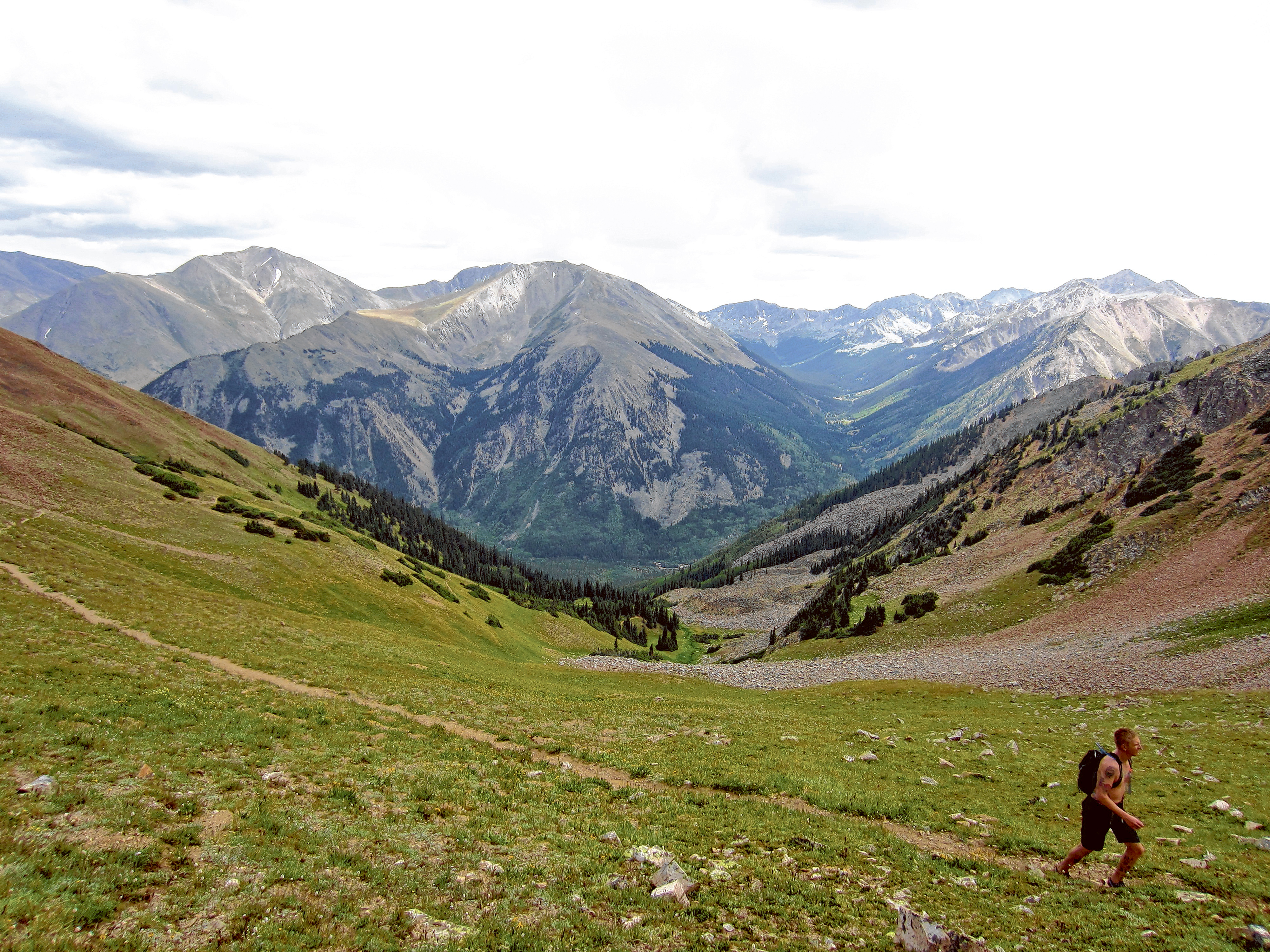
Romantically known as the Race Across the Sky for the rolling course that clings to the Rockies, Leadville delivers a low point of 9,200 feet above sea level and tops off at 12,600 of altitude. It’s a true there-and-back course, beginning in the small town of Leadville at 4 a.m. and, hopefully for most runners, ending back there less than 30 hours later at the finish line.
Only about 48 percent of racers finish. To even be allowed to finish, you have to make the aggressive cut-off times in the first 50 miles of the stretch. Experienced runners of the Leadville 100 say the race doesn’t start until after that, when the bulk of runners have dropped out of the race and when you’re pacing to make it under the 30-hour cut-off time.
“It’s a spiritual and psychological thing, it’s not really as physical as you think,” Lucas says. “Your body quits after only so long and it’s just a battle between your body and your mind. You experience a lifetime of highs and lows in one race.”
If it’s a spiritual thing, the 10 runners that travelled from Chattanooga to attempt the Leadville 100 this past August are gluttons for punishment. “This was not the first 100-mile race I wanted to do. It is very, very difficult,” says fellow first-time 100- miler Samuel Hammonds. “I wanted to do something easier for my first time … I even planned on trying to get another 100-mile race in before Leadville, but I was not able to.”
Both Hammonds and Lucas say they couldn’t sleep at all the night before the race. “You’re amped up, you have a lot of energy, you’re ready to go,” Hammonds says. That’s good, considering that time the next day, 24 hours later, Hammonds was crossing the finish line, followed not far behind by Lucas.
Hammonds and Lucas, joined by fellow Chattanooga runners Chad Wamack and Randy Whorton, give us a glance at their 100-mile experience. You know, just in case you ever wanted to know what it was like to run 100 miles.
Not even the beautiful imagery of hundreds of headlamps marching around a lake at dawn could convince some to even attempt a 100-mile race. “The thing is, in a 100-miler, so many things are working against you,” Hammonds says. “There’s sleep deprivation. I needed rest! It’s very difficult to eat the entire time, you have to train to eat different foods. The altitude is very hard to deal with, and it can seriously impact you.”
The altitude is what first makes runners weak.
Lucas’ first road block in the race was his start. He says he was the last of the Chattanooga 10 to make it to the 13.5 mile marker and he couldn’t breathe. Coming from Chattanooga’s humidity and trying to translate his running experience to the arid Colorado air was not easy.
“I was monitoring my heart rate-it was bad. I was hitting a wall at three hours. It was then that I realize, I could be a DNF, a did-not-finish,” Lucas says now, weeks after returning from the race. “There was 5 percent humidity. I never broke a sweat, and I’m a sweaty runner. It was so dry, I was just salt on skin. I was dehydrating twice as fast and by mile 20 to mile 30, we were running in direct sunlight. It felt like I was forging through the desert.”
And then you come to Hope Pass, the impetus for some runners and the curs
for many. Every runner has to make it up Hope Pass just to reach the halfway mark. Everyone’s experience differs.
“It is basically a march up a big mountain. This is a long, grueling climb and the air is really thin here,” Hammonds remembers. “Luckily, I made it up, and going down the other side of the mountain was good.”
Don’t ask, just climb only works for a few on the ascent of Hope Pass. It’s a mental beating to many whose eyes are open to the pain and suffering in front of them.
“Hope Pass is where it gets really hard. You’re going from the lowest part of the course, and then you climb up three miles. That’s where people were just falling apart,” Lucas remembers. “People looked like zombies from The Walking Dead! Their eyes were rolled back and they were really sickly looking.”
Lucas says he spotted a runner with a Bad Water tattoo, a memento from one of the world’s toughest footraces, a 135-mile torturous Death Valley run, hunched over and vomiting on the way up to the top. “I thought, ‘Holy crap, man! He’s been there, he’s done that, and he’s struggling,'” Lucas remembers.
At this point, the runners are weighed. Lucas had lost 7 pounds since beginning the race and he was grossly and dangerously dehydrated. Instead of giving up and succumbing to defeat, Lucas says he took time to refuel-three precious hours of walking, jogging, eating and drinking as much as he could as he made his way down the peak. “After three hours … I just hit the ground running. I felt like a brand new man.
I freaking flew! I felt so rejuvenated, ?like I hadn’t run a mile at all,” he says. That only lasts so long. Fatigue sets in and the sun goes down on runners
as they enter the last of the race, if they have made it that far. “In hindsight,
I should have kept a more conservative pace.At mile 60 or so I was on a purely liquid diet. It was rough,” Chad Wamack says. “I was prepared, I thought. But you’re running on fumes, so if you can work through that, the last 20 miles or so are like speed hiking.”
And if you didn’t sleep the night before, you could be in even worse shape.
“Mile 60 was rough. The sun was going down again and I didn’t pack Red Bull or caffeine and since I didn’t sleep the night before … I started lucid dreaming,” Lucas says. “I had to walk. There was nothing to do. I slapped myself and I couldn’t wake up.”
Hammonds, too, started to nod off at this point in the race. Heavy loss
of energy and being unable to take any foods or liquid calories will slow you down. “It gets really cold then,” Hammonds says. “And at this point, you’ve been on your feet for hours and hours and you’re sleep deprived. This is where it starts to get tough for everyone. It’s hard to keep food down.”
Leadville is really any one’s game. One year, you can finish, the next you might not. Randy Whorton is a two- time finisher of Leadville. But this year he didn’t finish. He made it to mile 86 before Leadville eventually beat him. “At the last aid station, they thought I had pulmonary edema. It scared me. That can kill you,” Whorton says. “I had a head cold and I was breathing really shallowly. I mean, at 86 miles you can crawl in. I wanted to. I wish I hadn’t even talked to those doctors, but I don’t regret it.”
If you’ve made it through the altitude and if you’ve managed to keep physically moving, the biggest challenge and what many attribute as the true test of ultra-running is the mental game. “I never had a bad attitude. I never
once allowed myself to feel bad about it. I stayed in the moment and I never thought about quitting,” Lucas says. “If you had asked me if I could do 10 or 20 more miles, I would have said yes. I had a lot of adrenaline, and I never sat down. I was scared if I sat down my legs would lock up and I wouldn’t get going.”
Despite the pain, suffering, weightloss, hallucinations and myriad other trials and tribulations, the idea of competing in Leadville was all it took for Lucas, Hammonds, Wamack and Whorton to make the pilgrimage to Colorado. “I just couldn’t shake the idea of the race. It was on my bucket list because it is a truly difficult race,” Lucas says.
“I mentioned it to Samuel once and then again we were with Randy and others and we talked about it more.”
Hammonds said to him, “Ok, you’re an idiot. Ok, I’ll do it,” and then others got on board. The group shook hands and months later, followed up to the commitment.
“The more beer, the more talking there is, right?
This time it was, let’s do a 100-miler. If you sign up, I’ll sign up, let’s do this together,” Whorton says.
The challenge extended to other ultra runners in Chattanooga. Only three of the 10 had run Leadville before, and this year, two of them didn’t finish. Some years are good and some years are bad.
“I said, if not now, when? I’m in shape, I have the ambition,” Lucas says. “In training I thought, if I could get to the start of the race, it’d be a blessing. I never once thought, what was I thinking?”
Hammonds, the runner who didn’t even want to run Leadville to begin with, made everyone proud with a finishing time under 25 hours-a feat for many, especially first-timers. Hammonds says everything went well for
him in the race until mile 80 when he started to run it a little too fast and he got a little cold without a jacket.
“I was greatly relieved. Those last six miles? I was nodding off,” Hammonds says. “I was so excited to just make it back in one piece.”
Now with the Leadville 100 out of the way, Whorton’s focusing on another 100-miler of his own creation. The Rock/ Creek Thunder Rock 100-miler is coming to the area next May after 10 years of running through Whorton’s dreams.
“It’s my baby. I’ve been thinking about it for so long. This is just such a perfect place. We have such a diversity of trails right here,” says Whorton, who already coordinates the trail races for Wild Trails and Rock/Creek.
It’s not just another 100-miler, he adds. He’s ready to take his experi- ences from other races and use them to build a bet- ter race. For instance, the Thunder Rock will have a noon start. The race will also be built for runners- using dedicated volunteers to fuel aid stations.
“I’m looking at it differently. I want it to be a blow-it-out-of-the-park experience. Our courses, our aid stations, there’s going to be celebrations with the race.” Whorton wants to involve the entire community by allowing groups to sponsor aid stations and compete for prizes-best costumes, best decorations, best food and drink. Whatever gives runners more motivation, the better, he says.
The race will begin at the Ocoee Whitewater Center and be a point-to-point race, essentially a horse- shoe that ends with a finish not far from the start. The race is also designed to let Tennessee’s beauty along the Ocoee shine. Night portions of the race will be run in thick woods and along dirt roads, leaving the scenic views for daylight. “There’s an amazing sunrise view and you’re actually going to cross the Hiawassee, you will get in the water if you want, and I would say along 70 percent of the course is close to water features,” he says.
Whorton’s also hoping that the accessibility of a 100-mile trail run will encourage runners to take the plunge to a longer distance. “It’s a mental game, seriously. You can go to the next level, and yes there is a certain level of suffer- ing, but you’d be surprised at what your body can do,” he says. “I just want to encourage runners, most marathon runners, you could run a 100- miler. For the more seasoned runner? You can, without a doubt, run this race.”
Racers Lucas, Wamack and Hammonds are all ready to jump on board for the Thunder Rock.
“Ultra-running takes you to some pretty great places,” Wamack says.
“I didn’t think I was going to run another 100-miler, but I never thought it was possible to run one in the first place,” Hammonds says. “Next thing you know, I’m running the Leadville.”