
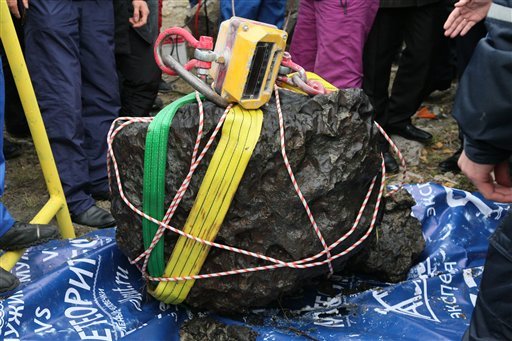
Divers at a Russian lake have pulled out a 5-foot-wide, half-ton hunk of meteorite from the Chelyabinsk meteor that streaked across skies in February. The large black fragment smashed a 6-meter-wide hole into the ice covering Lake Chebarkul. It could potentially be the most massive fragment of the dramatic fireball captured on video across the region, and researchers are calling it a once in a lifetime moment.
“It’s a once-in-a-100-year event. It’s very exciting from that point of view,” said meteoriticist Caroline Smith, who curates the Natural History Museum’s meteorite collection in London and was following the find’s progress. “It’s been of great interest to not only me but my colleagues around the world as well.”
The rock weighed in at 570 kilograms (about 1,257 pounds) but it may be heavier because it broke the scale, Smith noted — and broke into pieces in the process as well.
Even though this is a massive meteorite fragment, it’s a tiny portion of the original missile, a roughly 56-foot-wide space rock that traveled about 40,000 mph and vaporized roughly 15 miles above the surface, resulting in an explosion measured between 300 and 500 kilotons, roughly the same as a modern nuclear bomb, according to a Los Angeles Times report. Fragments rained down from the skies and several such meteorites have been collected since then.
This enormous specimen pulled from the lake may not provide any novel scientific information, Smith said, as it appears to be an ordinary chondrite, the most common meteorite to hit Earth. (This doesn’t necessarily mean that they are from the most common asteroids in the solar system — just that, for some reason, fragments from their particular parent asteroids tend to land on Earth more often.)