
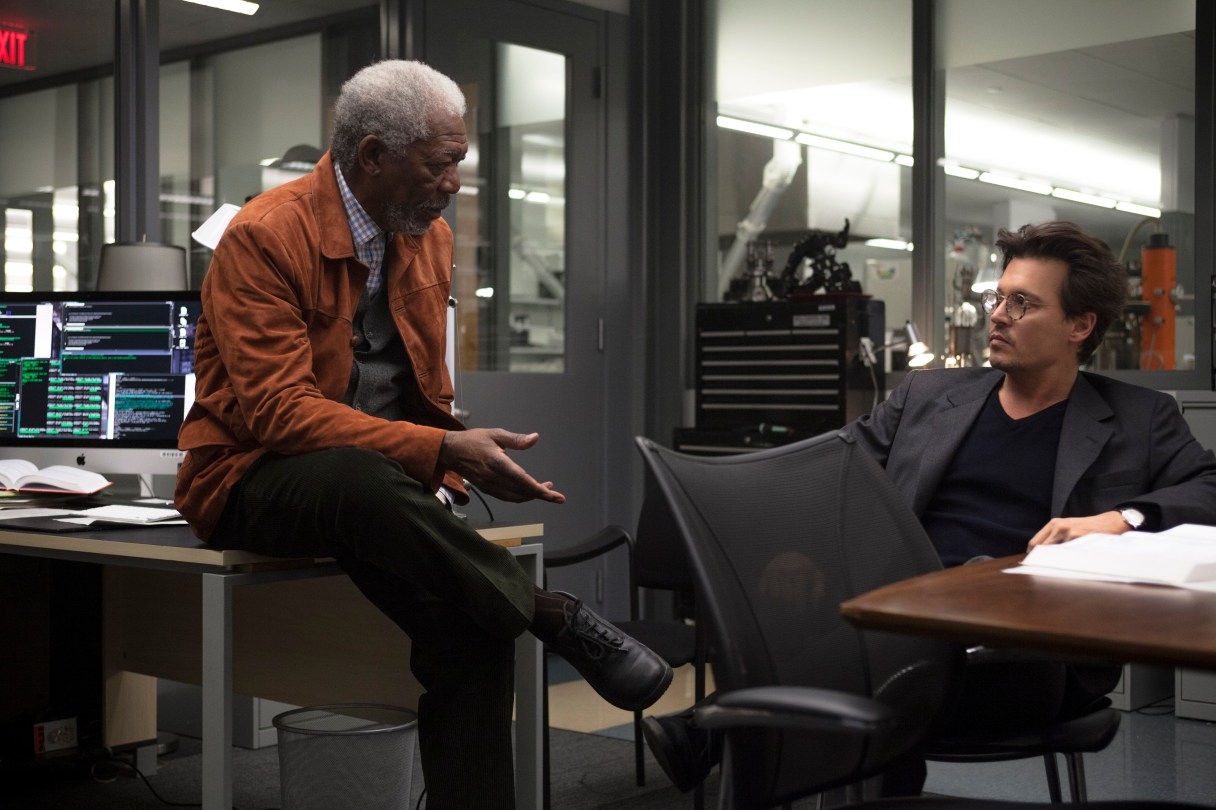
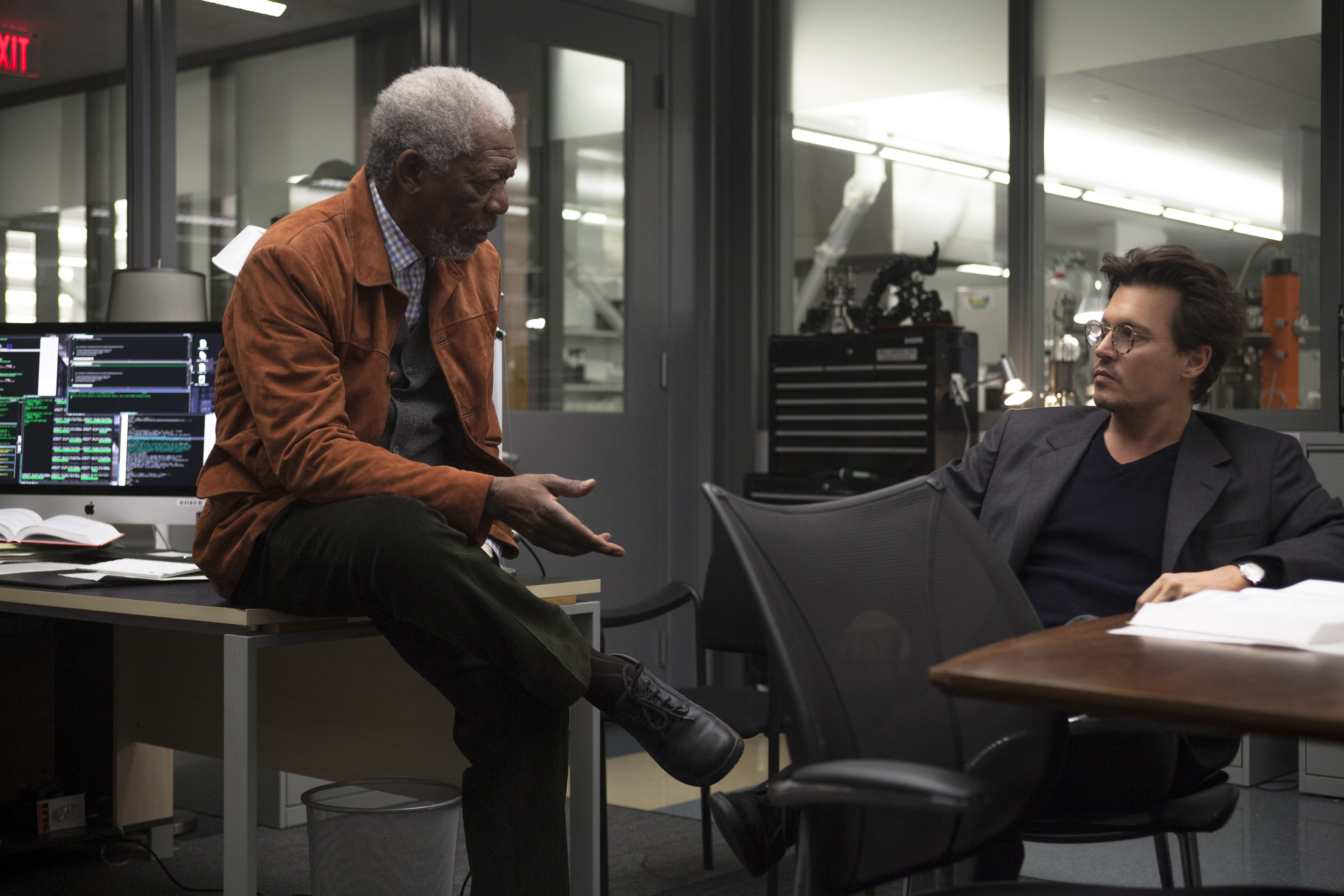
 Morgan Freeman stars as Joseph Tagger and Johnny Depp as Will Caster in “Transcendence.”
By Roger Moore
For years, the rumor about Johnny Depp was that he wouldn’t take a role that required him to get a haircut.
With “Transcendence,” he’s got a part that requires a shaved head in some scenes. And acting. He needs to suggest a brilliant scientist, the first to crack “the singularity,” a very smart man transferring his mind to a machine and thus achieving “Transcendence” – immortality.
He cuts it off, but he doesn’t pull it off.
This thoughtful but windy and winded sci-fi thriller shortchanges the science – understandably – and the thrills. It transcends nothing.
Depp is Dr. Will Caster, a mathematician, computer genius and artificial-intelligence theorist who, with the help of his brilliant wife (Rebecca Hall), is close to a computer that might overcome the limits of biology. It will think.
That troubles his equally brilliant neuro-scientist/ethicist pal, Max (Paul Bettany) who doesn’t give voice to fears of a machine that wants to jump from tic-tac-toe to “Global Thermonuclear War,” SkyNETand HAL not opening the pod bay door. But you know he’s thinking it.
And since this tale is told by Max in flashback, from a desolate, off-the-electrical-grid San Francisco five years in the future, we figure Max knows what he’s talking about.
Terrorists have decided that this project is a threat and try to blow it up and kill Dr. Caster. They almost succeed, sentencing the not-so-mad scientist to a lingering death. That gives his friends the chance to try to skip a few steps in their research. They’ll load the electrical and chemical contents of his brilliant mind – his thoughts, memories, ethics – into a vast machine and save his life.
In a manner of speaking.
Depp and Hall are supposed to have this “Ghost”-level love, a romance of longing that drives her actions to save him, in spite of Will’s warnings to her. They don’t set off sparks.
The script suggests the miracles that bio-tech has in store for us – repairing injuries and infirmities with nano-technology 3-D laser printers and the like. The lame will walk and the blind will see.
But there will be a cost, a cost common to sci-fi stories about “the singularity” and the unlimited power it promises.
Depp is a bland presence as a disembodied face on a computer screen. As Max says, in his narration and elsewhere, this sort of dilemma seems inevitable given the state of our wired-in world. But we learned that from “The Terminator.” The trick is to transcend sci-fi tropes and get into the experience of Will’s existence across the digital divide.
“Transcendence” doesn’t.