
Friday, October 30, 2026Oct 30

This story is free to read.

Scientists make cheap, fast self-assembling robots

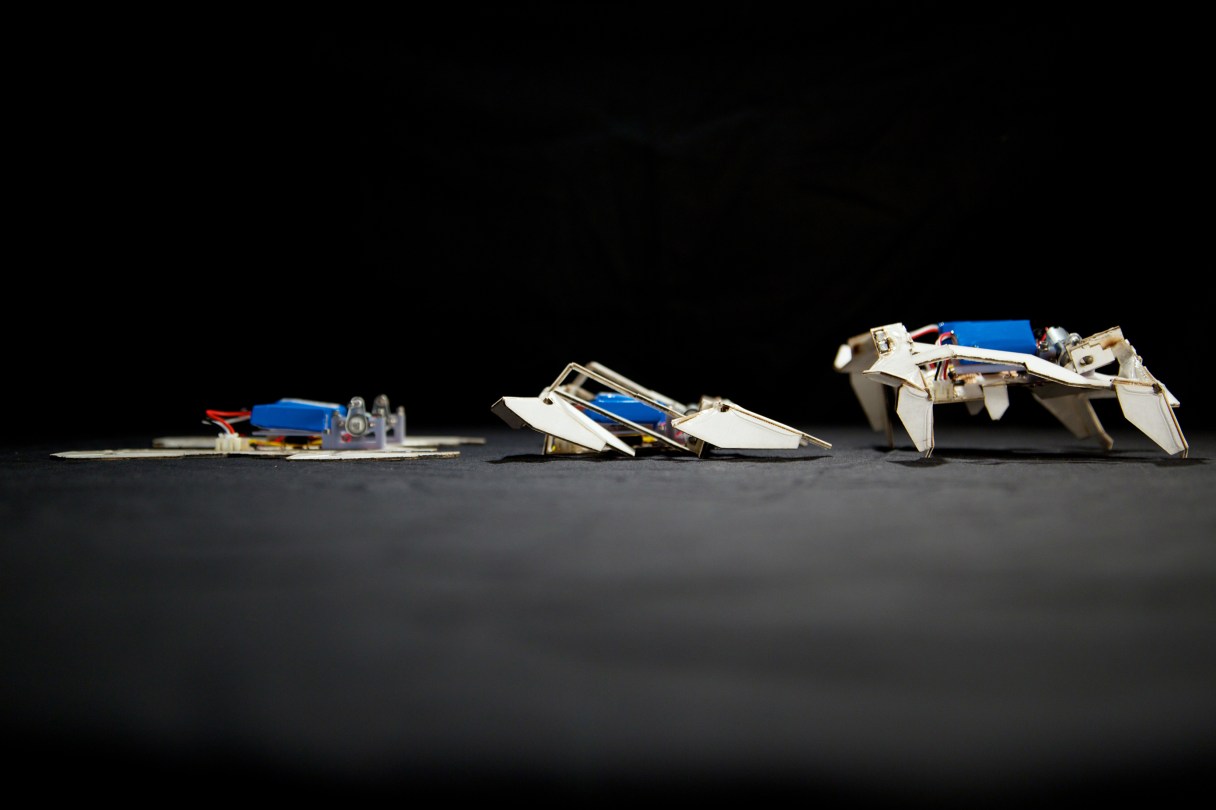
This undated handout image provided by the journal Science shows a self-folding crawling robot in three stages. In what may be the birth of cheap, easy-to-make robots, researchers have created complex machines that transform themselves from little more than a sheet of paper and plastic into walking automatons. Borrowing from the ancient Japanese art of origami, children’s toys and even a touch of the “Transformers” movies, scientists and engineers at Harvard and MIT created self-assembling, paper robots. They are made out of hobby shop materials that cost about $100. After the installation of tiny batteries and motors, the paper robot gets up, folds itself into the proper shape and is ambling across the table in just four minutes. (AP Photo/Seth Kroll, Wyss Institute - Science)
This undated handout image provided by the journal Science shows a self-folding crawling robot in three stages. In what may be the birth of cheap, easy-to-make robots, researchers have created complex machines that transform themselves from little more than a sheet of paper and plastic into walking automatons. Borrowing from the ancient Japanese art of origami, children’s toys and even a touch of the “Transformers” movies, scientists and engineers at Harvard and MIT created self-assembling, paper robots. They are made out of hobby shop materials that cost about $100. After the installation of tiny batteries and motors, the paper robot gets up, folds itself into the proper shape and is ambling across the table in just four minutes. (AP Photo/Seth Kroll, Wyss Institute - Science) This undated handout image provided by the journal Science shows a self-folding crawling robot in three stages. In what may be the birth of cheap, easy-to-make robots, researchers have created complex machines that transform themselves from little more than a sheet of paper and plastic into walking automatons. Borrowing from the ancient Japanese art of origami, children’s toys and even a touch of the “Transformers” movies, scientists and engineers at Harvard and MIT created self-assembling, paper robots. They are made out of hobby shop materials that cost about $100. After the installation of tiny batteries and motors, the paper robot gets up, folds itself into the proper shape and is ambling across the table in just four minutes. (AP Photo/Seth Kroll, Wyss Institute - Science)

WASHINGTON (AP) – In what may be the birth of cheap, easy-to-make robots, researchers have created complex machines that transform themselves from little more than a sheet of paper and plastic into walking automatons.

Borrowing from the ancient Japanese art of origami, children’s toys and even a touch of the “Transformers” movies, scientists and engineers at Harvard and MIT created self-assembling, paper robots. They are made out of hobby shop materials that cost about $100. After the installation of tiny batteries and motors, a paper robot rises on four stumpy legs and starts scooting in a herky-jerky manner. It transforms from flat paper to jitterbugging four-legged robot in just four minutes.

This small lightweight type of robot could explore outer space and other dangerous environments, and get into cramped places for search-and-rescue missions, researchers said. But that’s just the start of what may be a long-envisioned robotic revolution.

This eventually could be as technology-changing as the three-dimensional printer, said experts unconnected with the study and Harvard robotics researcher Sam Felton, who is lead author of the paper published Thursday in the journal Science.

Felton and study co-author Daniela Rus of MIT say they see a time when someone who wants a dog-walking robot would go to a store that has specialized equipment to make the device – “some sort of robo-Kinkos,” Felton said.