
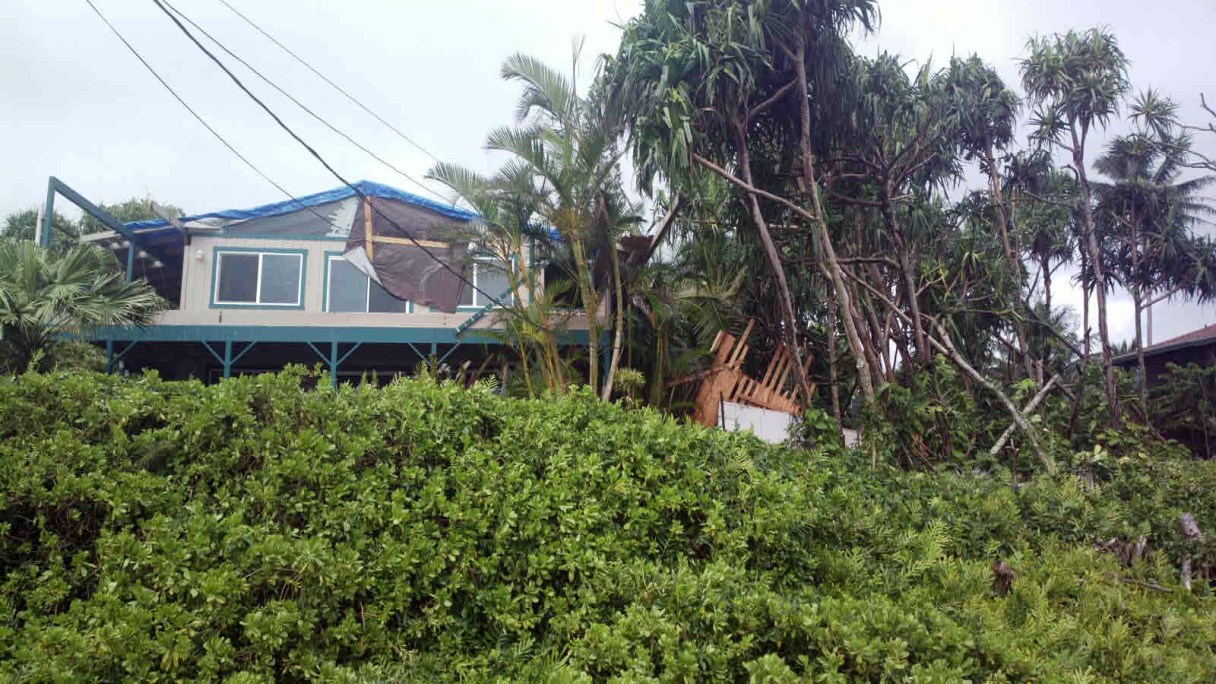
HONOLULU (AP) – His generator whirring at top speed, Gene Lamkin used rain captured from Tropical Storm Iselle to wash his hair as he and thousands of others in a rural swath of the Big Island remained in the dark and unable to traverse roads blocked by toppled trees. It was a far cry from the way tourists are spending their time in popular parts of Hawaii – sunbathing, kayaking and otherwise back to paradise despite an overcast sky.
“It’s like camping right now,” Lamkin said from a cellphone he charged using a generator after his electricity failed Thursday night. “We’re using water from our catchment system to bathe ourselves, shampoo our hair – trying to remain in a civilized manner.”
Lamkin knows life in the isolated, jungle-like Puna region, where unpaved roads of volcanic rock are not maintained by the county, means being prepared for the worst. The region, home to about 40,000 people, has spent a day and a half without electricity as Hurricane Julio lingered hundreds of miles off the coast.
“Those that didn’t prepare are going to be in dire straits,” he said. “We invested in a generator years ago, but this is the first time we’ve had to use it at a full-time capacity. We always have our shelves stocked with food and water.”
The National Weather Service on Saturday night downgraded Hurricane Julio to a Category 1, the lowest level. Julio’s winds have weakened to about 90 mph, said Sam Houston, a forecaster with the weather service in Honolulu. Julio was expected to pass roughly 250 miles northeast of Maui Sunday and linger through the night, the weather service said.