
Wednesday, November 11, 2026Nov 11

Coal gas boom in China holds climate change risks

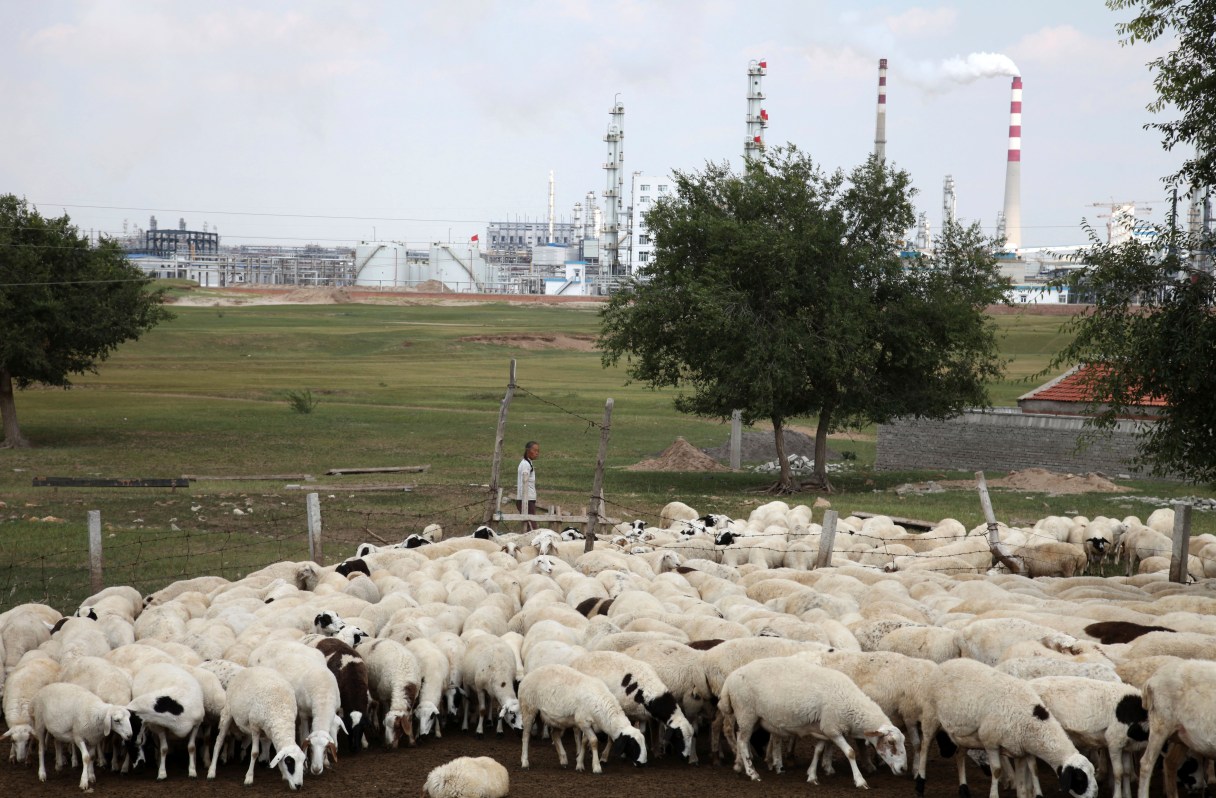
In this Friday, Aug. 8, 2014 photo, a sheep herder looks over sheep near a state-of-the-art power plant that turns millions of tons of coal every year into methane in  northern China's Inner Mongolia province. Deep in the hilly grasslands of remote Inner Mongolia, twin smoke stacks rise more than 200 feet into the sky, their steam and sulfur billowing over herds of sheep and cattle. Both day and night, the rumble of this power plant echoes across the ancient steppe, and its acrid stench travels dozens of miles away. (AP Photo/Jack Chang)
In this Friday, Aug. 8, 2014 photo, a sheep herder looks over sheep near a state-of-the-art power plant that turns millions of tons of coal every year into methane in northern China's Inner Mongolia province. Deep in the hilly grasslands of remote Inner Mongolia, twin smoke stacks rise more than 200 feet into the sky, their steam and sulfur billowing over herds of sheep and cattle. Both day and night, the rumble of this power plant echoes across the ancient steppe, and its acrid stench travels dozens of miles away. (AP Photo/Jack Chang) In this Friday, Aug. 8, 2014 photo, a sheep herder looks over sheep near a state-of-the-art power plant that turns millions of tons of coal every year into methane in northern China's Inner Mongolia province. Deep in the hilly grasslands of remote Inner Mongolia, twin smoke stacks rise more than 200 feet into the sky, their steam and sulfur billowing over herds of sheep and cattle. Both day and night, the rumble of this power plant echoes across the ancient steppe, and its acrid stench travels dozens of miles away. (AP Photo/Jack Chang)

HEXIGTEN, China (AP) – Deep in the hilly grasslands of remote Inner Mongolia, twin smoke stacks rise more than 200 feet into the sky, their steam and sulfur billowing over herds of sheep and cattle. Both day and night, the rumble of this power plant echoes across the ancient steppe, and its acrid stench travels dozens of miles away.

This is the first of more than 60 coal-to-gas plants China wants to build, mostly in remote parts of the country where ethnic minorities have farmed and herded for centuries. Fired up in December, the multibillion-dollar plant bombards millions of tons of coal with water and heat to produce methane, which is piped to Beijing to generate electricity.

It’s part of a controversial energy revolution China hopes will help it churn out desperately needed natural gas and electricity while cleaning up the toxic skies above the country’s eastern cities. However, the plants will also release vast amounts of heat-trapping carbon dioxide, even as the world struggles to curb greenhouse gas emissions and stave off global warming.

If all of the plants start up, the carbon dioxide they’d release would equal three-quarters of all energy-related carbon emissions in the U.S., according to U.S. government data and energy experts from Duke and Stanford universities. That is far more than now produced in China by burning coal, the country’s main source of power.

So far, China is running only two pilot plants to produce methane, which is also known as synthetic natural gas, in the provinces of Inner Mongolia and far western Xinjiang, with another 21 approved. Building all 60 plants would cost an estimated $65 billion.