
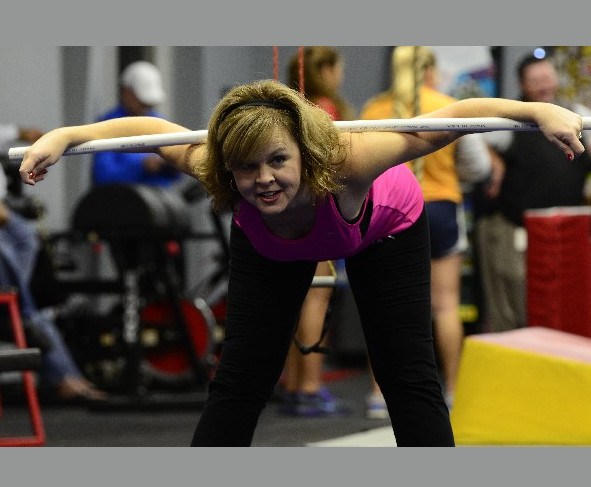
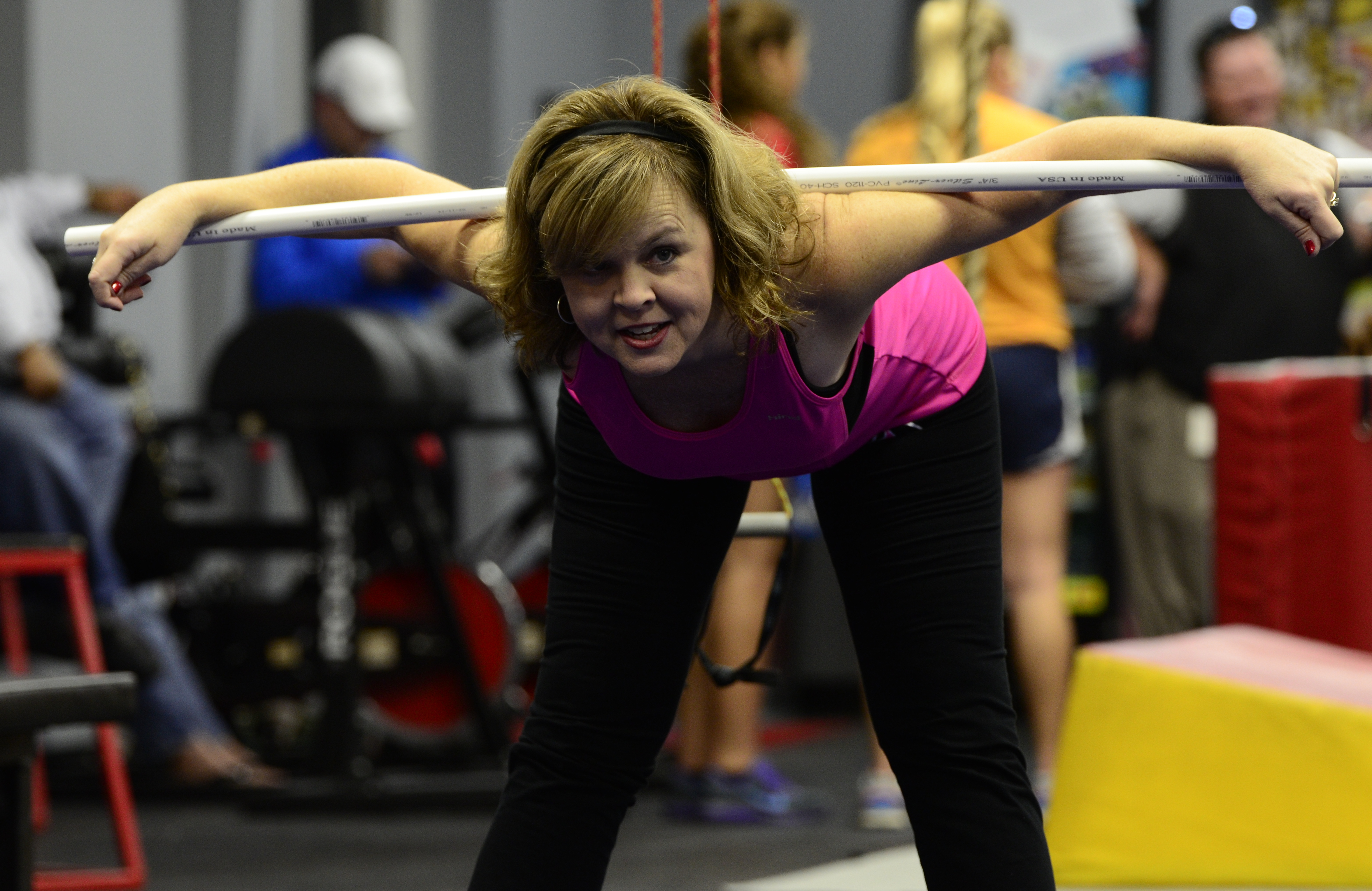
 Trina Whalen, who had a double mastectomy and reconstructive surgery last year, powers through a workout routine at Complete Training in Hixson.
It was a diagnosis she never expected.
Pediatric nurse Trina Whalen was 48 when she was told she had cancer in April 2013 after a routine self-examination revealed a lump in her left breast. With no family history of breast cancer, the news was shocking, she says.
“Though I was overwhelmed, and the diagnosis threw me for a loop, I knew immediately I would opt for a double mastectomy and reconstruction surgery,” says Whalen, of Hixson. “I knew I’d go into surgery with my ‘old’ breasts and come out with new ones. Knowing I would have breasts helped my psyche.”
Whalen knew someone who decades ago had a radical mastectomy — total removal of all tissue and lymph nodes in the breast — a time when reconstructive surgery immediately after a mastectomy was not an option.
By the NumbersIn 2012• 91,655: Total number of breast reconstructions• 46,914: Number of reconstructions in women age 40-54• 30,680: Number of reconstructions in women 55 years and older• 11,086: Number of reconstructions in women age 30-39• 72.3: Percentage of reconstruction patients who are white• 15.1: Percentage of reconstruction patients who are black• 10: Percentage of reconstruction patients who are HispanicSource: American Society of Plastic SurgeonsONLINETo see photos of bilateral circumvertical mastectomies with three-dimensional nipple tattoos, go to refinelooks.com.
“She told me that, when she walked out of the hospital without breasts, she felt and looked like a man. It was devastating to her,” Whalen recalls. “My situation was so different. For me, when I walked out of the hospital, I had breasts and I looked like a woman. I still looked — and felt — like me.”
While losing a breast is still a tremendous blow, mastectomies don’t have to end with the same emotional and psychological devastation of the past. No one is denying that it’s still a major and frightening surgery, but with decades of improvements to both the surgical techniques and the materials used in reconstruction, mastectomies can end on a positive note instead of as a horror story.
“The implants are better today. The techniques are better. We understand more,” says Dr. Mark Brzezienski, a surgeon with Plastic Surgery Group in Chattanooga who performed Whalen’s reconstructive surgery. Brzezienski is director of research at the University of Tennessee College of Medicine Department of Plastic Surgery.
“It has definitely improved over the years,” says Tonya Gentry, executive director of Breast Cancer Support Services in Chattanooga. “They are constantly learning new and better ways to hide or camouflage the scars when performing mastectomies.”
For Whalen, implants returned her breasts back to their original size and tattoos that look like nipples completed the uncannily realistic appearance of her new breasts. One-and-a-half years after the surgery, the scars, one located on the underside of each breast and running straight down from the nipple, have almost completely faded, she says.
“It’s amazing. Of course, I’d rather have my old breasts, but I’m happy with the new ones,” she says. “I can wear a bathing suit, and, if I wanted to, I could wear a low-cut dress, and you’d never know I had surgery.”
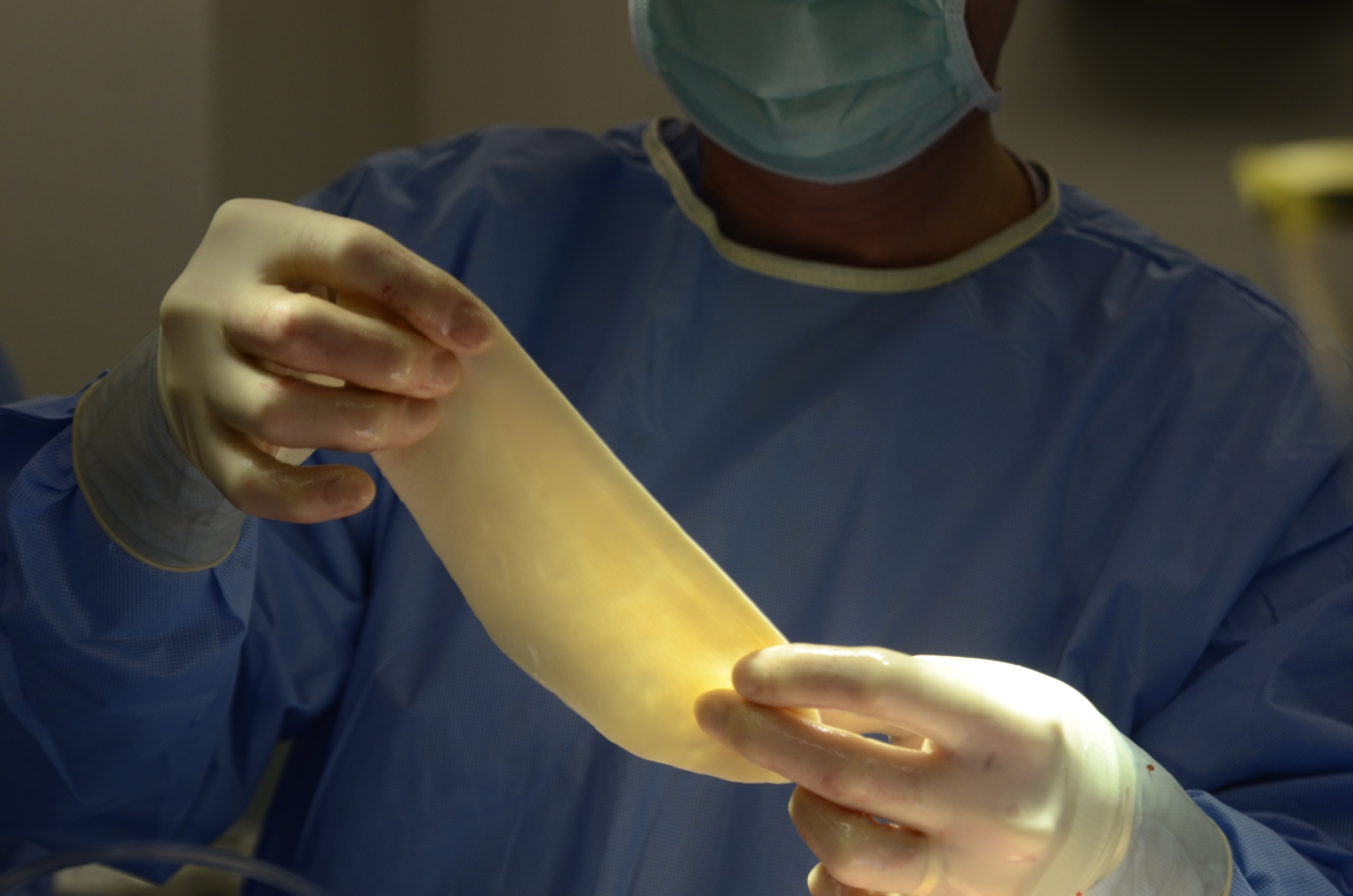 Dr. Mark Brzezienski holds a strip of cadaver skin while performing reconstructive breast surgery at Erlanger.
She says she recently showed her breasts to two friends who were diagnosed with breast cancer.
“I just don’t think many women know about how good reconstruction surgery is today,” she says. “So by showing them my breasts, it’s like paying it forward.”
Brzezienski, who helped perfect the procedure used on Whalen — known as a bilateral or unilateral circumvertical mastectomy incision — co-wrote a clinical paper on the surgery. It was published last June in the “Annals of Plastic Surgery.”
The single incision in the breast reconstruction procedure is comparable to those used in cosmetic surgery to enlarge and/or lift the breast, he says. In many cases, the plastic surgeon can begin the reconstruction immediately after the oncologic surgeon has performed the mastectomy, he says. The reconstructive procedure usually takes about 45 minutes to an hour.
“We keep tricking it up and tricking it up, and the other things that are making it great are the types of implants that we have now,” Brzezienski says. “We use them and take fat from the abdomen to touch up areas that have minor contour abnormalities.”
Surgery
On a recent weekday, Brzezienski and his team — including another physician, several nurses and technicians — begin the reconstruction process on a woman who has just had a double mastectomy. The skin of her chest is pulled back by forceps, creating two open, circular holes that expose the muscle beneath.
On each side of the chest, Brzezienski takes a rectangular piece of cadaver skin and sews it directly to the pectoral (chest) muscle, stitching it on all sides. Implants filled with about 100 milliliters of saline solution are then sewn to the cadaver skin and also to the serratus anterior muscles, which run down each side of the torso under the arms. According to Brzezienski, this prevents the implant from sliding to the outside and provides a natural curvature to the breast.
To finish, the exterior skin is released from the forceps and sewn up in a single vertical line on each breast. Patients are typically released from the hospital the next day.
During routine follow-ups to the doctor, saline-filled needles will be inserted into the implant to expand it to the desired volume. After healing, which varies from patient to patient, the patient is ready for the nipples to be created and tattooed.
Brzezienski, a member of every regionally and nationally recognized plastic surgery academic society, says he is constantly researching “outcome analysis” on reconstruction surgeries. He reads numerous medical journals about the subject and attends medical conferences.
“There’s an international breast cancer conference in Atlanta every January,” he says. “It’s great for our area because the greatest breast experts in the world attend the conference, so the proximity to those people and to our own training in Chattanooga is amazing.”
Whalen credits Brzezienski’s work as “a big part in helping me recover.”
“And though the cancer was just in one breast, I’ll never regret having both breasts removed,” she says. “I knew it was the best thing for me. It made me feel good knowing I was going to look normal.”
Surgical changes
The classic “Stewart incision,” initiated by Dr. Frances Stewart in 1915, is the familiar long and horizontal incision left after a radical mastectomy. In an attempt to get all cancer cells present in the breast, the incision was akin to a “sabre slash” across the chest, Brzezienski says. Some surgeons continue to use the procedure today.
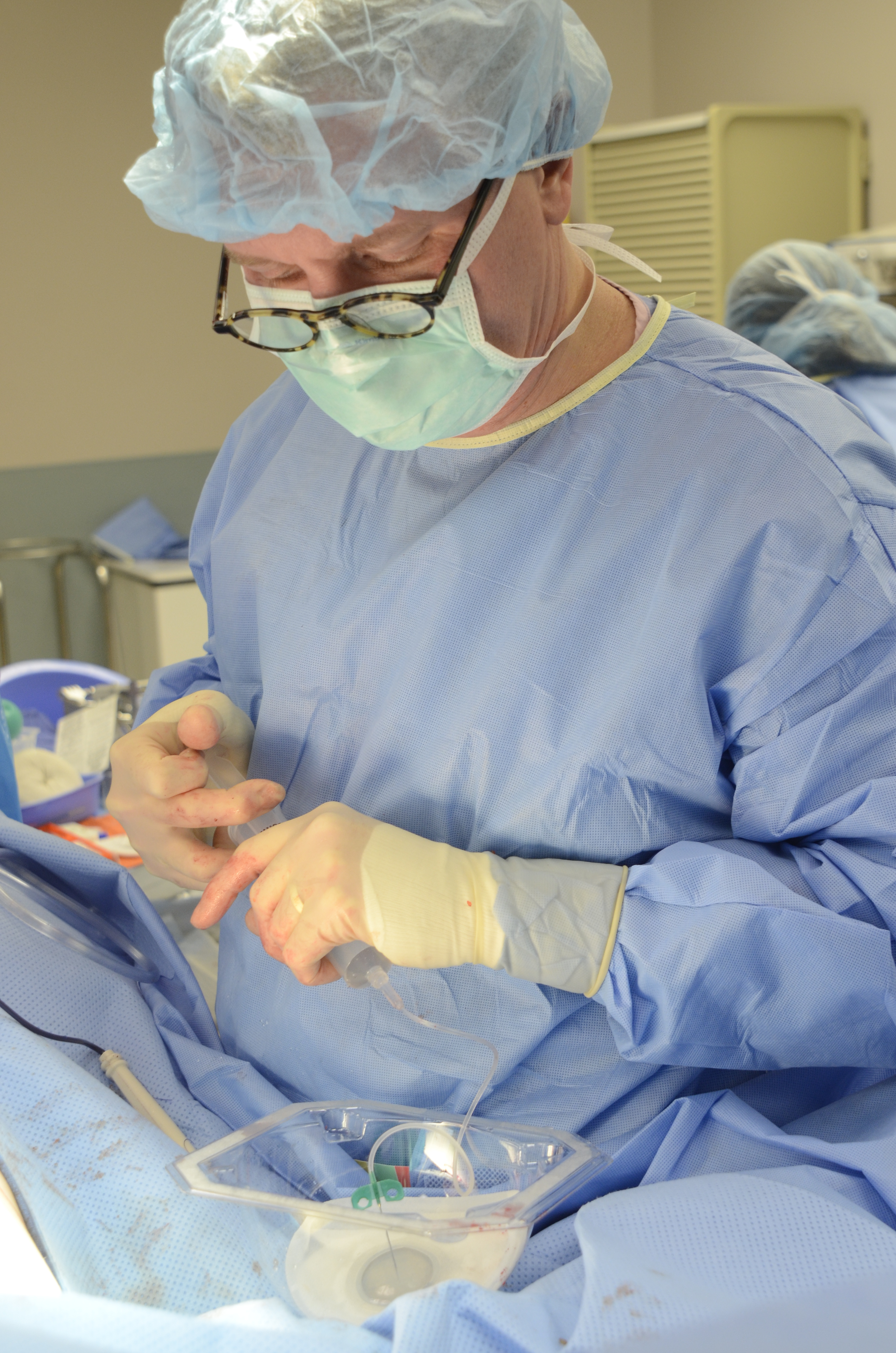 Dr. Mark Brzezienski uses antibiotic saline solution to wash an implant during reconstructive breast surgery at Erlanger.
“It could save your life, but it was mutilating,” Brzezienski says.
In the years after Stewart created his technique, other less-invasive procedures for breast cancer treatment came along, including lumpectomy, which removes only the section containing cancer instead of the entire breast, to radiation.
“Radiation does have a toll to pay, with stiffness, shrinkage, pain and possible changes in one’s ability to heal,” Brzezienski says. “This is what brought me to the circumvertical mastectomy and the notion that mastectomy reconstruction should be considered a cosmetic surgical intervention and afforded all the effort and innovation necessary to produce a predictably high-end aesthetic result.”
Most women are candidates for the same surgery performed on Whalen. The procedure leaves one small scar located just below the nipple so the woman cannot see the scar when looking down at her breasts, he says.
After the surgery, many women also choose tattooed nipples in which, several weeks or months after the surgery, a highly-trained tattoo artist will ink a three-dimensional nipple onto the breast. While the idea of a tattooed nipple may seem odd, the final look is very realistic, he says.
Whalen says that, when she looks down at her breast or in the mirror, the nipple looks “real.”
Reconstruction surgery following a mastectomy can be performed on women of all ages, Brzezienski says, and the surgery can be done to women who’ve already had a mastectomy, even years ago.
“Most of my practice is breast reconstruction, and I have re-reconstructed women who had the surgery 25 years ago,” Brzezienski says. “Every woman who is going to have a mastectomy is a candidate to visit a plastic surgeon.”
And, even though the procedure has improved immensely in the last 20 years, it’s continuously being re-examined, he says, including ways to deal with the psychological components of a mastectomy and reconstructive surgery.
“We constantly reflect on how to make it better and how to make patients more comfortable,” he says. “We want to demystify the process because people don’t know what to expect before they go to the hospital and what to do when they get out. We want our post-operative instructions to be as simple as possible.”
Contact Karen Nazor Hill at khill@timesfreepress.com or 423-757-6396.