
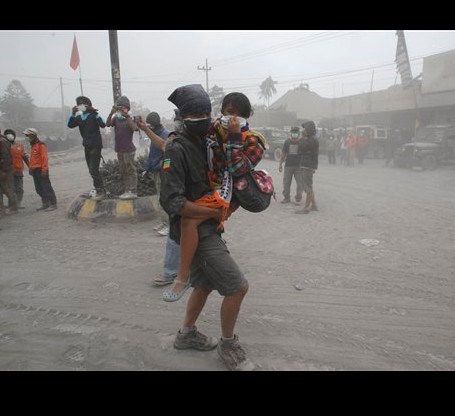
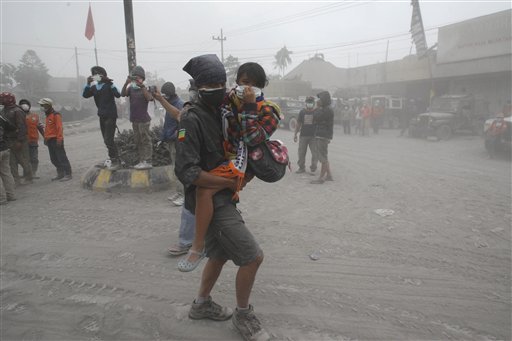
 A rescuer carries a child to a truck for evacuation following an eruption of Mount Kelud, in Malang, East Java, Indonesia, Saturday, Feb. 15, 2014.
SIDOMULYO, Indonesia – The ash and debris that Indonesia’s Mount Kelud blasted from its belly brought death and misery, and disrupted international air traffic. But for many of the millions of people cleaning up Saturday in the wake of the explosive eruption, it was also a money earner and a shot of life for their crops.
“This is a blessing of the disaster,” said Imam Choiri, a 55-year-old farmer who was scraping up the ash from the road to use as fertilizer on his small vegetable plot a few kilometers from the crater of the mountain, which was rumbling and smoking in the background. Choiri said locals believe the ash helps drive away pests from crops.
The eruption of the 1,731-meter (5,680-foot) -high mountain on Java island late Thursday was one of the most dramatic to hit Indonesia in recent years, with ash falling as far as 600 kilometers (370 miles) away.
Four people, including a 97-year-old woman, were killed when the roofs of their homes caved in under the weight of ash. More than 100,000 people were evacuated to temporary shelters.
On Saturday, scientists said Kelud’s activities were dying down, in line with its reputation as a mountain that blows its top dramatically but then quickly settles down for another 10 years or so. But authorities warned that water from its crater, along with rain, could bring deadly landslides of fresh ash and rocks down river beds into villages and valleys.