
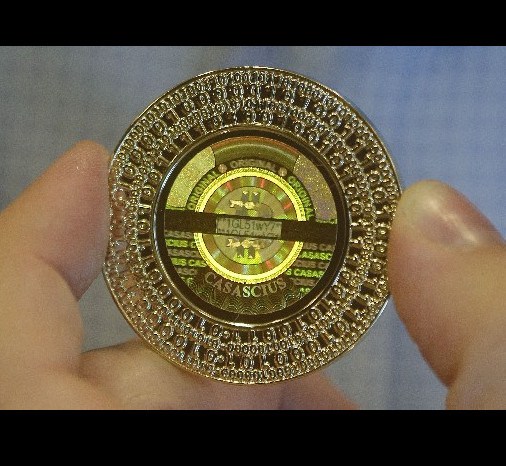
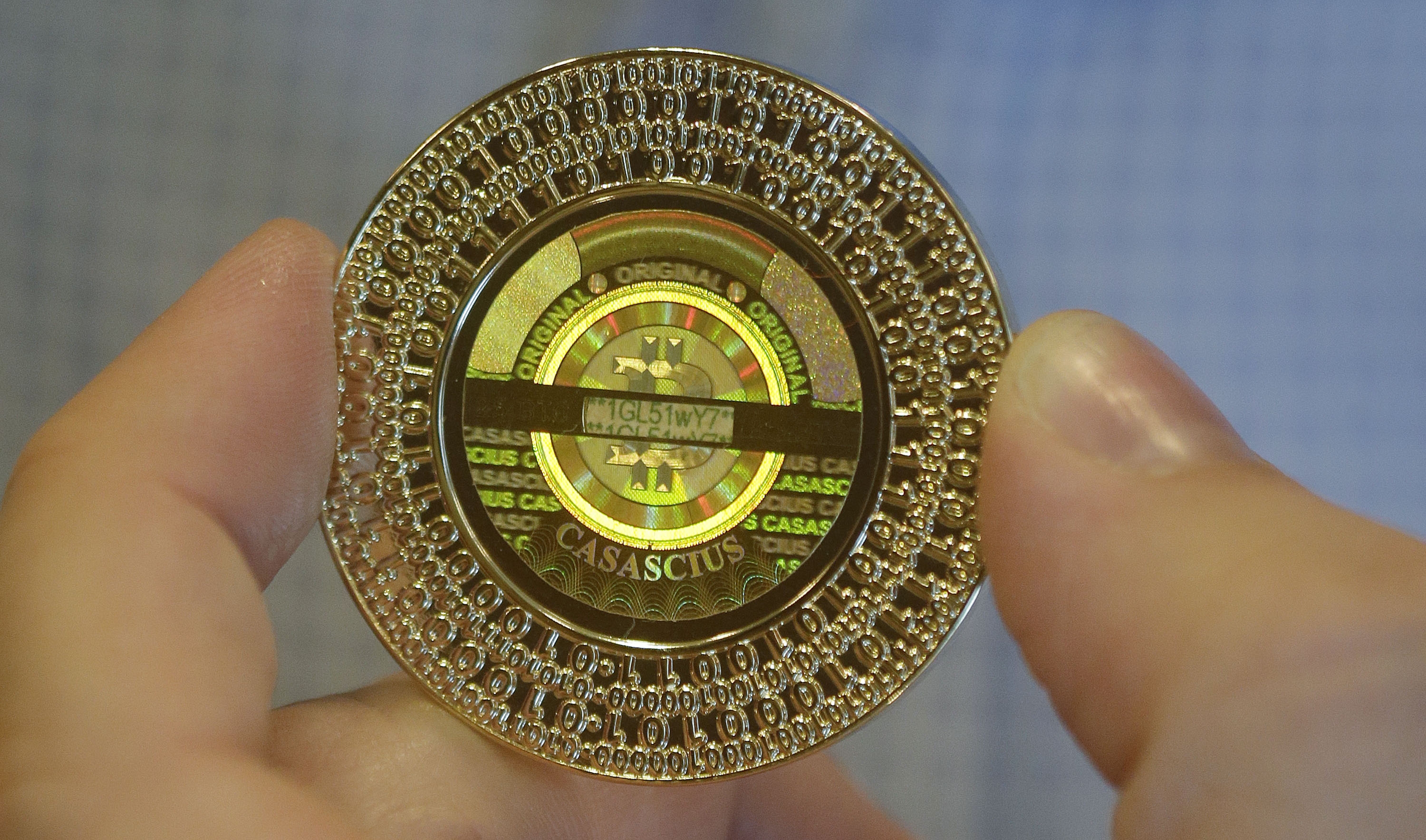
 Mike Caldwell, a 35-year-old software engineer, holds a 25 Bitcoin token at his shop in Sandy, Utah. Caldwell mints physical versions of bitcoins, cranking out homemade tokens with codes protected by tamper-proof holographic seals, a retro-futuristic kind of prepaid cash.
WHAT YOU CAN BUY WITH BITCOINAs an emerging form of wealth exchange, bitcoin is still building a community of businesses that accept it for transactions. However, it already is usable for a variety of purchases:[Note: Prices as of Feb. 12, 2014.]• A year’s daily subscription to the Chattanooga Times Free Press. (about 0.496 bitcoins).• A Canon EOS 7D Digital SLR Camera and lens bundle from TigerDirect.com. (about 2.537 bitcoins.)• A foot-long sandwich from the Subway franchise in Allentown, Penn. (about 0.007 bitcoins.)• A Pow Skate Snowboard from Zoo York. (about 1.000 bitcoins.)• A tub of The Big Wigg moustache wax from Motown Moustache Wax. (about 0.038 bitcoins.)• An R1 3D Printer from Robo 3D Printers. (about 1.045 bitcoins.)• A case of six bottles of pinot noir from Pyramid Valley Vineyards. (about 0.149 bitcoins.)• A SuperNova Tooth Whitening Kit from NovaWhite on Broad Street. (about 0.245 bitcoins.)• A 65-inch LG 3D LED TV from Overstock.com. (about 8.955 bitcoins.)
HOW IT WORKSTo those accustomed to traditional currency, a worldwide, non-government-backed, online alternative like bitcoin may seem baffling. Here’s a guide to how it works:• Bitcoin is an online payment network whose transactions are dealt in an unregulated, all-digital currency. It was created by an anonymous programmer or group of programmers operating under the pseudonym Satoshi Nakamoto, who released the software and an initial crop of bitcoins to the Internet in January 2009.• New bitcoins are generated by “mining,” a process in which software installed on users’ computers helps to record and verify recent bitcoin transactions and add them to an official ledger known as a “block chain.” Miners occasionally receive new coins as a reward for this contribution to the bitcoin economy.• Bitcoins can be exchanged for real-world currency – and vice versa – via online sites such as MtGox.com or 24Change.com as well as through local, in-person exchanges set up via services such as LocalBitcoins.com.• The value of bitcoins is determined by supply and demand. Compared to traditional currencies, a limited number of bitcoins are in circulation, which has helped to drive prices up dramatically in the last year as more people become aware of it.• New bitcoins are generated (or “discovered”) at a fixed rate – currently 25 new coins every 10 minutes, on average – which decreases as more miners join the network. The rate halves over time and will cease entirely once 21 million have been created, at which point miners will continue to earn money through small transaction fees. At this point, about 12.5 million bitcoins are in circulation, and reaching 21 million is estimated to take about 100 years.• Bitcoin users store their coins in digital “wallets,” software that can be located on a user’s computer, mobile device or on a website. The wallets can be “hot” (Internet-connected) or “cold” (offline). The appeal of the latter is to prevent another user from hacking into the wallet.• Each bitcoin account is assigned a unique online address, and transactions are peer-to-peer exchanges in which a user sends coins from one address to another. Each user authorizes the transaction using a privacy cryptographic key that is unique to them.• Users who worry about the safety of storing their bitcoins digitally can print an access key and online address on a piece of paper (also known as a “paper wallet”) or purchase physical bitcoins engraved with a private key.
Economic alchemy is the only way to describe it.
In January 2009, an anonymous programmer or group of programmers operating under the name Satoshi Nakamoto created bitcoin, the world’s first digital “cryptocurrency.” Having sprung, Athena-like, from the digital ether, bitcoins exist solely online but increasingly have become an accepted form of payment among retailers, both online and off.
As an unregulated currency, bitcoin’s value is determined not by a bank but by the growing body of people who have put their faith – and real-world dollars – into it. Last year, rampant demand drove the price of a bitcoin from the tin basement of $13 in January to a golden height of $1,242 on Nov. 29.