
FLAGSTAFF, Ariz. (AP) – In the mid-1950s, air travel was a shadow of the highly advanced operation of checks and rules seen today. The skies were largely uncontrolled, and pilots outside major U.S. cities relied on sight to avoid catastrophes.
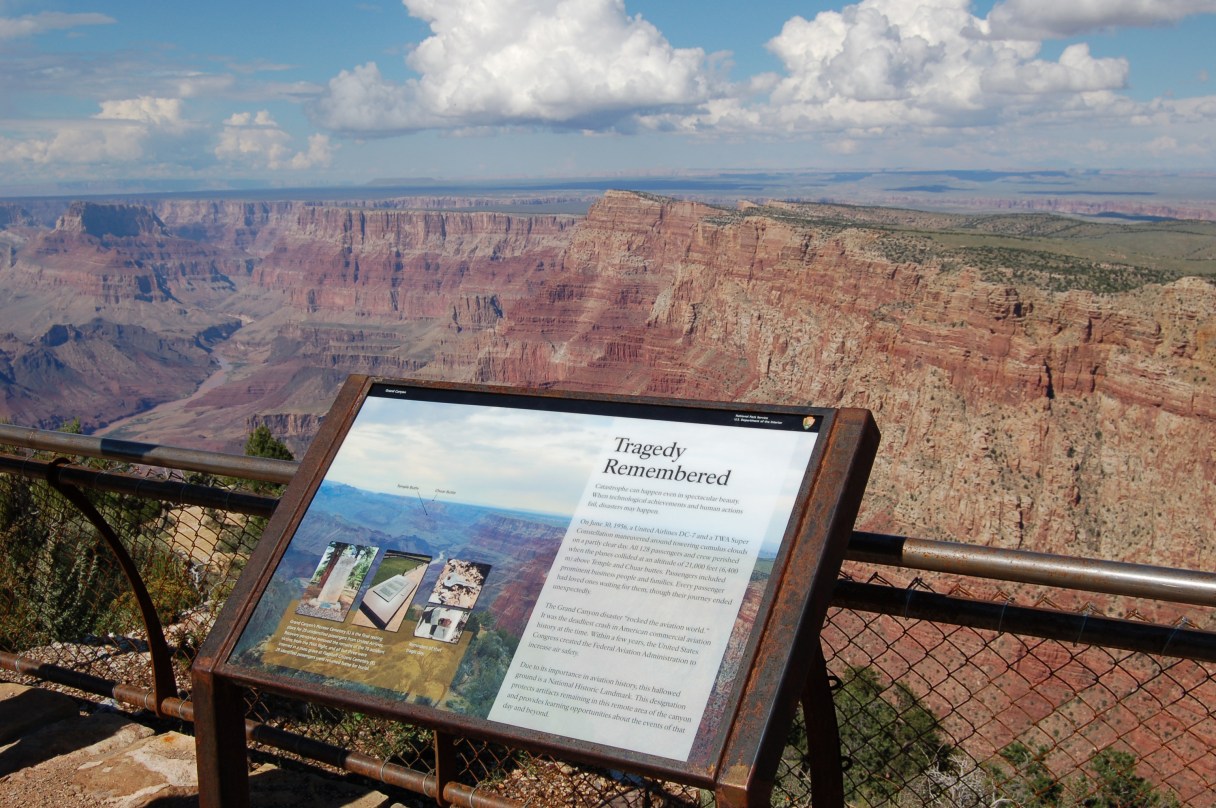
Then, two commercial airplanes crashed over the Grand Canyon in June 1956, killing all 128 people aboard in the deadliest aviation disaster of the time and helping spur an overhaul to flight safety. A country already grappling with increasingly busy skies pressured Congress for major changes to improve air traffic control and radar systems and to create a federal agency to regulate it.
“It really did underscore for the general public, for the first time, that much of the air space in America was uncontrolled at that time,” said Peter Goelz, former managing director for the National Transportation Safety Board. “Once you got up to 20,000 feet and beyond the terminal radars, it was see and be seen.”
Grand Canyon National Park will mark the designation of the crash site Tuesday as a National Historic Landmark in a ceremony overlooking the gorge on the east end where the wreckage was scattered over 1.5 square miles. Some of the victim’s remains never were identified, and most of those that were have been buried together in mass at cemeteries at the Grand Canyon and the northern Arizona city of Flagstaff.
The United Airlines Douglas DC-7 and a TWA Lockheed Super Constellation both left California on June 30, 1956, eventually cruising at the same altitude – 21,000 feet – after the TWA pilot requested to fly above the clouds. Shortly before 10 a.m., both pilots reported to different communications stations that they would be crossing over the canyon at the same position at 10:31 a.m.