
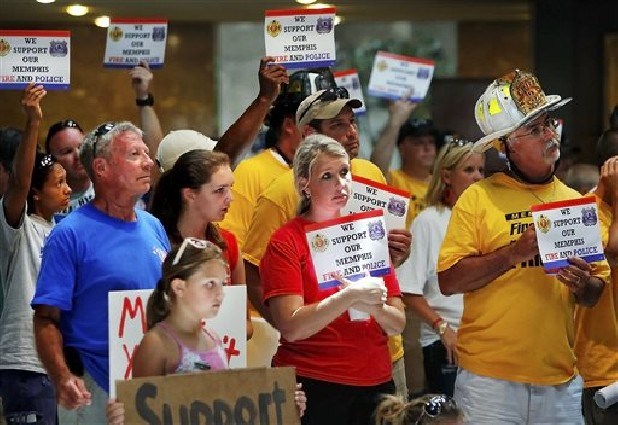
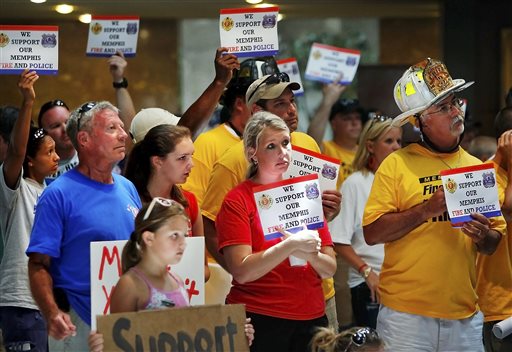
 Retired and active Memphis firefighters, off-duty police officers and their families gather in the Hall of Mayors, where Mayor A.C. Wharton was speaking in Memphis on Tuesday, July 8, 2014.
MEMPHIS – Faced with major changes to their health insurance benefits, more than 500 Memphis police officers called in sick Wednesday for the second consecutive day to protest cuts aimed at helping buttress the city’s troubled pension program in a showdown that reflects wider struggles in cash-strapped urban centers across the country.
Cuts approved by the City Council have led to protests from city workers, including police and fire staff, who say they cannot afford the changes and feel betrayed by a city they have served and protected. City leaders say public safety has not been compromised due to the so-called “Blue Flu.” Still, the state has offered to dispatch Tennessee Highway Patrol troopers if needed.
Memphis is not alone in dealing with consequences of decisions made by city governments facing financial problems such as pension shortfalls and high debt that could lead to bankruptcy. Detroit became the largest municipal bankruptcy in U.S. history last year due to massive debt and a crippling unfunded pension liability.
Meanwhile, police and fire unions in Baltimore are fighting a plan to replace traditional pensions for new officers with a hybrid plan that combines a pension with a 401(k)-like account. In Central Falls, Rhode Island, some public retiree pensions were cut by more than 50 percent when that city went into bankruptcy. Chicago Mayor Rahm Emanuel cited problems with Illinois’ teacher pension system when 2,100 school workers – including more than 1,000 teachers – were laid off last year.
And in Mississippi, government agencies and their employees have been forced to pay out more toward the Public Employees Retirement System, whose funding gap soared to $15 billion.