
Saturday, November 14, 2026Nov 14

Foster children become focus of California schools

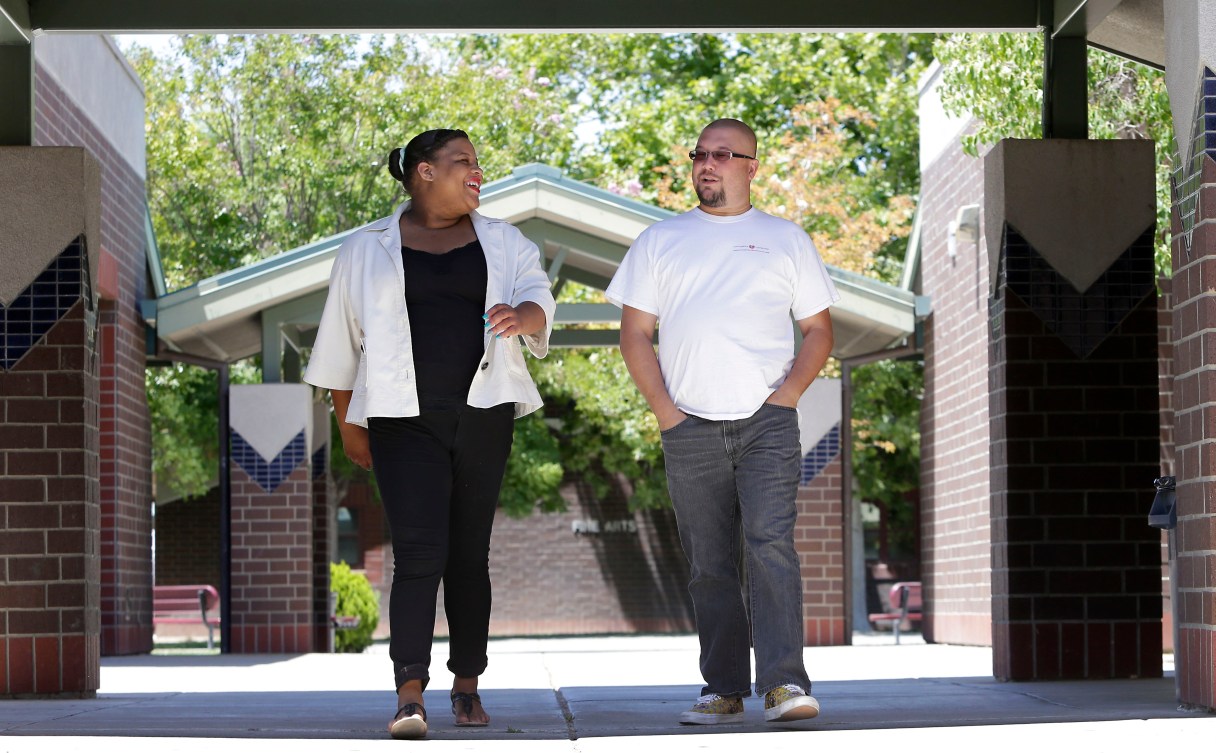
In this photo taken Friday, July 11, 2014, Elk Grove Unified School District teacher Michael Jones and his former student Kandance Stagner, a foster child, walk around Laguna Creek High School, where Stagner recently graduated from, in Elk Grove, Calif.  California, home to nearly one-fifth of the nation’s children living in foster care, is embarking on a first-of-its-kind attempt to improve the academic lives of foster youth by giving schools more money to meet their special learning and emotional needs and holding educators and administrators responsible for producing results. As part of a new school funding formula the state will direct billions of extra dollars to districts based on how many students they have with low family incomes, learning to speak English or in foster care.  Six years ago,  Jones, who as a high school science teacher, founded a weekly class where students in foster care could gather to discuss their shared struggles, has doubts about the proposed program saying  “I’ve yet to see a (formula) that says we are going to fund people to care.” Stagner, 18, who has been in seven foster care settings since she was taken away from her mother in second grade, is preparing to attend college in Nebraska, something she attributes directly to Jones’ unwavering support and nurturing family environment he created in his classroom. (AP Photo/Rich Pedroncelli)
In this photo taken Friday, July 11, 2014, Elk Grove Unified School District teacher Michael Jones and his former student Kandance Stagner, a foster child, walk around Laguna Creek High School, where Stagner recently graduated from, in Elk Grove, Calif. California, home to nearly one-fifth of the nation’s children living in foster care, is embarking on a first-of-its-kind attempt to improve the academic lives of foster youth by giving schools more money to meet their special learning and emotional needs and holding educators and administrators responsible for producing results. As part of a new school funding formula the state will direct billions of extra dollars to districts based on how many students they have with low family incomes, learning to speak English or in foster care. Six years ago, Jones, who as a high school science teacher, founded a weekly class where students in foster care could gather to discuss their shared struggles, has doubts about the proposed program saying “I’ve yet to see a (formula) that says we are going to fund people to care.” Stagner, 18, who has been in seven foster care settings since she was taken away from her mother in second grade, is preparing to attend college in Nebraska, something she attributes directly to Jones’ unwavering support and nurturing family environment he created in his classroom. (AP Photo/Rich Pedroncelli)

SAN FRANCISCO (AP) – California is embarking on a first-of-its-kind attempt to improve the academic lives of foster youth by giving schools more money to meet their special learning and emotional needs and holding educators and administrators accountable.

But first, officials have to figure out how many school-age foster children they have and where they are enrolled in a state that’s home to nearly one-fifth of the nation’s foster children.

Until now, no state has attempted to identify every foster child in its public schools or to systematically track their progress, much less funnel funds toward those students or require school districts to show they are spending the money effectively.

That changed in California this month as part of a new school funding formula that will direct billions of extra dollars to districts based on how many students they have with low family incomes, learning to speak English or in foster care.

The state’s 1,043 school systems had to submit plans by July 1 for how they intend to use the funds, a pot projected to reach at least $9.3 billion by 2021, to increase or improve services for those specific student groups.