
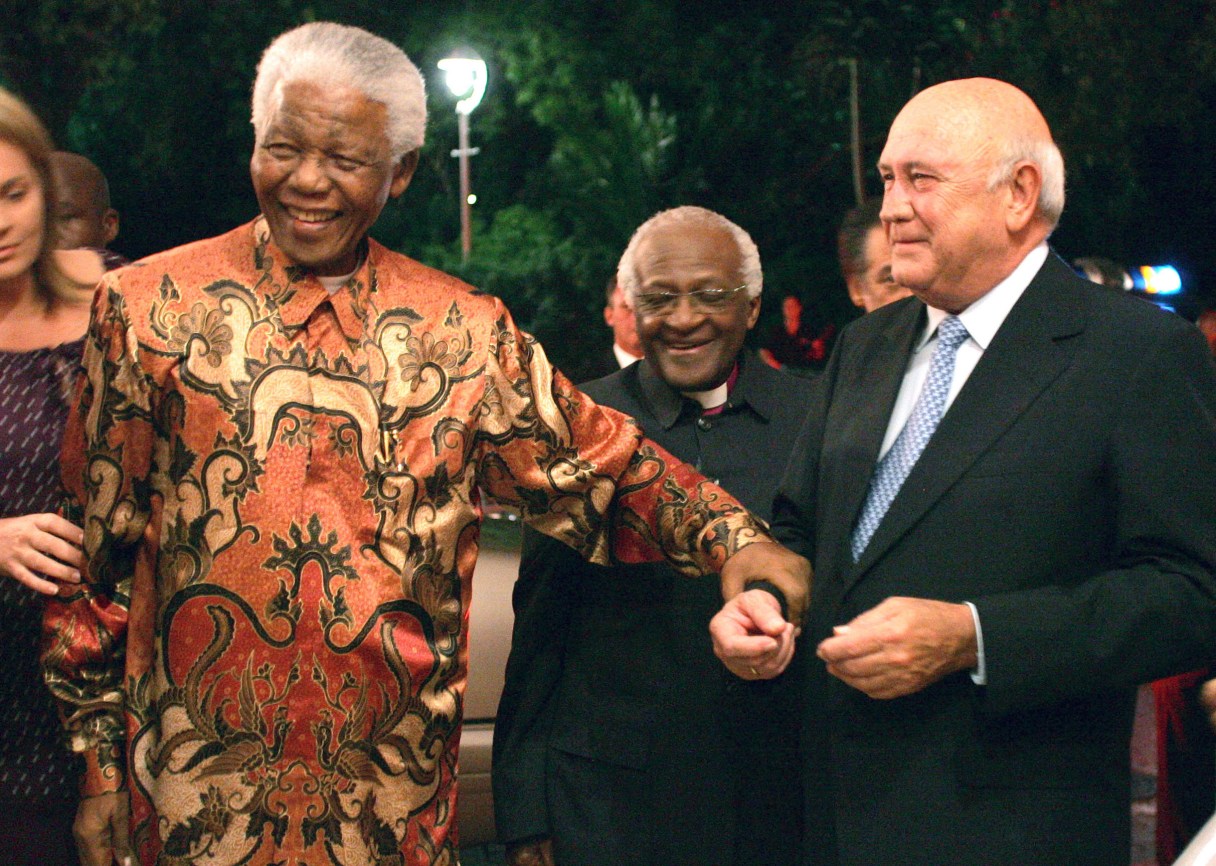
JOHANNESBURG (AP) – He was South Africa’s last white president, overshadowed by Nelson Mandela when they plotted the historic transition to a multi-racial democracy for which both men won the Nobel Peace Prize in 1993. Today, F.W. de Klerk is a distant figure for many South Africans who see his legacy as mixed.
A new documentary focuses on the man who teamed with Mandela, the anti-apartheid leader who spent 27 years in prison before replacing de Klerk as president, to end white minority rule and defuse fears of racial war. Despite this achievement, de Klerk’s record is clouded by accusations that he bears at least moral responsibility for torture and killings blamed on the white-led government before it gave up power.
“He’s this guy who got this most prestigious prize and he’s not really even known, not really talked about in South Africa. Or if he is, it’s not always in good terms,” said Nicolas Rossier, the American director of “The Other Man: F.W. de Klerk and the End of Apartheid in South Africa.”
Rossier’s 75-minute film premiers Saturday at the Durban International Film Festival in South Africa. Even then, the monumental figure of Mandela, who died in December at the age of 95, will be in the spotlight. Another film, “Nelson Mandela: The Myth and Me,” will be screened Friday, Mandela’s birthday and an occasion for South Africans to honor him with charitable acts.
De Klerk, who was applauded by the crowd at Mandela’s memorial service in a Johannesburg stadium, is often praised for his role in a spectacular turnaround in his country’s fortunes but criticized for what some victims of apartheid saw as a failure to take full responsibility for his government’s wrongdoing. Did he apologize enough? Was he forced to act by events beyond his control, or was he a pioneer guiding the sweep of history?