
Friday, November 13, 2026Nov 13

Virus drugmaker fights pediatricians’ new advice

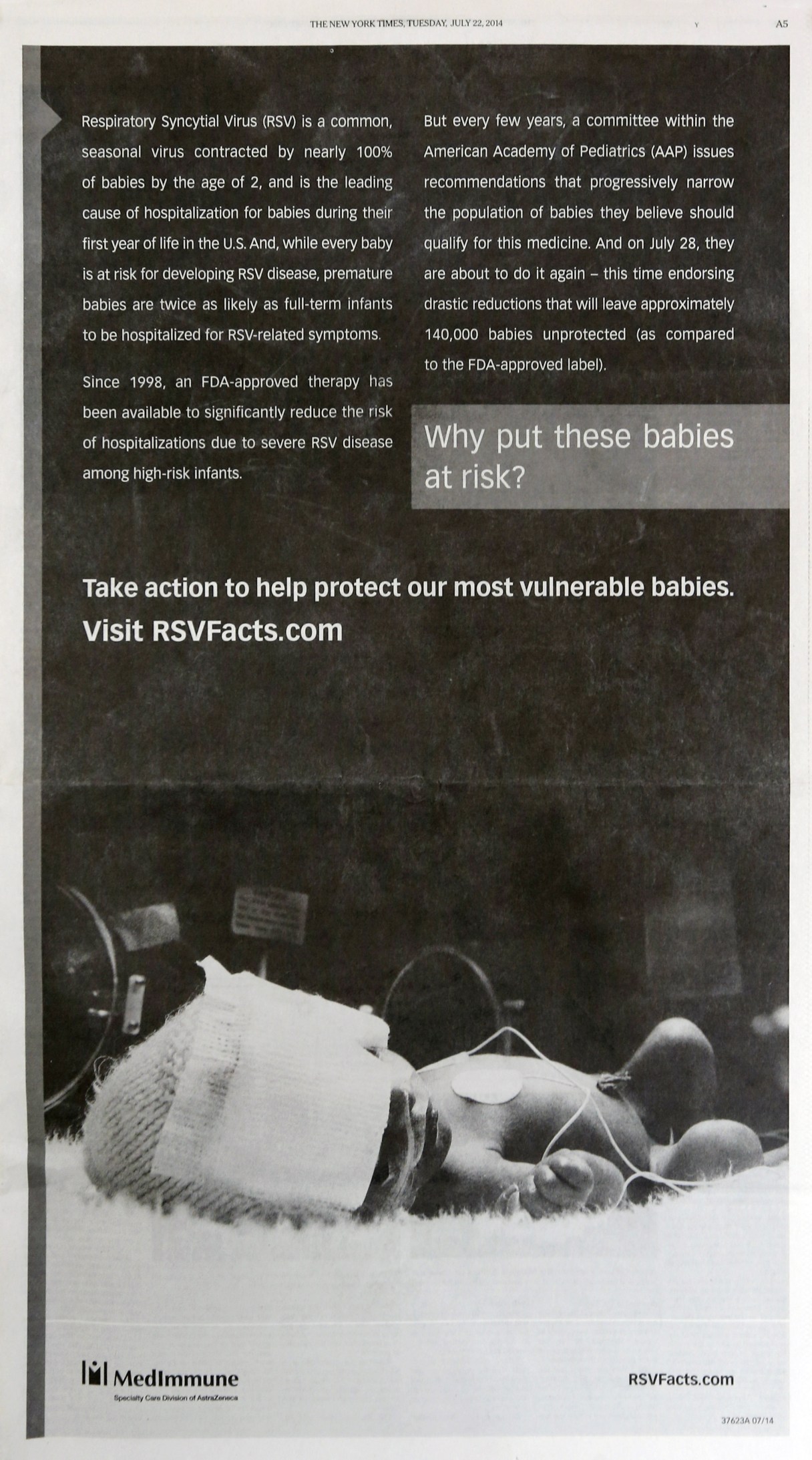
This photo shows a full-page ad by MedImmune that was published Tuesday, July 22, 2014, in the New York Times. MedImmune, a division of AstraZeneca, ran full-page ads in the New York Times and other newspapers in recent weeks protesting pediatricians’ new recommended limits on Synagis, a drug for preventing serious lung problems in premature infants caused by a common but usually mild virus. A new policy from the American Academy of Pediatrics says the costly drug has limited benefits and recommends scaling back its use. The policy was published online Monday, July 21, 2014, in Pediatrics. (AP Photo)
This photo shows a full-page ad by MedImmune that was published Tuesday, July 22, 2014, in the New York Times. MedImmune, a division of AstraZeneca, ran full-page ads in the New York Times and other newspapers in recent weeks protesting pediatricians’ new recommended limits on Synagis, a drug for preventing serious lung problems in premature infants caused by a common but usually mild virus. A new policy from the American Academy of Pediatrics says the costly drug has limited benefits and recommends scaling back its use. The policy was published online Monday, July 21, 2014, in Pediatrics. (AP Photo) This photo shows a full-page ad by MedImmune that was published Tuesday, July 22, 2014, in the New York Times. MedImmune, a division of AstraZeneca, ran full-page ads in the New York Times and other newspapers in recent weeks protesting pediatricians’ new recommended limits on Synagis, a drug for preventing serious lung problems in premature infants caused by a common but usually mild virus. A new policy from the American Academy of Pediatrics says the costly drug has limited benefits and recommends scaling back its use. The policy was published online Monday, July 21, 2014, in Pediatrics. (AP Photo)

CHICAGO (AP) – A costly drug given mostly to premature babies is at the center of a clash between the manufacturer and the nation’s leading pediatrician’s group, which recommends scaling back use of the medicine.

The dispute involves new guidelines from the American Academy of Pediatrics, which say medical evidence shows the drug benefits few children other than very young preemies. The medicine guards against a common but usually mild virus that can cause serious lung problems.

It’s the second time in two years that the influential group has recommended narrowing use of the drug, sold by MedImmune under the brand name Synagis (SIN’-uh-jis). MedImmune is fighting back with full-page newspaper ads that say the updated policy threatens “our most vulnerable babies.”

Synagis protects against RSV, or respiratory syncytial (sin-SISH’-uhl) virus, which infects nearly all U.S. children by the age of 2. For most, it causes only mild, cold-like symptoms. But it is also the most common cause of pneumonia in U.S. infants, and as many as 125,000 young children are hospitalized with RSV each year, according to the federal Centers for Disease Control and Prevention.

It was approved in 1998 for use in certain “high-risk” children, based on research showing benefits for certain children including premature infants born at 35 weeks or earlier. The pediatricians’ group says it has sought to provide more specific guidance because the government’s definition of high risk is vague.