
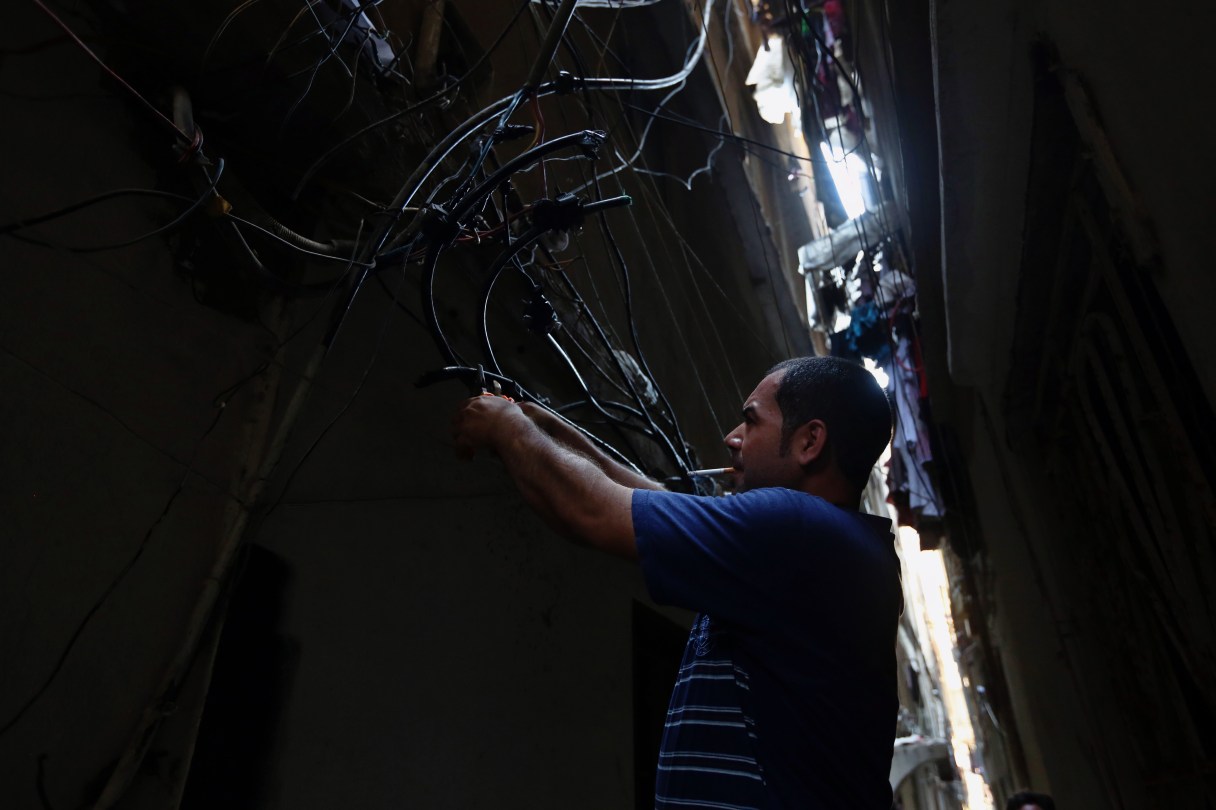
BEIRUT (AP) – By his own account, Abu Wadiyeh is a man very much in demand.
One look at the jumbled mass of sinewy electricity cables, TV and Internet lines that droop over the damp, narrow alleyways of the Palestinian refugee camp of Shatila, and it’s easy to see why. Abu Wadiyeh, as the chief electrician in Shatila, is responsible for making order out of that chaos and ensuring that the camp’s more than 20,000 residents can turn on their lights and televisions.
“When I first started working, I ran away. I thought to myself, ‘why would I do this?'” he said on a recent humid afternoon spent tending to the wires. “The network of wires is a spider web. … I was in awe. How was I supposed to figure all that out?”
But in his five years on the job, Abu Wadiyeh has indeed figured it out. He oversees his electrical empire from a dusty, white-washed building that serves as one of four substations that connects the camp to the Lebanese state grid. The station borders the largest open area in the crowded camp: a gravel yard the size of a volleyball court surrounded by six- and seven-story concrete bloc buildings.
At ground level, the yard betrays the camp’s tortured history as a place of politics and refuge. On one wall, someone has spray-painted a Palestinian flag, a yellow butterfly and flowers. On another, a torn poster of Yasser Arafat, his mustache still a youthful dark, clings to the dusty paintwork.