
Friday, November 6, 2026Nov 6

This story is free to read.

Bosnia marks end of Europe’s violent century

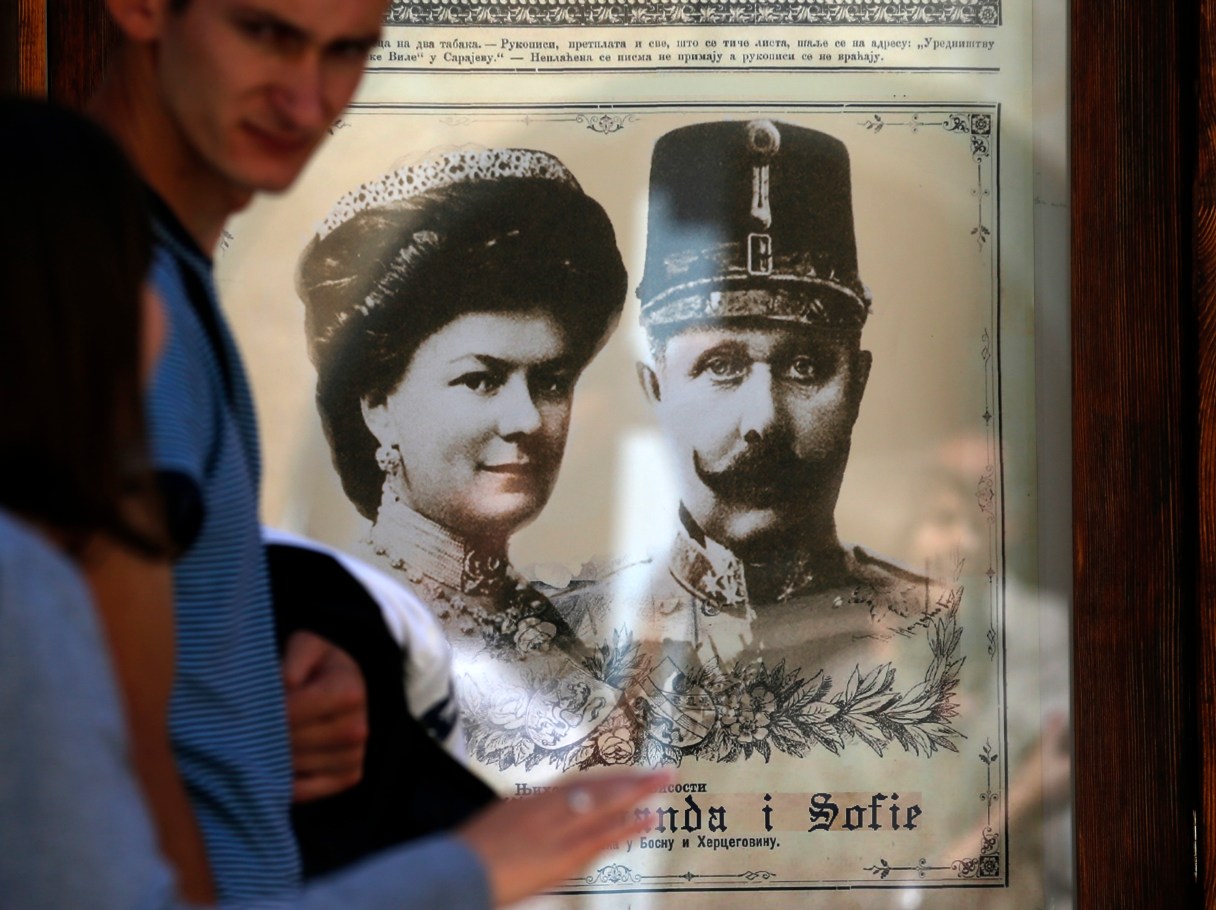
A couple walk past a poster of Archduke Franz Ferdinand and his wife Sophie, in the Bosnian town of Visegrad,140 kilometers east of Sarajevo, Saturday, June 28, 2014. Marking the centennial of the beginning of World War I in their own way, Bosnian Serbs in Visegrad, on Saturday unveiled a mosaic of the man who ignited the war by assassinating the Austro-Hungarian crown prince on June 28, 1914. (AP Photo/Darko Vojinovic)
A couple walk past a poster of Archduke Franz Ferdinand and his wife Sophie, in the Bosnian town of Visegrad,140 kilometers east of Sarajevo, Saturday, June 28, 2014. Marking the centennial of the beginning of World War I in their own way, Bosnian Serbs in Visegrad, on Saturday unveiled a mosaic of the man who ignited the war by assassinating the Austro-Hungarian crown prince on June 28, 1914. (AP Photo/Darko Vojinovic) A couple walk past a poster of Archduke Franz Ferdinand and his wife Sophie, in the Bosnian town of Visegrad,140 kilometers east of Sarajevo, Saturday, June 28, 2014. Marking the centennial of the beginning of World War I in their own way, Bosnian Serbs in Visegrad, on Saturday unveiled a mosaic of the man who ignited the war by assassinating the Austro-Hungarian crown prince on June 28, 1914. (AP Photo/Darko Vojinovic)

SARAJEVO, Bosnia-Herzegovina (AP) – Artists and diplomats have declared a new century of peace and unity in Europe in the city where the first two shots of World War I were fired exactly 100 years ago.

On June 28, 1914, the Austro-Hungarian crown prince Franz Ferdinand was assassinated in Sarajevo, where he had come to inspect his occupying troops in the empire’s eastern province. The shots fired by Serb teenager Gavrilo Princip sparked a war, followed decades later by a second world conflict, costing 80 million European lives in total.

On Saturday, Austria was represented in Bosnia not with military might but by the Vienna Philharmonic Orchestra performing works of European composers reflecting the century’s catastrophic events. The program concludes with the joint European hymn, Beethoven’s “Ode of Joy.”