
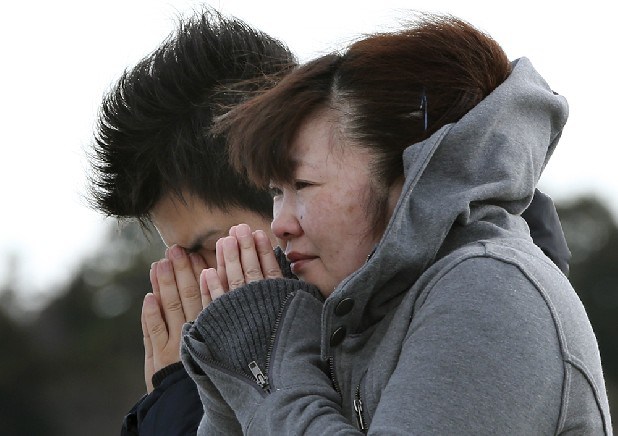
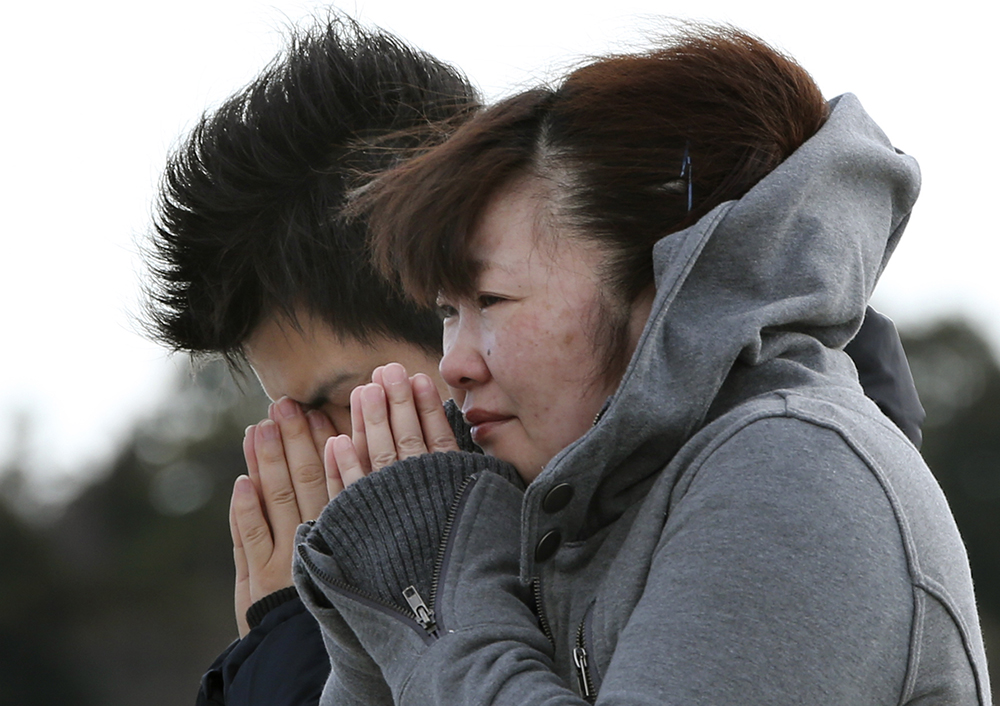
 People offer prayers Tuesday at 2:46 p.m., the time the March 11 earthquake hit three years ago at Kitaizumi beach in Minamisoma Fukushima Prefecture in northeastern Japan.
Fukushima three years later
The Fukushima-Daiichi nuclear meltdowns in Japan following a 9.0 Richter-scale earthquake and a tsunami continue to provide us with lessons that we may or may not be heeding.
The primary lesson is that we must prepare even for happenings we think are safely out of the range of probability, like earthquakes and tsunamis, like wave after wave of tornadoes. At Fukushima, the plant had a dreaded “station blackout” crisis — no power to control safety valves and emergency cooling systems.
In America, most nuclear plants have an emergency plan to deal with a station blackout of no more than four hours. The station blackout at Fukushima lasted 10 days.
But the lessons don’t stop there. Cleaning up the site will cost tens of billions of dollars and take almost a half century. Communities for miles around the plant have been rendered uninhabitable for decades to come.
Then there are the places where people can live — but not without cautions. Koriyama, a town 34 miles east of the Fukushima-Daiichi plant, is dotted with free-standing Geiger counters on sidewalks. Digital real-time readouts offer the radiation levels in red letters.