
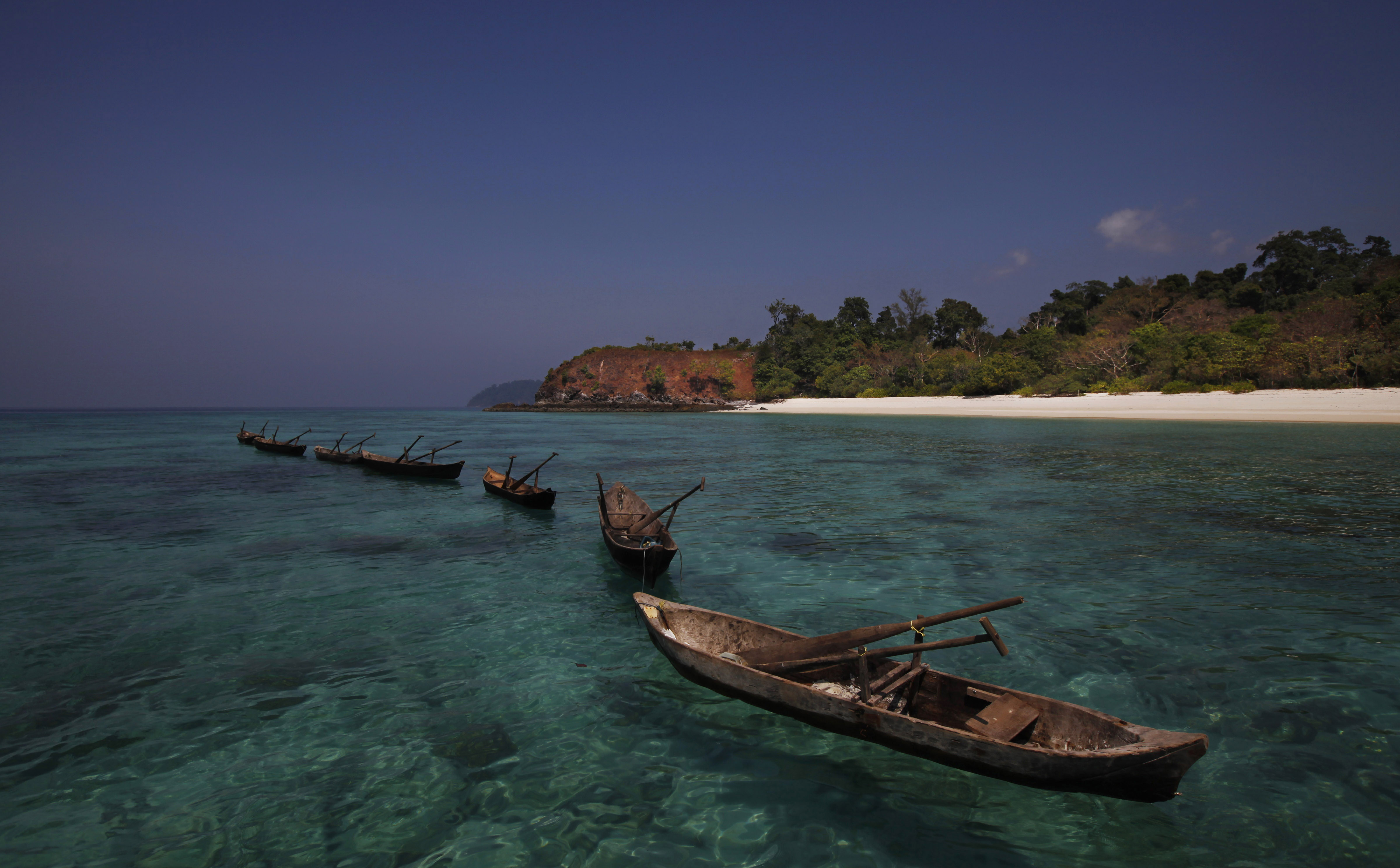
 Canoes stand tied close to Chin Kite Kyunn, or Mosquito Bite Island, in Mergui Archipelago, Myanmar. Isolated for decades by the country’s former military regime and piracy, the Mergui archipelago is thought by scientists to harbor some of the world’s most important marine biodiversity and looms as a lodestone for those eager to experience one of Asia’s last tourism frontiers before, as many fear, it succumbs to the ravages that have befallen many of the continent’s once pristine seascapes.
MERGUI ARCHIPELAGO, Myanmar – Where the Indian Ocean rolls toward Myanmar’s southwestern coast, a lacework of 800 islands rises, fringed with shimmering beaches of no footprints.
Here hornbills break a primeval silence as they flutter through soaring jungle canopy. Pythons slumber on the gnarled roots of eerie mangrove forests. Only rarely will you spot the people who live here: the Moken, shy, peaceful nomads of the sea.
The Mergui archipelago has been called the “Lost World,” but outsiders have found it — first fishermen, poachers and loggers, and now developers and high-end tourists. The people losing this world are the Moken, who have lived off the land and the sea for centuries.
The islands are thought to harbor some of the world’s most important marine biodiversity, and are a lodestone for those eager to experience one of Asia’s last tourism frontiers before, as many fear, it succumbs to the ravages that have befallen many once-pristine seascapes.
As the world closes in, the long-exploited Moken are rapidly diminishing in numbers and losing the occupations that sustained them for generations. Though they are known as “sea gypsies,” very few still live the nomadic life, and only some aging men can fashion the “kabang,” houseboats on which the Moken once spent much of every year.