

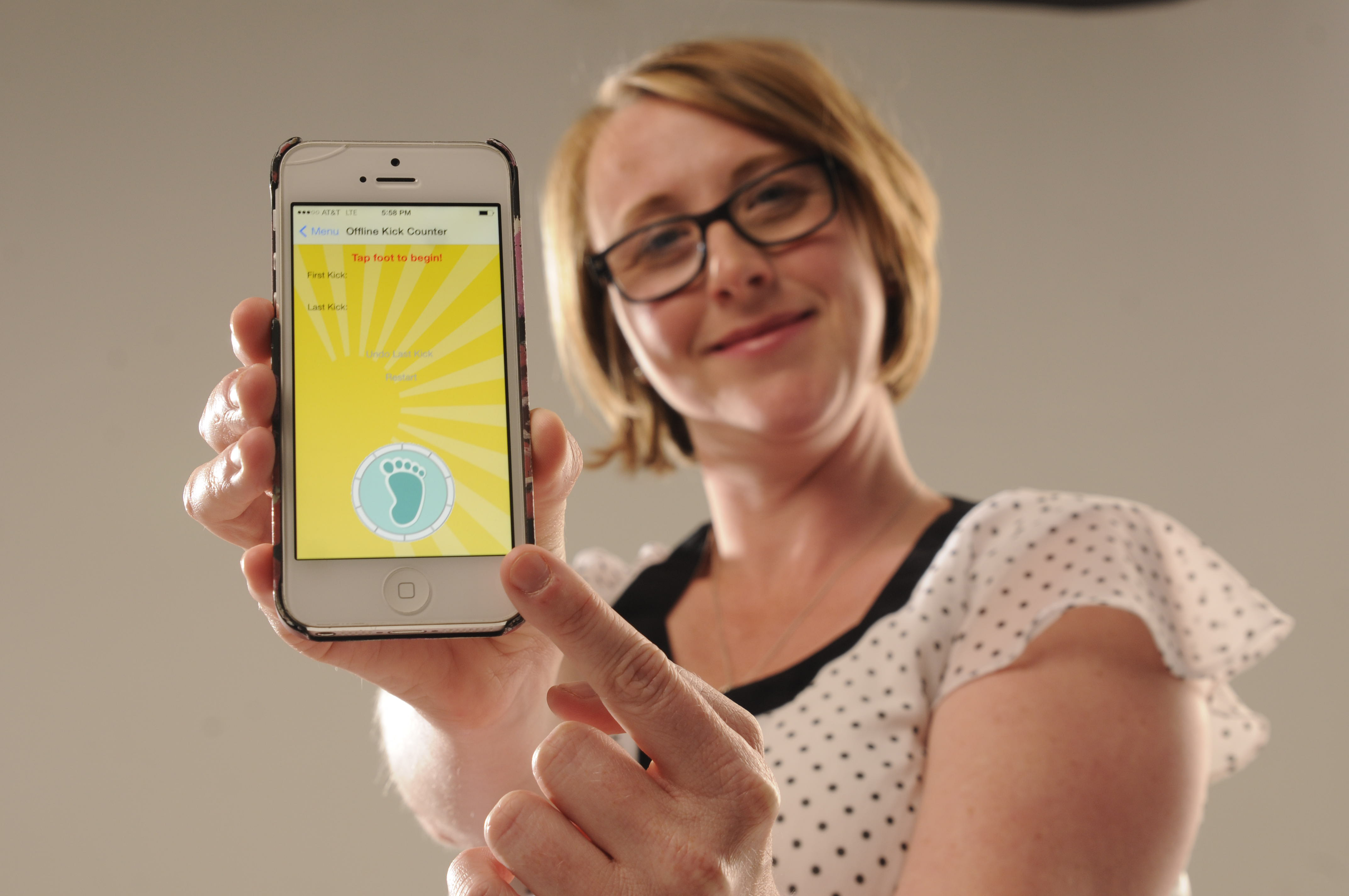
 Meghan Hughes Petty shows the Count the Kicks app, which prompts expectant moms to track their babies’ movements.
KEEPING A KICK CHARTThe American College of Obstetrics and Gynecology offers a step-by-step guide for mothers to start and maintaining a kick chart. Monitoring should begin in the 28th week of pregnancy or the 26th week for high-risk mothers or mothers who are pregnant with multiple children:• Count the kicks every day, preferably at the same time of day.• Pick a time based on when your baby is usually active, such as after a meal or snack.• Make sure your baby is awake before counting by pushing on your stomach or having a cold drink first.• Sit with your feet up or lie on your side, count each movement — kicks, rolls or pokes — as one “kick” and stop when you reach 10.• The time it takes to reach this benchmark varies but could be between 30 minutes and two hours.n Log your recorded time on a chart or use the one automatically generated through the Count the Kicks app.• If your baby doesn’t reach 10 kicks in two hours, try to wake him or her up and start a new session.• Notify your health provider immediately if you notice significant changes in your baby’s movements.Source: Count the KicksFOR SMART MOMS WITH SMARTPHONESThe Count the Kicks smartphone app is available for free on Apple’s App Store or Google’s Google Play marketplaces. Mothers touch a large onscreen icon to register each of their baby’s kicks. They also can set an automatic reminder to ensure each session occurs at the same time of day. Each session is recorded and stored in a history that can be reviewed or shown to a practitioner to document changes in activity level.
Two years ago, Meghan Hughes Petty suffered through an expectant mother’s worst nightmare.
The day before she was scheduled for a regular checkup with her obstetrician, she felt like something wasn’t right. Her son, Miles, wasn’t moving as much. She could feel him shifting in the womb when she walked, but otherwise, he seemed uncharacteristically lethargic.
Her Google queries were mildly reassuring. She was late-term and many online commenters quoted a common adage that babies naturally become less active toward the end of a pregnancy.
Petty’s husband, Jamie, suggested a wait-and-see approach. The checkup, which corresponded with Miles’ due date, was only a few hours away, and her doctor would have an answer, he said.