
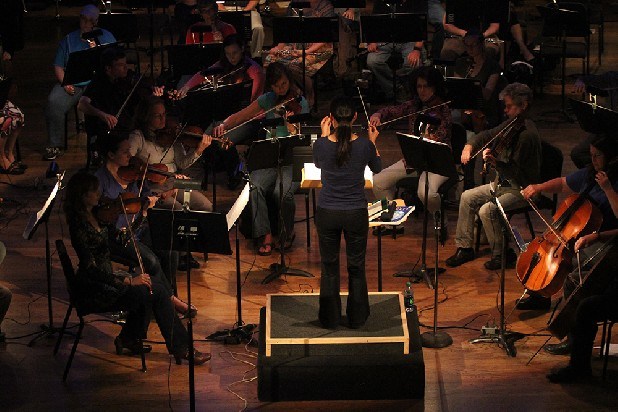
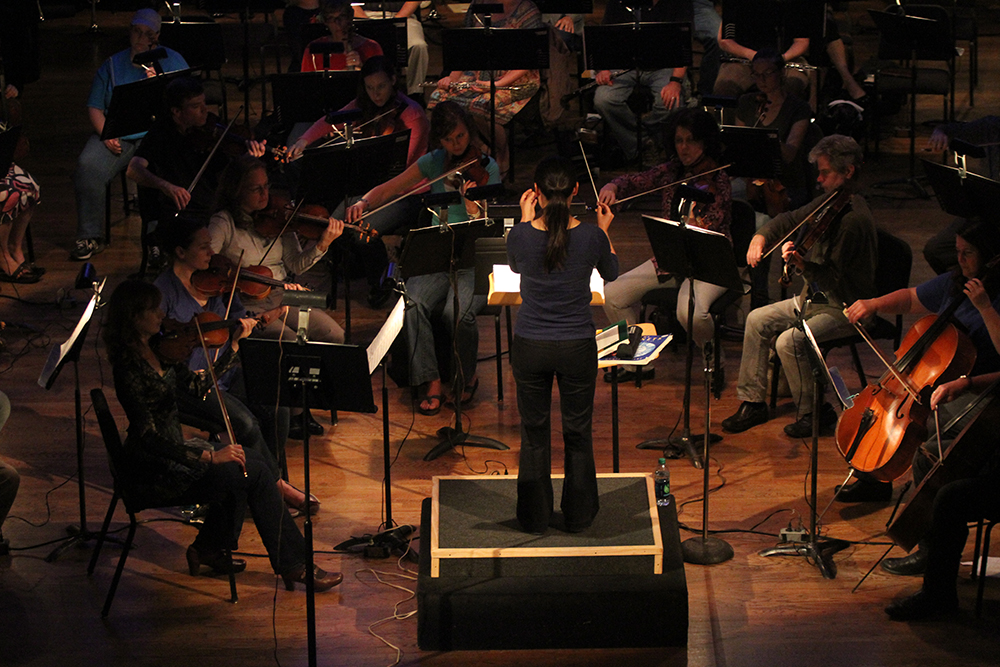
 Kayoko Dan conducts a Chattanooga Symphony Orchestra rehearsal at the Tivoli Theater in Chattanooga.
As the teeth-chattering cold of last week surrendered to a beautiful-albeit blustery – fall evening and gleaming full moon, the dazzling colors among the maples gave meaning to the Scenic City’s moniker, offering the perfect excuse to get out on Thursday evening to hear the Chattanooga Symphony Orchestra in another Masterworks Series at the Tivoli Theatre.
Beethoven composed only one opera and probably wished he hadn’t tackled that (“it brought me the most sorrow; and for that reason, it is the one most dear to me”). It was known as Fidelio, although Beethoven called it Leonore, and he never could seem to decide how it should go. Almost every time the opera had a new performance, Beethoven was tweaking this or that aria or composing a whole new overture to open the work. The result was three separate overtures.
“Leonore Overture No. 3, Op. 72b” was prepared for one of his revisions (1806), but it didn’t really work because it overpowered the opera that was to follow. Although it didn’t succeed as a prelude to the opera, it did thrive as a dramatic single-movement orchestral work, reflecting the heroic struggles of the Napoleonic era on an epic scale. It’s the perfect concert opener.
And it was a near-perfect performance with maestro Kayoko Dan managing her forces in a tensely coiled rendition that bubbled with Beethovenian energy. The ensemble offered a full-bodied sound and a surety of playing, featuring principals Kristen Holritz (flute), Eric Anderson (bassoon), and David Hobbs (offstage trumpet).
While Beethoven was the transitional composer from the Classical to the Romantic era, Franz Schubert was clearly a child of the latter. His “Symphony No. 4 in C minor”- which he called “Tragic” – is explained by some as being autobiographical, reflecting his despair as a 19-year old young man, trying to establish himself.