
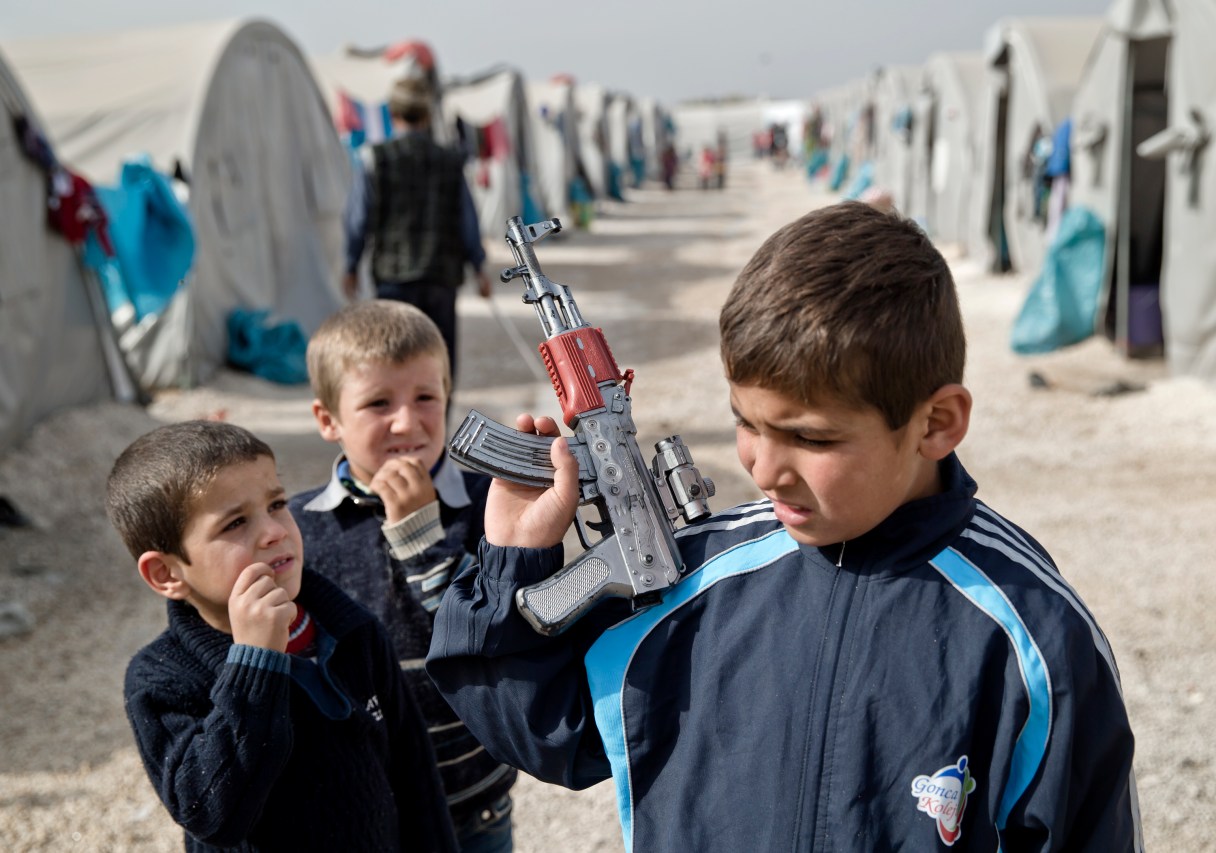
CAYKARA, Turkey (AP) – Their collars pulled up against the evening cold, a group of men and women peer through binoculars, scanning the fields along a barbed wire fence. A few kilometers (miles) away across the Turkish border, black smoke rises from the besieged Kurdish Syrian town of Kobani, the dull thud of mortars carrying across on the breeze.
They are some of the hundreds of volunteers, predominantly Kurdish Turks, who have traveled from villages, towns and cities across southeastern Turkey and even from Istanbul, to keep watch on the border. They are on the lookout for potential fighters of the extremist Islamic State group attempting to cross into Kobani, besieged since mid-September by IS and defended by Kurdish Syrian fighters known as the People’s Protection Units.
“To be honest, we don’t trust (the Turkish border guards), because we have seen many occasions that the Turkish government has loosened its borders for ISIS fighters, weapons and logistical support to cross,” said Ibrahim Binici, a Kurdish lawmaker for the left-wing HDP party, which put out a call in September for the volunteers.
It’s a claim Turkey vehemently rejects. But the deep distrust of Turkish authorities in the border area reflects Turkey’s complicated attitude toward the Islamic extremists who captured swaths of Iraq and Syria, and its strained relations with its own Kurdish population.
The country’s reluctance to join a U.S.-led international coalition action against IS in Syria and Iraq, mainly through airstrikes, has frustrated Turkey’s American and European allies. Ankara, however, insists the priority should be the unseating of Syrian President Bashar al-Assad, whose 2011 crackdown on protesters sparked an uprising that soon spun into a vicious civil war.