
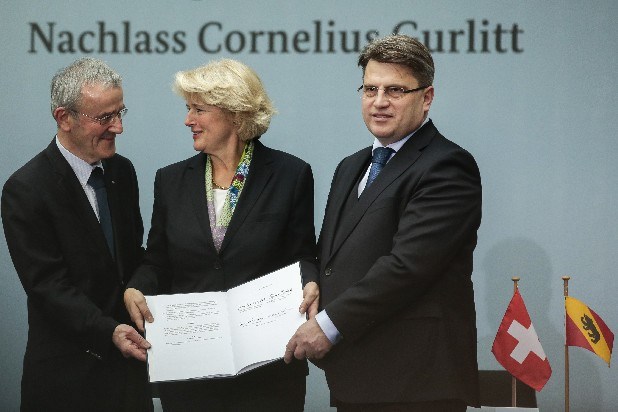
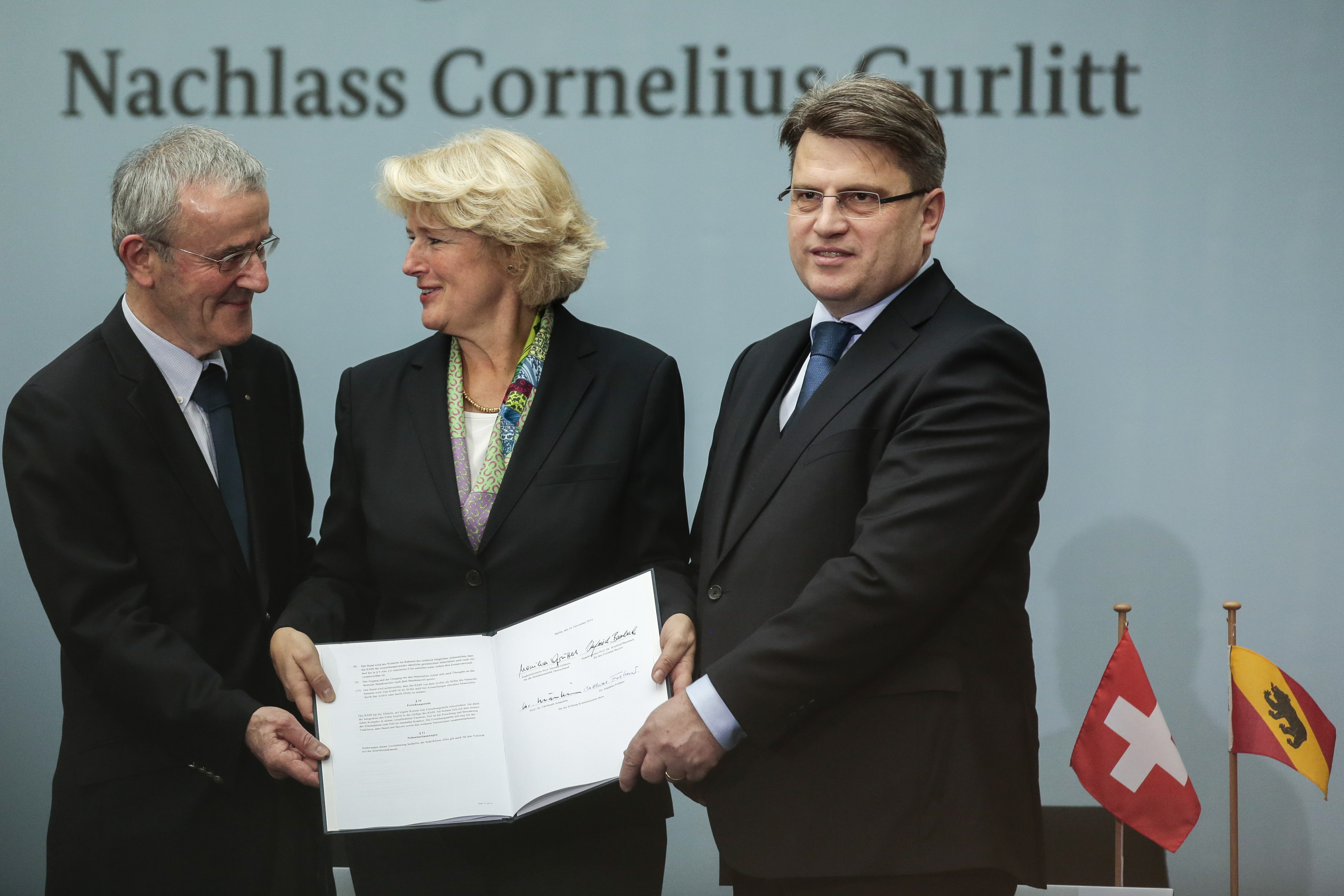
 Bern’s Kunstmuseum President Christoph Schaeublin, left, Minister of State for Culture and Media Monika Gruetters, center, and Justice Minister of the German state Bavaria Winfried Bausback show an agreement on the inheritance of late German art collector Cornelius Gurlitt after the signing ceremony in Berlin, Germany, Monday. The Swiss museum agreed on Monday to accept a priceless collection of long-hidden art bequeathed to it by Gurlitt, but said it will work with German officials to ensure any pieces looted by the Nazis from Jewish owners are returned. The words in background read: ‘Singing of an agreement on the inheritance of Cornelius Gurlitt’.
BERLIN – A Swiss museum accepted a massive, priceless trove of long-hidden art from the late German collector Cornelius Gurlitt on Monday, promising to work with Germany to make sure that any Nazi-looted pieces in it are returned to Jewish heirs.
Three works in the collection donated to Switzerland’s Kunstmuseum Bern will be returned immediately because they have already been identified as looted art, German Culture Minister Monika Gruetters said at a joint news conference with the museum. The pieces are by Henri Matisse, Max Liebermann and Carl Spitzweg.
Germany, meanwhile, published online the business ledgers of Gurlitt’s father Hildebrand, an art dealer who had worked closely with the Nazi regime. Many potential heirs and art experts had demanded the move to help their searches for possible looted art. The ledgers covered the years from 1937-45, detailing in neat fountain pen the purchases and sales of various paintings.
Monday’s press conference was the latest twist in a saga that has captivated the art world.
In 2012, German authorities seized 1,280 pieces of art from Cornelius Gurlitt’s Munich apartment while investigating a tax case, including works by Pablo Picasso and Marc Chagall. The development shocked the art world, since many of the works had not been seen for decades and experts feared they had been lost or destroyed.