
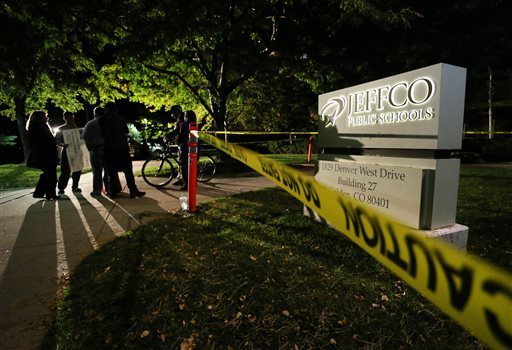
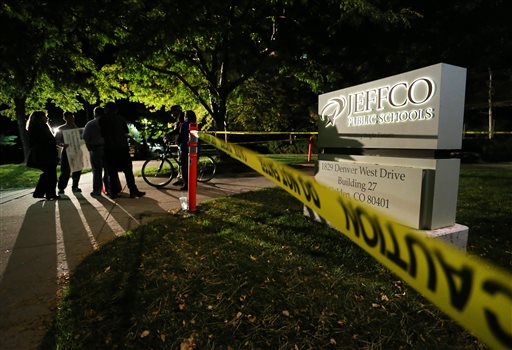
 Police tape blocks off the lawn in front of the Jefferson County Public Schools building, while inside the Jeffco Public School Board heard testimony from members of the public weighing in on the school board’s proposal to emphasize patriotism and downplay civil unrest in the teaching of U.S. history, in Golden, Colo., on Oct. 2, 2014.
GOLDEN, Colo. – Students, parents and teachers in suburban Denver are vowing to continue demonstrating against a school board’s new conservative majority after it refused to back off plans to review Advanced Placement U.S. history courses for what some see as anti-American content.
The Jefferson County Board of Education voted Thursday night to lay the groundwork for a review of curriculum, with the AP history course likely the first to get a deeper look.
The elective course has been criticized by the Republican National Committee and the Texas State Board of Education, which has told teachers not to teach according to the course’s new framework. Being taught for the first time this year, it gives greater attention to the history of North America and its native people before colonization and their clashes with Europeans, but critics say it downplays the settlers’ success in establishing a new nation.
The Colorado board didn’t vote on its original proposal to review the history course with an eye toward promoting patriotism and downplaying social disorder – language students have blasted in waves of school-time protests across the district. However, students and other activists say the board’s new approach to include students on existing curriculum review committees doesn’t satisfy them because they believe board members will ultimately try to change the history course to suit their views.
“This isn’t over,” said Ashlyn Maher, 18, a Chatfield High School senior who has been helping organize protests over the past two weeks. “We are going to fight until we see some results.”
Michele Patterson, the head of the district’s parent-teacher association, said she didn’t expect students to keep walking out of class to protest, because parents and administrators don’t want children missing any more school.
“We’re proud of our kids, but we obviously don’t want kids missing school on a regular basis,” she said.
Students and parents – along with Jefferson County teachers who are in their own fight with the board over evaluations and merit pay – planned to demonstrate Friday afternoon, lining a major street that runs through the district.
The College Board administers the course and other AP classes, which are meant to prepare students for college and give them a chance at earning college credit. It says the framework – an outline of the course built around themes like “politics and power” and “environment and geography” – isn’t meant to be an exhaustive list of everything to be studied, and teachers are always free to add material required by their states.
For example, Martin Luther King Jr. isn’t mentioned in the framework, but the Black Panthers are. The College Board’s instructions about the new framework say teachers know to include King but asked for help with less obvious examples of people and events to discuss around some of the themes.
But besides who is mentioned and who isn’t, veteran history teacher Larry Krieger, of Montgomery, New Jersey, faults the framework for having a global, revisionist view. He said it depicts the U.S. as going from conquering Native Americans to becoming an imperial power, while downplaying examples of cooperation and unity.
“Native Americans were defeated, wrongs were done, African-Americans were enslaved. However, at the same time this was going on, democratic institutions were being established, there was religious toleration and a new society was being created,” he said.
The College Board says students need to be familiar with concepts taught in college classes but the exam for college credit will often give students a chance to demonstrate multiple points of view.
Joan Bertin, executive director of the National Coalition Against Censorship, which opposed the Colorado proposal, said it’s likely the issue could come up before school boards elsewhere at a time when some are also upset about Common Core, a new set of educational standards for reading and math adopted by 45 states and the District of Columbia.
“People who are not in any ideological camp are going to say: ‘Wait a minute. We just want our kids to get a good education. We don’t want them to be indoctrinated into anything,'” she said.