
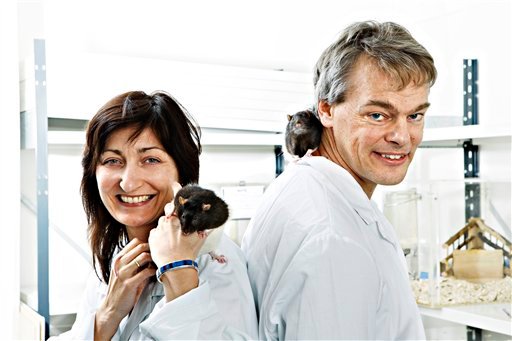
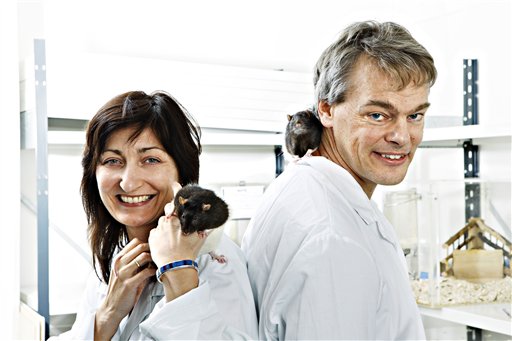
 This is handout image provided NTNU in Troondheim Norway on Monday Oct. 6, 2014 of Edvard Moser and his wife May-Britt Moser in a laboratory in in Trondheim in 2008. The 2014 Nobel Prize for Medicine was won by Edvard and May_Britt Moser together with U.S.-British scientist John O’Keefe it was announced in Stockholm Monday Oct. 6, 2014. (AP Photo/Geir Mogen, NTNU)
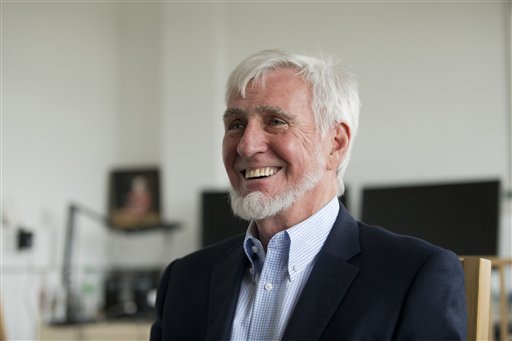 Joint winner of the Nobel Prize for Physiology or Medicine professor John O’Keefe, a dual U.S. and British citizen, speaks as he is interviewed by The Associated Press in an office he uses at the University College London (UCL), in London, Monday, Oct. 6, 2014. The U.S.-British scientist and a Norwegian husband-and-wife research team won the Nobel Prize in medicine Monday for discovering the brain’s navigation system – the inner GPS that helps us find our way in the world – a revelation that one day could help those with Alzheimer’s. The research by John O’Keefe, May-Britt Moser and Edvard Moser represents a “paradigm shift” in neuroscience that could help researchers understand the sometimes severe spatial memory loss associated with Alzheimer’s disease, the Nobel Assembly said. (AP Photo/Matt Dunham)
STOCKHOLM (AP) – Neuroscientist Edvard Moser landed at Munich airport on Monday, casually dressed in a comfortable sweater for a visit to a German university. He had no idea he had just won a Nobel prize.
“When I got off the plane there was a woman standing at the gate with flowers and a car. I didn’t understand anything,” the 52-year-old Norwegian told The Associated Press. “She said I had won a prize, but she didn’t know what it was – and I didn’t know what it was.”
Then he switched on his cellphone. A virtual torrent of emails, text and voice messages and missed calls ensued, congratulating him on winning a prize that many scientists consider the greatest honor of all.
Moser won the Nobel for medicine with his wife May-Britt Moser, 51, and U.S.-British researcher John O’Keefe, 74.
In research three decades apart, the New York-born O’Keefe and the Norwegian couple discovered the GPS-like brain functions that help people map their surroundings and navigate the world.