
Saturday, October 31, 2026Oct 31

This story is free to read.

Islamic State group downs another Iraqi helicopter

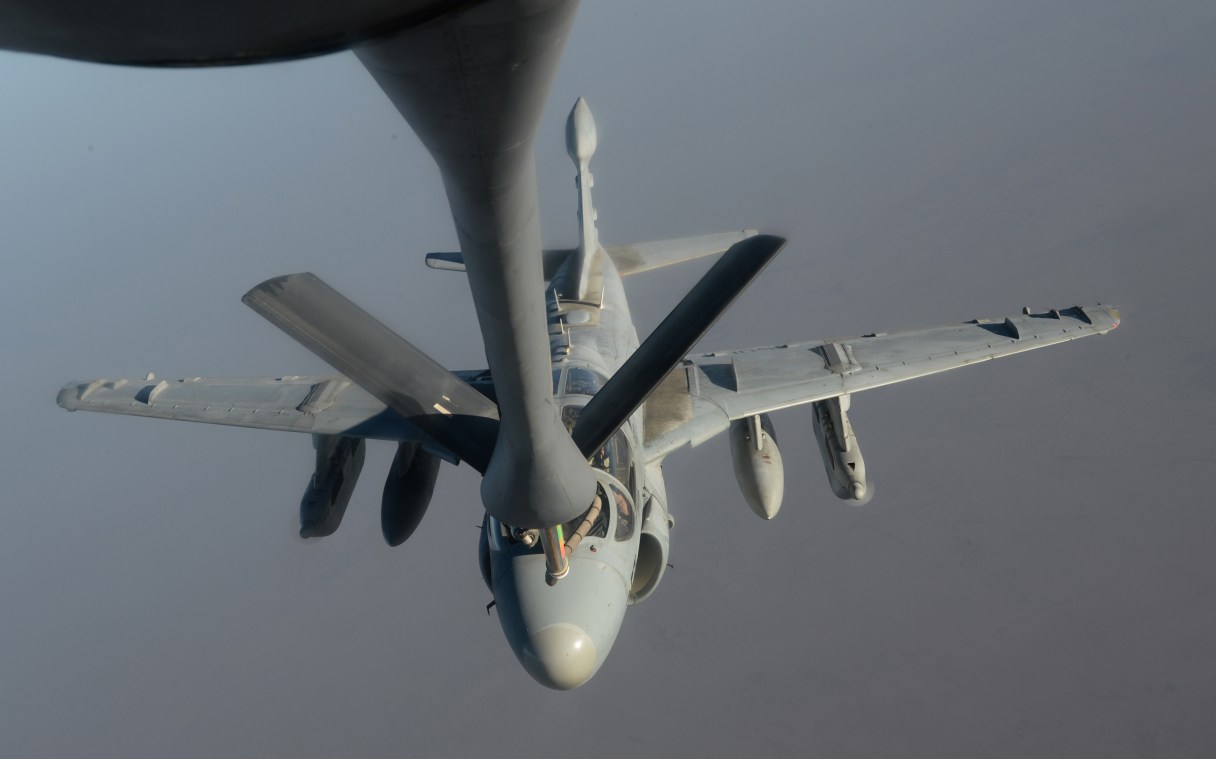
In this Saturday, Oct. 4, 2014 photo, released by the U.S. Air Force, A U.S. Navy EA-6B Prowler  supporting operations against the militant Islamic State group, receives fuel from a KC-135 Stratotanker over Iraq.  After two months, the U.S.-led aerial campaign in Iraq has so far hardly dented the core of the Islamic State group’s territory. The extremists’ grip on major cities across Iraq and neighboring Syria remains unquestioned. The campaign has brought some gains, with Kurdish fighters taking back towns on the fringes of the Islamic State group’s territory. But those successes only underline a major weakness: Besides the Iraqi Kurds, there are no forces on the ground ready to capitalize on the airstrikes. (AP Photo/U.S. Air Force, Shawn Nickel)
In this Saturday, Oct. 4, 2014 photo, released by the U.S. Air Force, A U.S. Navy EA-6B Prowler supporting operations against the militant Islamic State group, receives fuel from a KC-135 Stratotanker over Iraq. After two months, the U.S.-led aerial campaign in Iraq has so far hardly dented the core of the Islamic State group’s territory. The extremists’ grip on major cities across Iraq and neighboring Syria remains unquestioned. The campaign has brought some gains, with Kurdish fighters taking back towns on the fringes of the Islamic State group’s territory. But those successes only underline a major weakness: Besides the Iraqi Kurds, there are no forces on the ground ready to capitalize on the airstrikes. (AP Photo/U.S. Air Force, Shawn Nickel) In this Saturday, Oct. 4, 2014 photo, released by the U.S. Air Force, A U.S. Navy EA-6B Prowler supporting operations against the militant Islamic State group, receives fuel from a KC-135 Stratotanker over Iraq. After two months, the U.S.-led aerial campaign in Iraq has so far hardly dented the core of the Islamic State group’s territory. The extremists’ grip on major cities across Iraq and neighboring Syria remains unquestioned. The campaign has brought some gains, with Kurdish fighters taking back towns on the fringes of the Islamic State group’s territory. But those successes only underline a major weakness: Besides the Iraqi Kurds, there are no forces on the ground ready to capitalize on the airstrikes. (AP Photo/U.S. Air Force, Shawn Nickel)

BAGHDAD (AP) – Militants with Islamic State group on Wednesday shot down an Iraqi military attack helicopter, killing the two pilots on board in the second such incident in a week and raising concerns about the extremists’ ability to attack aircraft amid ongoing U.S.-led airstrikes.

According to two Iraqi officials, the extremists used a shoulder-fired missile to take down the Bell 407 helicopter, which crashed just north of the refinery town of Beiji, located about 200 kilometers (130 miles) north of Baghdad.

The pilot and co-pilot were both killed in the attack, a military aviation official told The Associated Press. A Defense Ministry official confirmed the information. Both officials spoke on condition of anonymity in line with regulations.

This is the second Iraqi military helicopter shot down by the Islamic State group over Beiji in one week. Militants shot down an Mi-35 helicopter near Beiji on Friday, also killing the pilot and co-pilot in that attack.

The two incidents highlight the Islamic State group’s ability to counter air operations, potentially putting at risk U.S.-led airstrikes in Iraq and Syria. Some fear the militants may have captured some sophisticated weapons, such as ground-to-air missiles capable of shooting down airplanes when they overran abandoned Iraqi army bases this summer.

European airlines including Virgin Atlantic, KLM and Air France, U.S. carrier Delta Air Lines and Dubai-based Emirates changed their commercial flight plans over the summer to avoid the Iraqi airspace.