
Monday, November 16, 2026Nov 16

Supreme Court weighs generic drug dispute

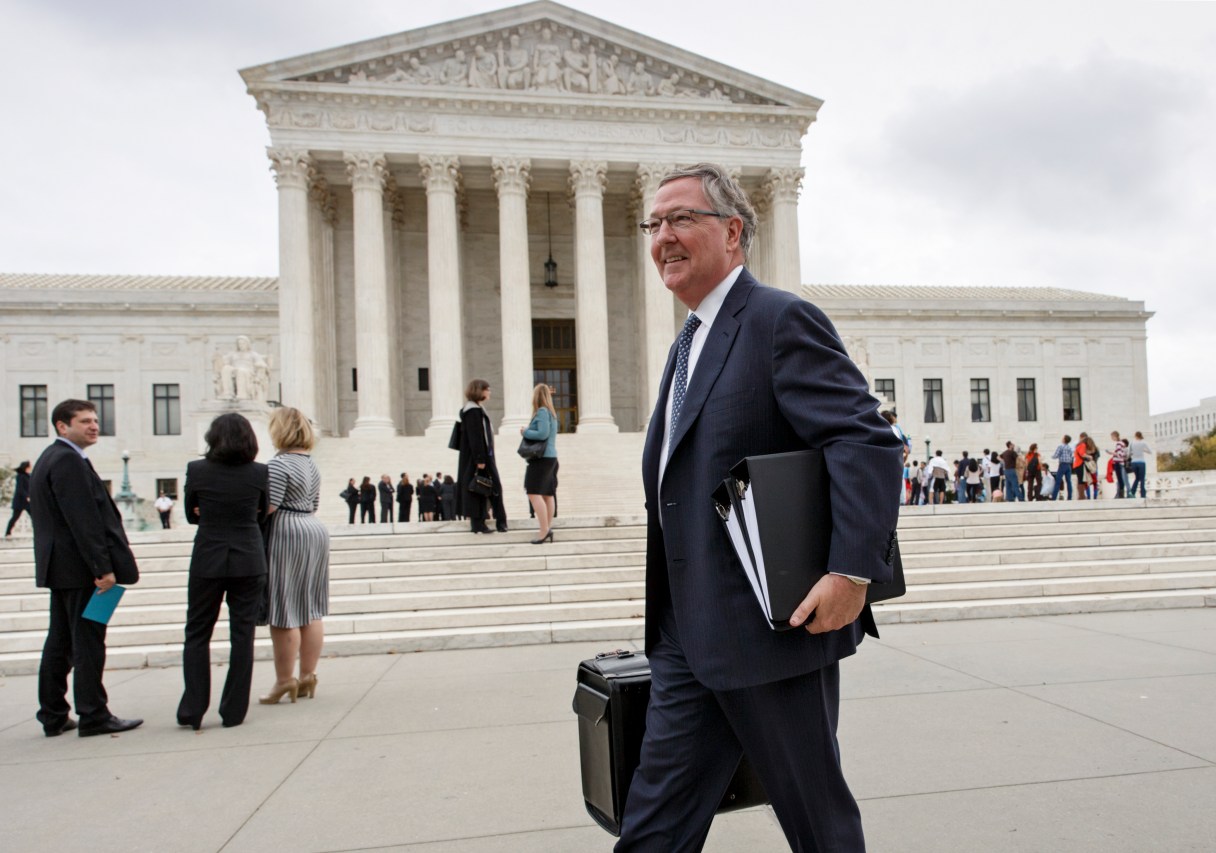
Attorney Carter G. Phillips, representing generic drug maker Mylan Pharmaceuticals, departs the Supreme Court in Washington, Wednesday, Oct. 15, 2014, after arguments in Teva Pharmaceuticals U.S.A., Inc. v. Sandoz, Inc. Justices seem divided as it considers a high stakes patent dispute between rival pharmaceutical companies over the world's best-selling multiple sclerosis treatment, a case that threatens to cut into the $4 billion-a-year profits that Israel-based Teva Pharmaceutical Industries Ltd. earns selling the drug Copaxone. Teva claims the U.S. Court of Appeals for the Federal Circuit wrongly overturned five of its patents for the drug.   (AP Photo/J. Scott Applewhite)
Attorney Carter G. Phillips, representing generic drug maker Mylan Pharmaceuticals, departs the Supreme Court in Washington, Wednesday, Oct. 15, 2014, after arguments in Teva Pharmaceuticals U.S.A., Inc. v. Sandoz, Inc. Justices seem divided as it considers a high stakes patent dispute between rival pharmaceutical companies over the world's best-selling multiple sclerosis treatment, a case that threatens to cut into the $4 billion-a-year profits that Israel-based Teva Pharmaceutical Industries Ltd. earns selling the drug Copaxone. Teva claims the U.S. Court of Appeals for the Federal Circuit wrongly overturned five of its patents for the drug. (AP Photo/J. Scott Applewhite)

WASHINGTON (AP) – The Supreme Court seems divided as it considers a high-stakes patent dispute between rival pharmaceutical companies over the world’s best-selling multiple sclerosis treatment.

Justices heard arguments Wednesday in a case that threatens to cut into the profits of Israel-based Teva Pharmaceutical Industries Ltd., which sells $4 billion annually of the drug Copaxone.

Teva claims the U.S. Court of Appeals for the Federal Circuit wrongly overturned five of its patents for the drug. That 2013 ruling cleared legal hurdles for rival drug companies to sell cheaper generic versions this year, though no company has yet received federal approval.

Teva’s patent on Copaxone is set to expire in September 2015, but it would like to keep its exclusive rights to the lucrative drug until then.

At issue is whether the appeals court was allowed to second guess factual findings made by a federal district court that had earlier ruled in Teva’s favor. The Federal Circuit re-examined the evidence and concluded that Teva’s patent claim based on the drug’s molecular weight was too ambiguous.