
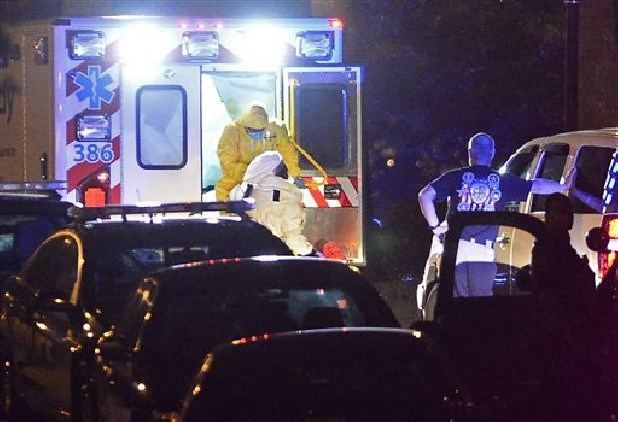
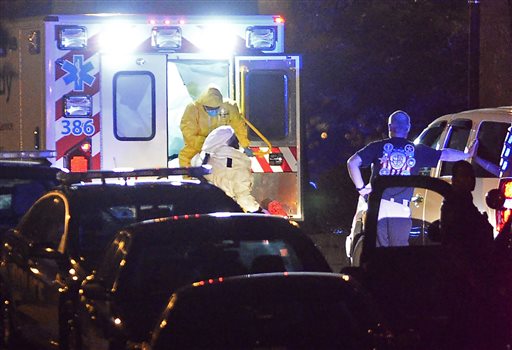
 An ambulance carrying Amber Joy Vinson, the second health care worker to be diagnosed with Ebola in Texas, arrives at Emory University Hospital on Oct. 15, 2014, in Atlanta.
Updated at 4:40 p.m. to include the following statement from Chuck Fleischmann:
“Ebola is a serious crisis and calls for a serious response, which is why the House appropriated more money for the CDC than requested. I urge the President to keep all options on the table, including a travel ban. My heart goes out to the Americans and all people who have been impacted by Ebola, and I will implore the administration to use every tool possible to combat this virus and keep Americans safe.”
Original story follows:
As officials Wednesday announced another case of the Ebola virus contracted within U.S. borders, questions swirled.
How did two hospital workers become infected? Should the government, or the Centers for Disease Control and Prevention, have responded differently to the outbreak? Are hospitals prepared? Should borders be closed?
Locals remained split.
Some thought, as pundits suggested, that the United States should seal its borders to prevent the infection’s spread. Others expressed a lack of confidence in the country’s preparedness. And nearly all remarked they never expected Ebola, long known as deadly in Africa, to spread to three people on our shores.
“It’s still way more than I thought it would be,” said Steven Stafford, a 32-year-old coordinator with Coyote Logistics.
Texas Health Presbyterian Hospital announced Wednesday that a second health care worker who made contact with Thomas Eric Duncan tested positive for Ebola. Duncan, a Liberian who died last week, was the first person diagnosed with the virus in the United States.
Frontier Airlines later said the second worker, a woman, flew from Cleveland to Dallas/Fort Worth on Monday.
In other developments Wednesday:
• The first Dallas nurse who contracted Ebola was being transferred to Emory University Hospital in Atlanta for treatment.
• U.S. Sen. Bob Corker, R-Tennessee, called for a “robust, comprehensive response” that includes restricting tourism and non-essential travel to the United States.
• President Barack Obama vowed that his administration would provide “much more aggressive” monitoring of Ebola cases in the United States and warned that in an age of frequent travel the disease could spread globally if the world doesn’t respond to the “raging epidemic in West Africa.”
• And two-thirds of the respondents to a Washington Post-ABC News poll said they were concerned about a widespread epidemic of Ebola in this country.
Experts who study public psychology say the next few weeks will be crucial to containing mounting anxiety.
“Officials will have to be very, very careful,” Paul Slovic, president of Decision Research, a nonprofit that studies public health and perceptions of threat, told the New York Times. “Once trust starts to erode, the next time they tell you not to worry — you worry.”
The risk of Ebola infection remains exceedingly small in this country. The virus is not airborne, not able to travel in the way that, say, measles can. Close contact with a patient is required for transmission. Just one death from Ebola has occurred here, and medical care is light-years from that in West Africa, where more than 4,400 people have died in the latest outbreak.
By contrast, in some years, the flu kills more than 30,000 people in the United States, the New York Times reported. Yet this excites little anxiety: Millions of people who could benefit from a flu shot do not get one.
“We’re familiar with the flu, we’ve had it and gotten better — we feel we know that threat,” Slovic said.
In Chattanooga, restraint was still the order of the day on Wednesday.
“Caution is called for, but not panic,” Chattanooga-Hamilton County Medical Society Executive Director Rae Bond said.
Centers for Disease Control and Prevention chief Tom Frieden has said the government wasn’t aggressive enough in managing Ebola, or in controlling its spread from Duncan to a nurse at the Dallas hospital.
“We could’ve sent a more robust hospital infection control team and been more hands-on with the hospital from day one about exactly how this should be managed,” he said Tuesday.
Though Frieden also told national media the infection of a first nurse was due to a breach of protocol, nurses unions have said hospital workers are ill-equipped to handle the threat.
“The medical community is being cautions and vigilant,” Bond said. “There aren’t any cases that have been reported in Tennessee as yet. I think everyone is in a state of preparedness.”
She’s confident the CDC, based just over 100 miles away in Atlanta, would assist if any case of Ebola popped up in Chattanooga.
And despite local assurances that doctors and hospitals in Tennessee are ready, some Chattanoogans said they had little faith.
“We’re not properly trained in health care facilities to deal with this virus and not transmit it,” said Chris Jenkins, 52, a Tennessee Valley Authority manager.
Retail worker Annette Merchant, 50, said the most recent diagnosis of a hospital worker gave her pause. She wondered if the disease was really airborne.
“We’re just so used to going along,” Merchant said. “We haven’t had to be this careful about anything since AIDS.”
Nonchalance could be deadly, said Dr. Henry Spratt, a professor of biological and environmental science at the University of Tennessee at Chattanooga.
“We’ve become complacent in regard to infectious disease,” Spratt said. “We never see anything like this, and we let down our defenses.”
Spratt pointed to what he saw as lapses in judgment and a lack of adherence to the rules by health care workers in Dallas.
“This is where you have to follow the rules, the guidelines, to a T,” Spratt said.
Bond said the disease is not spread easily through casual contact or through water. Still, some Chattanoogans thought that stopping travelers from entering the country would be smart.
“Closing the borders more firmly would be a tremendous assistance,” 35-year-old graduate student Robert Modrall said.
Modrall said he would support cutting off travelers from West Africa, where the disease is widespread and is projected to potentially claim lives at a rate of 10,000 per week, until the outbreak is under control.
But Diego Gonzalez, 26, a contractor specialist at TractManager, said the United States is too globalized to truly close out travel from affected nations.
“I see that as almost impossible to do,” Gonzalez said.
Stephen Spalding, 30, an engineer with TVA, said he didn’t think border controls would make a difference. Throwing resources at the countries in need would be more beneficial, Spalding said.
“There are a lot of things to worry about, and really the scale of this is quite small, just looking at the numbers,” Spalding said.
The Associated Press contributed to this report.
Contact staff writer Claire Wiseman at cwiseman@timesfreepress.com or (423)-757-6347. Follow her on twitter @clairelwiseman.